































The retail landscape has undergone profound transformation in recent years. Contemporary consumers no longer seek merely functional apparel; they demand experiences that reflect individual identity, values, and aesthetic preferences. Custom apparel merchandising strategies have emerged as powerful tools enabling retailers to respond to these evolving expectations while simultaneously driving meaningful business growth. These strategies extend far beyond simple embroidery or personalized names on standard products. Rather, comprehensive custom apparel merchandising represents an integrated approach encompassing product selection, visual presentation, data analytics, brand storytelling, and customer engagement tactics designed to create memorable shopping experiences that convert casual browsers into loyal, repeat customers.
The Strategic Significance of Custom Apparel in Modern Retail
Custom apparel occupies a unique position within contemporary retail landscapes. Unlike mass-produced merchandise requiring retailers to forecast demand months in advance and invest substantial capital in inventory, custom apparel operates on a made-to-order basis, where customers specify preferences and retailers produce items to exact specifications. This fundamentally different business model creates opportunities for retailers to achieve superior profitability metrics while simultaneously offering customers unprecedented choice and personalization.
The financial impact proves substantial. The global custom apparel market was valued at USD 10.5 billion in 2024 and is projected to expand to USD 15.3 billion by 2030, representing a compound annual growth rate of 6.5%. This growth trajectory reflects far more than simple market expansion; it demonstrates that custom apparel merchandising strategies are becoming increasingly integral to retail strategies across multiple sectors. Fashion retailers, corporate apparel providers, promotional merchandise companies, and sporting goods brands all recognize that custom apparel merchandising offers competitive advantages, margin enhancement, and customer engagement benefits unavailable through conventional merchandising approaches.
Research from McKinsey demonstrates the quantifiable impact of personalized merchandising. Retailers implementing sophisticated custom apparel merchandising strategies achieve customer satisfaction increases of 20% while simultaneously improving sales conversion rates by 15%. These improvements translate directly to bottom-line financial results through multiple pathways: increased average transaction values as customers purchase more items, improved customer lifetime value through enhanced loyalty, reduced marketing costs per acquisition through word-of-mouth referrals, and reduced inventory carrying costs inherent to made-to-order business models.
Foundational Elements of Custom Apparel Merchandising Strategy
Effective custom apparel merchandising strategies rest on several foundational elements that work synergistically to create retail experiences driving growth. Understanding these core components enables retailers to develop and execute strategies aligned with their specific brand positioning, target customer demographics, and competitive environments.
Target market understanding forms the essential foundation. Custom apparel merchandising strategies must be grounded in detailed knowledge of intended customer demographics, psychographics, preferences, and purchasing behaviors. This understanding encompasses not merely age, income, and gender classifications, but deeper insights regarding lifestyle orientation, values, aesthetic preferences, and decision-making criteria. Retailers investing in comprehensive market research—through surveys, focus groups, social listening, and purchasing pattern analysis—develop the customer insights necessary to craft genuinely appealing custom apparel offerings. This approach contrasts sharply with generalized merchandising strategies assuming relatively homogenous customer preferences across broad populations.
Product selection and curation represents the second foundational element. Custom apparel merchandising requires deliberate decisions regarding which product categories, styles, colors, materials, and personalization options to offer. Retailers must balance offering sufficient selection to appeal to diverse preferences against complexity that overwhelms customers with excessive options. Successful retailers often employ tiered approaches offering core offerings that appeal to broad audiences alongside premium or limited-edition options targeting niche segments willing to pay substantial premiums for distinctive personalization.
Data collection and utilization form the third critical foundation. Custom apparel merchandising strategies leverage customer data to drive increasingly personalized experiences. Sales transaction data reveals which products, colors, sizes, and personalization options resonate most strongly with different customer segments. Preference data from browsing behavior, wish lists, and explicit customer feedback provides insights into customer interests. Demographic and psychographic data from customer profiles enables segmentation and targeted communication. Retailers systematically collecting and analyzing this data gain competitive advantages in anticipating customer preferences, optimizing product selections, and personalizing recommendations and marketing communications.
Personalization Strategies Driving Customer Engagement and Sales
Personalization within custom apparel merchandising encompasses far more than simply embroidering a customer’s name or initials on a standard garment. Modern personalization strategies operate across multiple dimensions simultaneously, creating uniquely tailored experiences that resonate with individual customer preferences while maintaining operational efficiency through standardized systems and processes.
Visual personalization and customization interfaces represent the most obvious personalization dimension. Web-based tools allowing customers to select base garment colors, add custom graphics or text, choose embroidery placements, and preview final designs before purchase create engaging experiences while ensuring products meet customer specifications exactly. Sophisticated design tools offer millions of potential combinations, making each personalized garment functionally unique while standardized production processes maintain quality and profitability. Brands like Printful and Print On Demand services have built billion-dollar businesses on these capabilities, enabling small designers and large retailers equally to offer extensive customization at scale.
Recommendation personalization leverages customer data to present relevant products and customization options aligned with individual preferences. Machine learning algorithms analyze purchase histories, browsing behavior, product ratings, and similar customers’ preferences to generate personalized product recommendations. A customer previously purchasing graphic t-shirts featuring band logos receives recommendations for concert merchandise and band-related apparel, while customers with professional wardrobe interests see business casual customization options. This algorithmic personalization, when implemented thoughtfully, increases discovery of relevant products and conversion of browsers into purchasers.
Experiential personalization involves tailoring the overall shopping experience to customer preferences and needs. Some customers prefer extensive product selection and detailed specifications; others appreciate curated selections pre-filtered to match their style. Some customers value detailed size and fit information; others benefit most from size recommendations based on similar customers’ feedback. Flexible retail platforms accommodating these varying preferences improve customer satisfaction and conversion rates across diverse populations.
Pricing personalization, while controversial, can enhance custom apparel merchandising outcomes when implemented ethically. Tiered pricing rewarding bulk purchases, loyalty program discounts reducing prices for repeat customers, and seasonal promotions strategically timing discounts to maximize sales all represent legitimate personalization approaches. More sophisticated dynamic pricing adjusts prices based on demand, inventory levels, and customer segments, though transparency regarding pricing logic is essential for maintaining customer trust.
Brand Storytelling and Emotional Connection Through Custom Apparel
While product selection and personalization drive functional appeal, brand storytelling creates emotional connections differentiating retailers in competitive markets. Custom apparel offers unique opportunities for brands to communicate their values, heritage, and vision through products customers actively choose to wear.
Effective brand storytelling through custom apparel begins with clarity regarding brand values and personality. Brands must understand and articulate what they represent, why their products matter, and what emotions they intend customers to experience. A brand positioning itself around environmental sustainability tells a different story than one emphasizing luxury, affordability, or bold fashion-forward design. This clarity guides all subsequent customization options, marketing communications, and customer touchpoints, creating coherent narratives customers recognize and respond to.
Product narratives and heritage communicate brand authenticity. Customers increasingly desire understanding product origins, manufacturing practices, material sourcing, and artisan involvement. Brands transparently sharing this information build customer appreciation and justify premium pricing inherent to many custom apparel offerings. A custom denim brand explaining its heritage spanning multiple generations, its commitment to ethical labor practices, and its selection of premium denim mills resonates differently than generic positioning emphasizing only customization capability.
Visual brand identity through design curation influences how customers perceive brand storytelling. Curating available customization colors, design templates, and embellishment options to align with overarching brand aesthetic creates coherent visual identities across diverse product variations. A luxury brand might restrict color palettes to sophisticated neutrals and jewel tones, limiting customization possibilities to maintain premium positioning, while a streetwear brand might encourage bold color combinations and experimental graphic designs reflecting its youth-oriented culture.
Community engagement and customer co-creation deepen emotional connections between brands and customers. Inviting customers to submit design ideas, voting on new color offerings, or featuring customer-created designs in marketing communications transforms passive consumers into brand co-creators. This approach, while requiring careful management to maintain brand integrity, creates powerful emotional investments in brand success and customer advocacy.
Data-Driven Decision Making and Merchandising Optimization
Contemporary retail success increasingly depends on sophisticated data collection and analysis enabling rapid identification of emerging opportunities and optimization of merchandising strategies. Custom apparel businesses possess distinct advantages in this regard, as every transaction generates detailed records of product specifications and customer preferences.
Sales data analysis reveals which products, colors, sizes, and customization options generate strongest customer response. Retailers tracking which product categories generate highest margins, which customization options command price premiums, and which designs enjoy strongest customer demand can optimize product curation and marketing emphasis. This analytical approach contrasts with purely intuitive merchandising decisions based on buyer preferences or past industry trends.
Seasonal and trend analysis enables retailers to anticipate demand shifts and adjust product offerings accordingly. Sophisticated retailers recognize that apparel preferences vary by season, occasion, and cultural moments. Custom apparel systems can rapidly introduce limited-edition designs or seasonal color palettes responding to emerging trends without committing extensive capital to inventory. When a particular celebrity or influencer adoption creates demand spikes, retailers can quickly introduce related custom designs and capitalizations while momentum persists.
Customer segmentation analysis identifies which customer groups respond most strongly to specific merchandising strategies. Age, geographic location, purchase frequency, average order value, and product preferences all reveal opportunities for targeted strategies. A retail business might discover that younger customers respond strongly to bold, statement-making designs, while older customers prefer subtle personalization on classic silhouettes. Tailoring product selection, visual presentation, and marketing communications to these segments improves overall business performance.
Inventory optimization represents another critical benefit of data-driven approaches. Custom apparel businesses conducting direct-to-order operations essentially eliminate inventory carrying costs while gaining detailed demand insights. However, many retailers maintain small inventory reserves of popular designs for immediate fulfillment or display purposes. Data analysis identifying which specific products and variations should be held in inventory optimizes the balance between customer service benefits of immediate availability against inventory carrying costs and potential obsolescence.
Implementation Strategies for Retailers Launching Custom Apparel Initiatives
Retailers considering custom apparel merchandising strategies or expanding existing programs benefit from structured implementation approaches reducing risk and maximizing probability of success.
Technology selection represents the first critical decision. Numerous platforms offering custom apparel design tools, production management, and order fulfillment exist across price points and capability ranges. Retailers must evaluate whether to build custom infrastructure, acquire established solutions, or partner with service providers offering turnkey capabilities. Each approach involves different cost structures, control levels, and operational requirements. Established providers like Printful, Printdoors, and Gelato offer proven platforms with extensive integrations, quality control systems, and logistics networks, while custom development provides maximum control and potential competitive differentiation.
Product selection strategy shapes the scope of initial offerings. Some retailers launch with focused offerings—perhaps personalized t-shirts and hoodies—to simplify operations and quality control, later expanding into additional categories as systems mature. Others begin with extensive offerings across numerous product types and customization options. The optimal approach depends on target customer expectations, competitive positioning, and operational capabilities.
Quality control and fulfillment excellence prove absolutely critical to custom apparel success. Customers purchasing custom merchandise make emotional investments in their purchases and respond powerfully to quality deficiencies. Retailers must establish rigorous quality standards, implement consistent processes, and maintain oversight across the full production and fulfillment pipeline. This commitment to excellence builds reputation for reliability and justifies premium pricing custom apparel commands.
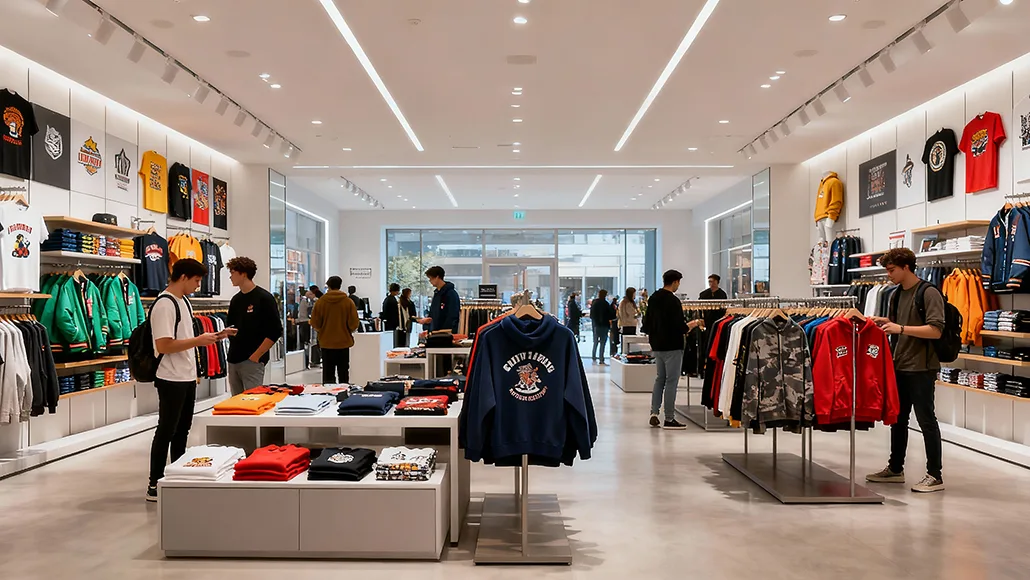
Marketing and customer education drive awareness and trial. Many potential customers lack familiarity with custom apparel possibilities or harbor misconceptions regarding quality, cost, or production timelines. Effective marketing clearly communicates value propositions, showcases design capabilities, and removes adoption barriers through education and incentives. Businesses like ASICS, JD Sports, and Decathlon have successfully built competitive advantages through sophisticated visual merchandising communicating custom apparel benefits effectively.
Future Evolution and Emerging Opportunities
Custom apparel merchandising strategies continue evolving as technology advances, consumer preferences shift, and competitive dynamics change. Artificial intelligence applications will increasingly personalize product recommendations and design suggestions to individual customers. Advanced 3D visualization and augmented reality will enable customers to preview customized products in realistic contexts before purchase. Distributed manufacturing networks will reduce production times and enable even more rapid response to trending designs.
Sustainability represents an emerging focus area reshaping custom apparel strategies. As consumer environmental consciousness increases, many custom apparel retailers highlight reduced waste inherent to made-to-order production models compared to mass manufacturing. Choices regarding base material sustainability, production location environmental impacts, and packaging materials increasingly influence purchasing decisions, particularly among younger demographics. Retailers positioning custom apparel as inherently more sustainable gain competitive advantages in environmentally conscious market segments.
The convergence of custom apparel merchandising strategies with broader retail trends—omnichannel experiences, experiential retail, social commerce—suggests expanding opportunities for sophisticated brands investing in this space. As retail competition intensifies and consumers increasingly value personalization and individual expression, custom apparel merchandising strategies will likely become less specialized offerings and more central to mainstream retail operations.