
































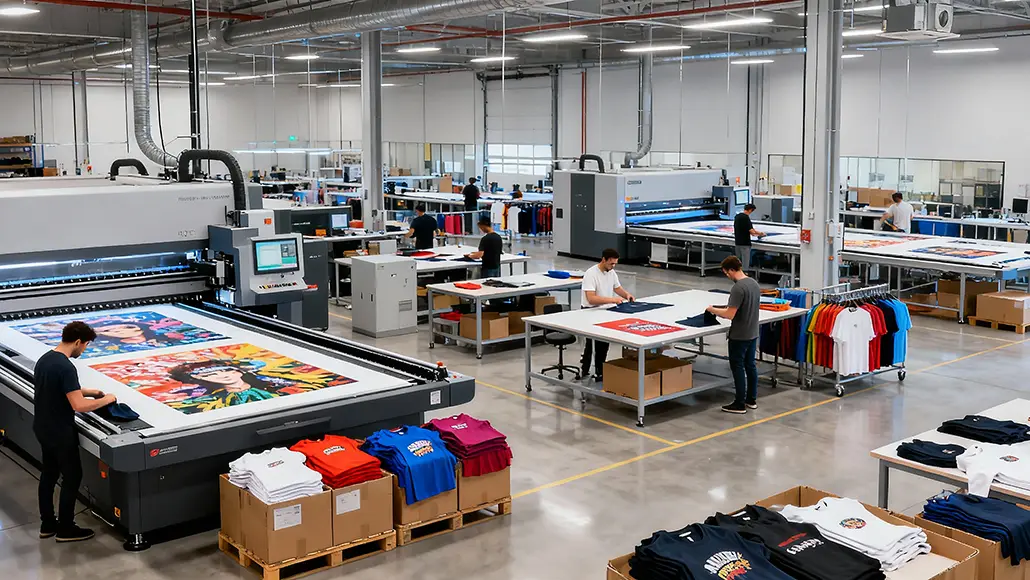

The traditional textile supply chain model has remained fundamentally unchanged for nearly a century. Manufacturers estimate demand months in advance, invest massive capital in inventory production, store completed garments in warehouses, and hope consumer preferences align with production decisions. This linear system generates enormous waste, creates financial risk through unsold inventory, constrains designers to seasonal cycles, and produces environmental consequences spanning raw material extraction through manufacturing, transportation, storage, and disposal. Today, a transformative alternative is disrupting this entrenched model: small-batch and on-demand apparel production approaches are fundamentally reshaping how fashion is manufactured, distributed, and consumed. These supply models replace forecasting-driven production with demand-driven creation, eliminate inventory carrying costs, enable rapid trend response, and empower designers and retailers with unprecedented flexibility and economic viability.
The Limitations of Traditional Textile Supply Chain Models
Traditional fashion retail operates on a seasonal calendar, with manufacturers producing vast quantities of apparel six to nine months before intended sale. This extended timeline reflects the realities of conventional manufacturing: establishing production lines, procuring raw materials at scale, managing complex production schedules, and organizing logistics networks to deliver products to thousands of retail locations. Designers commit to designs and production quantities years in advance, with minimal flexibility to adjust course based on emerging trends or actual consumer response.
This model generates substantial inefficiencies and waste. Demand forecasting, despite sophisticated analytical approaches, inherently exhibits significant error margins. Retailers inevitably overbuy certain items while underselling others, creating markdowns that devastate profitability and require costly inventory management. The result manifests as mountains of unsold inventory: approximately 85 percent of textiles produced annually end up discarded, with much reaching landfills within one year of manufacture. Fashion retailers, even those employing advanced analytics, typically maintain inventory turnover rates of only 50-60 percent within a single season, accepting that 40-50 percent of produced inventory will require markdown and eventual disposal.
Financial burdens accompanying inventory-based models extend beyond waste. Capital commitment to inventory ties up resources that could otherwise support growth, innovation, or other business needs. Fulfillment complexity increases significantly when managing thousands of SKUs across numerous warehouse and retail locations. The longer timeframe between design decisions and market feedback prevents designers from learning what customers actually prefer, reinforcing cycles of overproduction and waste.
Global supply chain disruptions over the past decade—exemplified dramatically by pandemic-related manufacturing shutdowns, port congestion, geopolitical tensions affecting trade routes, and shipping cost volatility—exposed profound vulnerabilities in traditional models. Brands dependent on long, geographically dispersed supply chains experienced delays, elevated costs, and inability to respond to shifting consumer demands. These disruptions catalyzed serious reconsideration of supply chain assumptions that had seemed immutable.
Small-Batch Production Fundamentals and Benefits
Small-batch production represents a fundamental reimagining of textile manufacturing logistics. Rather than producing thousands of identical garments in advance, manufacturers produce limited quantities—perhaps 50 to 500 units—based on confirmed or highly probable demand. This approach retains most advantages of standardized production regarding quality consistency and operational efficiency while eliminating waste and inventory risk inherent to mass production.
Small-batch production offers multiple distinct advantages reshaping industry economics. Inventory risk diminishes dramatically when manufacturers produce only quantities with confirmed demand or extremely high-probability forecasts. Retailers place orders reflecting actual customer inquiries, pre-orders, or sophisticated trend analysis rather than speculative forecasts. This demand alignment reduces markdown pressure, improves profitability, and frees working capital for other uses.
Production flexibility increases substantially when batch sizes remain small. Designers can experiment with multiple colorways, fit variations, or design iterations without committing enormous resources to variants that might underperform. Consumer feedback from initial batches informs subsequent production, enabling rapid iteration and product refinement. This flexibility proves particularly valuable for emerging designers and small brands lacking resources to absorb large inventory risks.
Sustainability benefits from small-batch production derive primarily from eliminating overproduction waste. Producing only what will likely sell means far fewer garments reach end-of-life in landfills prematurely. Resource consumption aligns directly with actual demand rather than inflated forecasts. Smaller production runs can be distributed to geographically proximate facilities, reducing transportation distances and emissions. For certain categories, small-batch approaches enable experimentation with sustainable materials and techniques—potentially more expensive than conventional approaches—without requiring volume scale to achieve cost viability.
Speed and responsiveness represent another critical small-batch advantage. When designers can produce new designs in small quantities, market response time decreases from seasonal cycles to weekly or monthly innovation cycles. Fashion brands producing clothing responding to emerging trends while momentum peaks capture competitive advantages unavailable to traditional manufacturers constrained by lengthy lead times. Zara, a pioneer in fast fashion, built its competitive advantage partly through small-batch production enabling rapid response to emerging consumer preferences observed through real-time retail data.
On-Demand Manufacturing and the Print-On-Demand Revolution
On-demand manufacturing extends small-batch flexibility to its ultimate expression: producing garments only after purchase confirmation. This approach eliminates inventory entirely, removing the largest financial and environmental burden from traditional retail. Unlike small-batch production, which involves some speculation regarding demand likelihood, on-demand manufacturing involves zero production before confirmed sales.
The print-on-demand (POD) sector has demonstrated the commercial viability of this approach at substantial scale. As of 2024, global custom apparel represented USD 10.5 billion in market value, with growth projections reaching USD 15.3 billion by 2030. This expansion reflects far more than niche experimentation; mainstream brands and retailers increasingly integrate print-on-demand into their operational models. Printful, Printdoors, Gelato, and Printify—platforms enabling seamless print-on-demand integration with e-commerce systems—collectively process millions of orders monthly, demonstrating that consumers willingly purchase custom, on-demand apparel when designs resonate with their preferences.
On-demand manufacturing fundamentally redistributes value and risk within apparel supply chains. Traditional retail concentrates risk with manufacturers and retailers, requiring large upfront investments with uncertain returns. On-demand approaches transfer risk to consumers, who explicitly choose to purchase specific designs, accepting production timelines in exchange for products precisely matching their specifications. Retailers and designers eliminate inventory carrying costs, markdowns, and waste, improving profitability while accessing capital that would otherwise tie up in inventory.
The technological infrastructure enabling on-demand production has matured substantially. Direct-to-garment (DTG) printing technology applies full-color designs directly to finished garments, enabling economical small-run and single-unit production. Sublimation printing transfers dyes directly onto polyester fibers, achieving rich colors and durability for all-over print designs. Heat transfer printing applies pre-printed designs to garments through precise temperature and pressure application. 3D knitting technology creates seamless garments with zero excess fabric in single production runs, eliminating assembly and cutting waste while enabling extensive customization. Each technology advance reduced costs, improved quality, and expanded production possibilities for made-to-order manufacturing.
Fulfillment logistics supporting on-demand production have evolved to meet consumer expectations for rapid delivery. Centralized fulfillment centers processing orders placed through e-commerce platforms enable significant consolidation of inventory compared to distributed retail warehouses. Production on receipt of orders means no inventory carrying costs or long-term storage. Integration with global logistics networks enables worldwide shipping within 1-3 weeks from order placement, acceptable timelines for most consumers while remaining vastly faster than traditional 6+ month lead times from design to retail availability.
Localized Manufacturing and Microfactory Models
Geographic distribution of manufacturing represents an emerging approach combining on-demand flexibility with localized production efficiency. Rather than centralizing manufacturing in a handful of overseas facilities, localized production networks position smaller, technologically advanced facilities close to end-consumer markets. These microfactories—compact, highly automated manufacturing units handling complete production processes from design through fulfillment—offer compelling advantages compared to both distant offshore manufacturing and centralized on-demand production.
Localized manufacturing dramatically reduces transportation distances and associated carbon emissions. Instead of shipping completed garments from Asia to North America and Europe, products travel perhaps from regional facilities to local distribution networks. For time-sensitive, trend-driven products, local production can deliver products within days of order placement, dramatically exceeding shipping speed from distant facilities.
Los Angeles has emerged as a model for localized manufacturing, with a densely interconnected ecosystem of fabric suppliers, production facilities, finishing services, and supporting infrastructure. Emerging fashion brands increasingly produce locally, benefiting from short design-to-production cycles, personal relationships with facilities enabling rapid iteration, and transparency into manufacturing processes. Though per-unit production costs exceed offshore manufacturing, avoided inventory costs, reduced transportation expenses, and premium positioning for locally made products often improve overall profitability compared to traditional models.
Microfactories introduce technological elements enabling true localized production at commercially viable costs. Automation, artificial intelligence production scheduling, and advanced equipment design reduce labor requirements and enable smaller facilities to achieve efficiency approaching larger factories. Flexible production systems transitioning between designs rapidly allow facilities to serve multiple customers simultaneously without lengthy changeover periods. Digital connectivity enables microfactory networks to operate coordinatedly, directing orders to facilities with available capacity rather than requiring centralized coordination.
Nearshoring represents an intermediate approach between centralized offshore production and fully localized manufacturing. Many brands, particularly following pandemic-related supply chain disruptions, relocated production from distant Asia facilities to nearer alternatives—Mexico for North American companies, Eastern Europe for European brands, India or Vietnam for Asian retailers. This approach retains significant cost advantages of offshore production while reducing lead times, improving supply chain visibility, and reducing vulnerability to geopolitical disruptions. Nearshoring enables small-batch and on-demand production at lower costs than localized production in high-wage regions.
Technological Enablers and Supply Chain Innovation
The rapid scaling of small-batch and on-demand production reflects not only market demand but also technological capabilities enabling these models’ practical implementation. Digital technologies, manufacturing innovations, and supply chain digitization work synergistically to enable flexible production at commercial scale.
Digital design and customization tools allow customers to design custom garments through intuitive web interfaces, immediately visualizing designs on garment models before purchase. These interfaces manage complexity, preventing customers from overwhelming themselves with infinite options while enabling genuine personalization. Integrated CAD systems enable seamless transition from customer designs to production instructions for automated equipment.
Three-dimensional knitting technology represents a manufacturing breakthrough enabling true on-demand seamless garment production. Unlike traditional knitting producing flat panels requiring subsequent sewing assembly, 3D knitting machines create complete garments in single production runs shaped to specific customer measurements. Shima Seiki machines, adopted by on-demand manufacturer Tailored Industry, achieve this capability while achieving design flexibility enabling rapid variation between orders. The technology eliminates sewing assembly, reduces scrap waste to essentially zero, and dramatically improves quality consistency.
Supply chain digitization through blockchain, IoT, and advanced data systems provides visibility and coordination capability previously unattainable. Brands can track material provenance, monitor production in real-time, and verify ethical labor practices across distributed manufacturing networks. Predictive analytics anticipate demand and optimize production scheduling, preventing bottlenecks and excess capacity simultaneously.
Artificial intelligence applications optimize production scheduling, demand forecasting, and design recommendations. Machine learning algorithms analyzing customer preferences, browsing behavior, and social media trends enable more accurate demand prediction than traditional forecasting. AI-optimized production scheduling coordinates manufacturing across distributed facilities, routing orders to facilities with appropriate capacity and capabilities.
Supply chain coordination platforms integrated with enterprise systems enable rapid communication and order flow across distributed networks. When a customer places an order, systems automatically determine optimal production location considering inventory, capacity, and logistics, routing the order accordingly. Real-time visibility enables customers to track production and delivery, building confidence in on-demand processes.
Market Adoption and Future Trajectory
The transition from traditional to on-demand and small-batch production models is progressing rapidly, though with uneven adoption across industry segments. Large retailers and major brands have invested substantially in digital infrastructure and supplier relationships enabling integration of on-demand capabilities alongside traditional production. ASOS, Urban Outfitters, and similar retailers increasingly offer made-to-order options. Sportswear brands including Nike and Adidas offer limited customization options, testing direct consumer demand for personalization. Luxury brands, where craftsmanship and exclusivity command premium pricing, embrace made-to-order and bespoke production as core business models.
Emerging brands and independent designers disproportionately utilize print-on-demand and on-demand models, leveraging flexibility and low capital requirements to establish market presence without resources for traditional inventory investment. Platforms enabling these businesses to build brands and reach global audiences through integrated e-commerce and production networks have generated thousands of small businesses operating exclusively on on-demand models.
The most significant growth opportunity for small-batch and on-demand production likely lies in midmarket retailers and emerging designers currently dependent on traditional inventory models. As technology maturity increases, costs decrease, and supply chain infrastructure develops, these businesses will increasingly adopt hybrid models combining core inventory of bestselling items with on-demand production for trend-responsive and customization options. This hybrid approach balances inventory efficiency with fashion responsiveness, likely representing the predominant retail model within the next decade.
Regulatory frameworks increasingly supporting on-demand production through sustainability requirements and waste reduction mandates will accelerate adoption further. As extended producer responsibility legislation spreads globally, manufacturers and retailers benefit economically from on-demand approaches generating minimal waste compared to overproduction models. Digital product passports and supply chain transparency requirements are more readily achievable in smaller, more controlled production runs than in complex global supply chains.
The convergence of consumer demand for personalization and sustainability, technological capability enabling on-demand production, regulatory momentum supporting waste reduction, and competitive advantages accruing to responsive brands suggests that small-batch and on-demand production will progress from emerging innovation toward industry mainstream within the coming years. Brands and retailers investing in these capabilities today position themselves advantageously to compete effectively in increasingly personalized, environmentally conscious, and trend-responsive fashion markets.