
































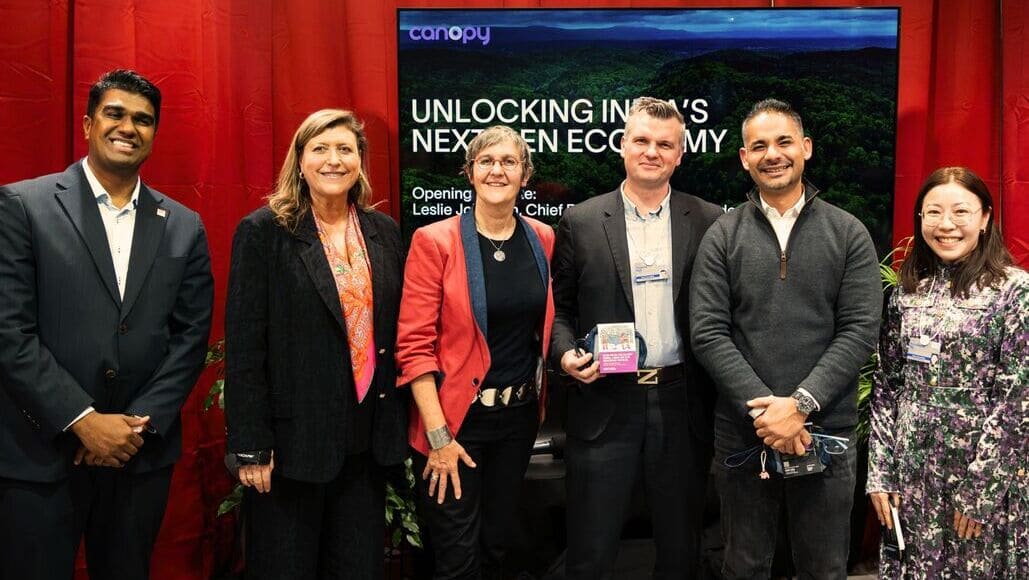

Environmental nonprofit Canopy has unveiled a wood supply risk assessment and a $2 billion financing mechanism at the current World Economic Forum in Davos, Switzerland.
Canopy, a nonprofit organization collaborating with more than 1,000 brands to facilitate sustainable supply chain transformations that safeguard forests and encourage low-carbon practices, has unveiled new research detailing the vulnerabilities in global wood supply chains. Alongside this, Canopy announced the launch of a $2 billion blended finance platform designed to expand sustainable textile production.
The research brief, produced in association with Finance Earth, highlights the various pressures influencing global wood supply chains, including climate-related challenges, changing regulations, and increasing competition for forest resources.
It identifies significant risks for businesses that depend on forest products, particularly noting that the surge in demand for wood fiber across multiple sectors now exceeds what forests can sustainably provide.
Additional challenges include limited wood availability due to land competition and ecosystem degradation, as well as stricter compliance demands associated with regulations like the EU Deforestation Regulation and human rights due diligence.
To address these challenges, the research outlines three strategic approaches for companies:
- Reduce reliance on raw wood: Companies should expand their use of circular and next-generation materials sourced from agricultural by-products, discarded textiles, and recycled resources. This strategy separates economic growth from primary forest usage, mitigating vulnerability to price fluctuations and regulatory changes.
- Enhance the security of the remaining wood supply: When utilizing new wood, it’s essential to ensure proper certification, traceability, and assessment of environmental and community impacts. This includes addressing risks to ancient forests, endangered ecosystems, Indigenous Peoples, and local communities.
- Anticipate potential disruptions: Companies should incorporate wood-related risks in their scenario planning and stress testing, while also directing investments toward more robust sourcing strategies.
Nicole Rycroft, Canopy’s founder and executive director, remarked, “Forests are one of our greatest climate allies and central to meeting global climate and nature targets, yet current sourcing models and supply chains are pushing them to breaking point. This brief makes it clear: if companies and investors stay locked into business-as-usual wood sourcing, they are signing up for higher costs, greater supply vulnerability, and growing regulatory and reputational risk. This exposes businesses unnecessarily, given there is a clear exit ramp with Next Gen and alternative sources.”
With the launch of the blended finance platform, Canopy aims to engage government agencies, private sector stakeholders, investors, and philanthropic organizations to facilitate the wider adoption of sustainable textile production.
Canopy’s replicable financing model seeks to support the complete value chain, from feedstock systems and pre-processing to mill enhancements and secure offtake agreements. The program will first roll out in India, where an abundance of residues and recycled textiles, along with strong fiber-processing capabilities and rising global demand, will facilitate rapid scaling. By aligning catalytic capital, private investors, and supply chain partners under a coordinated approach, the initiative aims to scale sustainable textile production across paper, packaging, and MMCF textiles, establishing a blueprint for other markets.