


























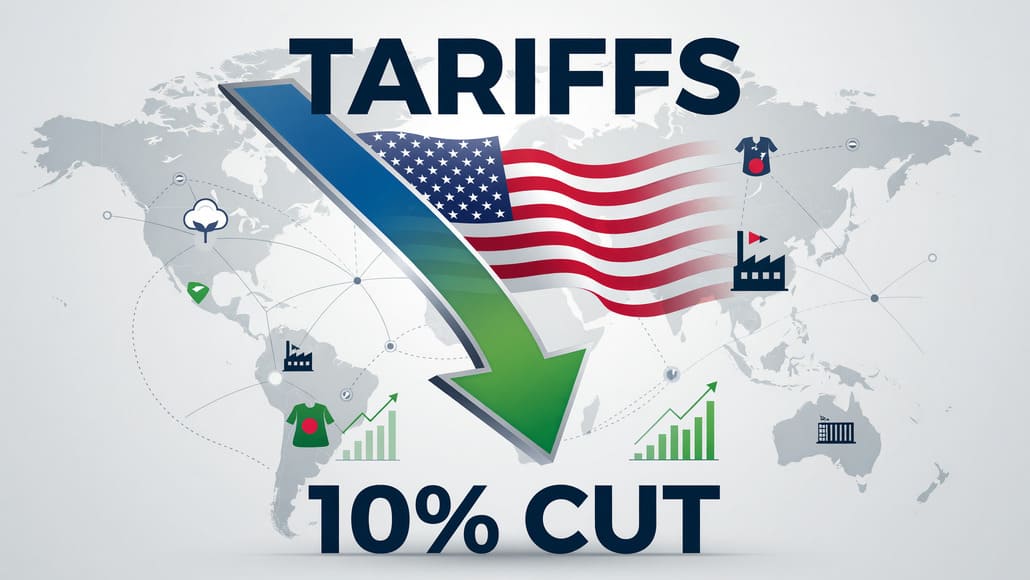
The announcement of a US 10% tariff cut effective February 24 for a 150-day period marks a significant inflection point in global trade policy, with direct consequences for the textile and apparel value chain. For an industry that operates on thin margins, complex sourcing networks and tight delivery schedules, even a 5–10% swing in duty structures can materially alter competitiveness.
The temporary tariff framework follows a judicial reset of earlier sweeping trade measures, prompting Washington to introduce a uniform 10% duty across a broad range of imports. Unlike earlier country-specific or sector-specific tariffs, this measure applies widely, covering textiles, garments, fabrics and related products entering the United States — the world’s largest apparel import market.
For global manufacturers, brands and exporters, the US 10% tariff cut represents neither a complete relief nor a punitive escalation. Instead, it introduces a recalibration — easing extreme tariff pressures in some corridors while imposing a standardized cost layer across global suppliers.
A Structural Shift in Trade Dynamics
The United States accounts for roughly one-third of global apparel imports, making it the single most influential demand center for garment-producing economies. Any change in US tariff architecture immediately reverberates across Asia’s manufacturing hubs, from South Asia to Southeast Asia, as well as across Latin America.
The earlier tariff regime had, in some cases, pushed effective duties on select goods to elevated levels, disrupting sourcing patterns and triggering price renegotiations. The US 10% tariff cut, while still representing an added cost burden, offers relative predictability compared to the volatility of previous measures.
Uniformity, in trade terms, reduces distortion. However, it also narrows preferential gaps. Countries that previously enjoyed temporary advantages under differentiated structures may now find those margins compressed.
Implications for Major Textile Exporters
India: Breathing Space Amid Uncertainty
India’s textile and apparel exporters, who had faced episodes of elevated tariff exposure in recent cycles, are likely to view the US 10% tariff cut as short-term relief. A standardized 10% structure may lower peak duty burdens seen previously in certain categories, improving price stability for Indian cotton garments, home textiles and synthetic blends.
However, competitiveness will hinge not only on tariffs but also on logistics efficiency, compliance standards and currency movements. Indian exporters will need to capitalize on the temporary window to strengthen buyer relationships and secure forward contracts before the 150-day review period concludes.
Bangladesh: Margin Pressures in Price-Sensitive Segments
Bangladesh, one of the world’s largest ready-made garment exporters, operates primarily in highly price-sensitive mass-market categories. Even a 10% duty can materially affect landed costs in the US retail market.
For Bangladeshi suppliers, the key question is cost absorption. Will manufacturers share the burden with US buyers? Or will retailers pass it on to consumers? The answer will determine order volumes for the upcoming sourcing cycles.
While the US 10% tariff cut lowers the ceiling compared to previous peaks, it still compresses margins in an industry already grappling with rising wages, energy costs and compliance investments.
Vietnam and Southeast Asia: Supply Chain Recalibration
Vietnam, Cambodia and Indonesia have emerged as strong alternatives in diversified sourcing strategies. A uniform tariff narrows extreme disparities but preserves competition on productivity, speed and free trade alignment.
Vietnam’s vertically integrated textile ecosystem may offer resilience. Yet buyers are unlikely to rely solely on one geography. Instead, brands may further diversify sourcing across multiple Asian and near-shore hubs to mitigate future policy risk.
Impact on Global Supply Chains
The apparel supply chain is globally fragmented: cotton from one continent, yarn from another, fabric processed elsewhere, and final stitching in yet another country before shipment to US retailers.
The US 10% tariff cut adds a predictable cost variable at the final import stage. While it does not directly alter upstream production costs, it influences sourcing decisions downstream.
Brands and retailers typically respond in three ways:
-
Price renegotiation: Sharing tariff costs across the supply chain.
-
Vendor consolidation: Favoring large, compliant suppliers who can absorb cost pressures.
-
Near-shoring exploration: Expanding production closer to the US market, particularly in Mexico and Central America.
In this context, Latin American producers under existing regional trade frameworks could see incremental demand, especially in fast-fashion and replenishment models.
Retail Pricing and Consumer Demand
The US apparel market remains highly competitive and promotion-driven. Retailers are cautious about passing on full tariff costs to consumers, particularly in mid-market and value segments.
However, sustained duties — even at 10% — tend to gradually seep into pricing structures. If the US 10% tariff cut remains in effect beyond the 150-day window or transitions into a longer-term policy, consumers may face incremental price adjustments in seasonal collections.
Retail equities have historically reacted positively to clarity in trade policy, even when tariffs are imposed, as predictability reduces inventory risk. Yet demand elasticity remains a critical variable.
Strategic Considerations for the Textile Industry
The temporary nature of the policy introduces planning complexity. Textile manufacturers operate on investment cycles that extend beyond six months. Machinery upgrades, compliance certifications and capacity expansions cannot be calibrated to short-term tariff windows alone.
Industry stakeholders must therefore prepare for multiple scenarios:
-
Extension of the 10% tariff beyond 150 days
-
Reversion to higher duties under alternative trade statutes
-
Negotiated bilateral adjustments with specific partners
In each case, cost competitiveness, sustainability compliance and supply chain transparency will remain decisive factors.
A Broader Trade Policy Signal
Beyond immediate cost implications, the US 10% tariff cut signals a broader recalibration of trade enforcement strategy. It underscores the growing interplay between judicial oversight, executive trade authority and legislative frameworks in shaping global commerce.
For exporters, the lesson is clear: reliance on a single market exposes structural vulnerability. Diversification across Europe, emerging Asia, the Middle East and Africa is increasingly a strategic imperative.
Outlook: Cautious Optimism with Structural Risks
In relative terms, the US 10% tariff cut reduces extreme tariff volatility and offers interim stability to the global textile trade. For some exporters, it softens prior burdens. For others, it standardizes competitive conditions.
Yet the apparel and textile industry thrives on predictability. The temporary horizon of 150 days keeps strategic decisions in a holding pattern.
As global brands finalize sourcing for upcoming seasons, much will depend on whether the tariff remains transitional or evolves into a new baseline. Until then, manufacturers, exporters and retailers will continue balancing cost management with supply resilience in a rapidly shifting trade landscape.