





























PSI 2026

The Heritage – Virtual Textile Machinery Exhibit by ACIMIT

Note* - All images used are for editorial and illustrative purposes only and may not originate from the original news provider or associated company.

Subscribe

- Never miss a story with notifications

- Gain full access to our premium content

- Browse free from up to 5 devices at once

Media Packs

Expand Your Reach With Our Customized Solutions Empowering Your Campaigns To Maximize Your Reach & Drive Real Results!
– Access The Media Pack Now!
– Book a Conference Call
Leave Message for us to Get Back

Related stories

Advancements in Natural Fiber Textile Recycling for Cotton and Wool

Natural fiber textile recycling has advanced significantly through cutting-edge chemical dissolution, fiber regeneration, and advanced separation technologies enabling high-purity recovery of cotton and wool fibers matching virgin specifications. Processes like Renewcell’s Circulose® and Evrnu’s NuCycl technology now enable indefinite cycling of cotton fibers while wool recycling technologies preserve fiber properties across multiple reuse cycles, creating genuine circular pathways for natural textiles and addressing the environmental advantages of fiber recovery from conventional resource-intensive virgin cultivation.

The Role of AI and Automation in Advancing Textile Recycling Systems

Artificial intelligence and automation technologies are revolutionizing textile recycling by dramatically improving sorting accuracy, material separation efficiency, and overall system throughput. Machine learning algorithms, computer vision systems, near-infrared spectroscopy, and robotic automation are transforming labor-intensive manual processes into intelligent automated systems capable of identifying and processing hundreds of items per hour with accuracy exceeding 95%, enabling scalable textile recycling infrastructure that was previously economically unviable.

How Brands are Redesigning Products to Support Textile Recycling and Circularity

Fashion brands are fundamentally redesigning product architecture to support textile recycling and circular business models through design-for-recycling principles including mono-material construction, detachable trims, and simplified component design. These design transformations address downstream processing requirements, reduce end-of-life complexity, and enable brands to achieve circular positioning while simultaneously improving manufacturing efficiency and creating differentiated market positioning in sustainability-conscious segments.

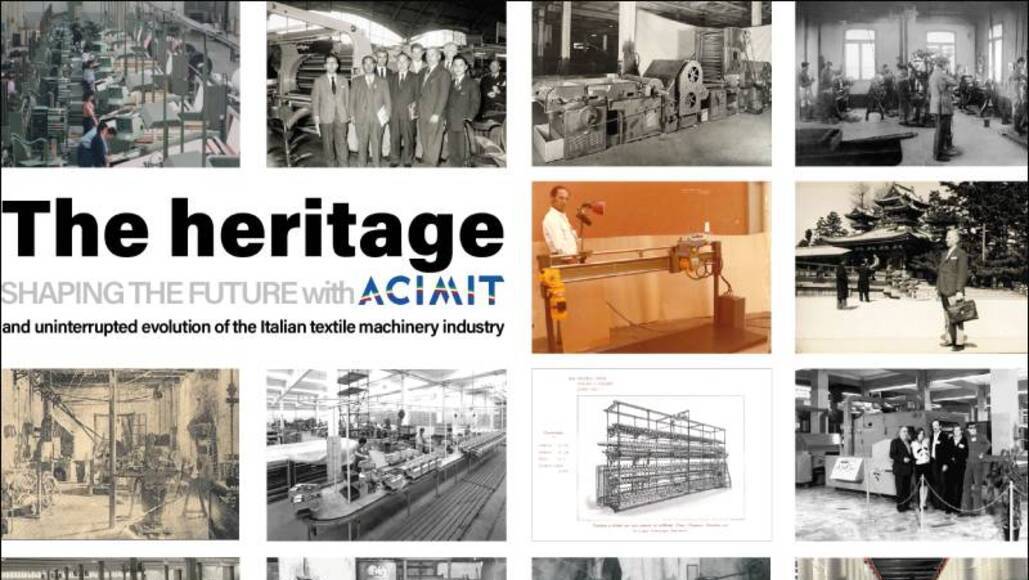
ACIMIT, the Association of Italian Textile Machinery Manufacturers, has launched The Heritage, a virtual exhibition that traces the history of Italy’s textile machinery sector. This initiative, developed in partnership with the Italian Trade Agency and financially backed by the Italian Ministry of Foreign Affairs and International Cooperation, showcases over a century of industrial evolution through a digital platform.

The Heritage acts as a digital extension of the exhibition first presented at ITMA 2023 in Milan, the leading global trade fair for textile machinery. Initially a captivating photographic display for both national and international visitors, this online platform transforms the historical narrative into an immersive and interactive experience.

Featuring contributions from numerous textile machinery companies, The Heritage highlights over 100 years of industry advancements within a visually engaging gallery. The exhibition is organized into several sections, including Machineries, Entrepreneurs, Factories, World, Companies, Exhibition, and ACIMIT, allowing visitors to explore drawings and photographs of iconic machines, significant moments from trade fairs, and vintage images of production plants that have shaped the industry.

ACIMIT President Marco Salvadè emphasized the initiative’s significance: “The primary aim of The Heritage, both at ITMA 2023 and now as a digital platform, is to showcase the history, values, and technological evolution of the Italian textile machinery industry. It offers an evocative and engaging journey that illustrates how Italian manufacturing has progressed over the past century.”

Italy continues to be a global leader in textile machinery, with nearly 300 companies in the sector, driven by extensive expertise and ongoing innovation. Salvadè noted that The Heritage is not a static exhibition but rather a dynamic and evolving space: “This virtual platform will continue to grow, enriched by ongoing contributions from companies sharing images and testimonies that narrate the continuous story of our industry.”

By providing an accessible and engaging platform, The Heritage ensures that the legacy of Italian textile machinery is celebrated and shared globally.

Latest stories

Related stories

Advancements in Natural Fiber Textile Recycling for Cotton and Wool

Natural fiber textile recycling has advanced significantly through cutting-edge chemical dissolution, fiber regeneration, and advanced separation technologies enabling high-purity recovery of cotton and wool fibers matching virgin specifications. Processes like Renewcell’s Circulose® and Evrnu’s NuCycl technology now enable indefinite cycling of cotton fibers while wool recycling technologies preserve fiber properties across multiple reuse cycles, creating genuine circular pathways for natural textiles and addressing the environmental advantages of fiber recovery from conventional resource-intensive virgin cultivation.

The Role of AI and Automation in Advancing Textile Recycling Systems

Artificial intelligence and automation technologies are revolutionizing textile recycling by dramatically improving sorting accuracy, material separation efficiency, and overall system throughput. Machine learning algorithms, computer vision systems, near-infrared spectroscopy, and robotic automation are transforming labor-intensive manual processes into intelligent automated systems capable of identifying and processing hundreds of items per hour with accuracy exceeding 95%, enabling scalable textile recycling infrastructure that was previously economically unviable.

How Brands are Redesigning Products to Support Textile Recycling and Circularity

Fashion brands are fundamentally redesigning product architecture to support textile recycling and circular business models through design-for-recycling principles including mono-material construction, detachable trims, and simplified component design. These design transformations address downstream processing requirements, reduce end-of-life complexity, and enable brands to achieve circular positioning while simultaneously improving manufacturing efficiency and creating differentiated market positioning in sustainability-conscious segments.

Subscribe

- Never miss a story with notifications

- Gain full access to our premium content

- Browse free from up to 5 devices at once

Media Packs

Expand Your Reach With Our Customized Solutions Empowering Your Campaigns To Maximize Your Reach & Drive Real Results!

– Access The Media Pack Now!
– Book a Conference Call
Leave Message for us to Get Back

Translate »