
































The global fashion industry faces an unprecedented sustainability crisis. Every year, approximately 92 million tonnes of textile waste accumulates in landfills and incinerators, with projections suggesting this figure could escalate to 134 million tonnes by 2030 if current consumption patterns persist unchanged. Yet beneath this alarming reality lies a transformative solution reshaping the entire industry’s future: circular textile systems and large-scale fiber-to-fiber recycling technologies. These innovative approaches represent a fundamental paradigm shift from the linear take-make-dispose model toward a regenerative, closed-loop ecosystem where textile waste becomes a valuable resource rather than an environmental burden.
Understanding Circular Textile Systems and Fiber-to-Fiber Recycling
Circular textile systems operate on the principle of designing, producing, and managing textiles in ways that minimize waste, reduce environmental impact, and keep materials in productive use for extended periods. At the heart of this transformation lies fiber-to-fiber recycling technology, which breaks down post-consumer and pre-consumer textile waste into their constituent fibers or molecular components, creating high-quality raw materials suitable for manufacturing new garments. Unlike conventional recycling, which often downcycles materials into lower-grade applications such as insulation or rags, fiber-to-fiber recycling maintains material integrity and quality, enabling the creation of garments indistinguishable from virgin-fiber products.
The circular fashion market validates this approach’s commercial viability. Valued at USD 7.63 billion in 2025, the sector is projected to reach USD 13.94 billion by 2032, representing a compound annual growth rate of 9.0%. This expansion reflects growing consumer demand for sustainable products, increasingly stringent regulatory requirements, and fashion brands’ recognition that circularity offers both environmental and economic advantages. North America currently dominates the market with 35% share, followed closely by Europe at 25%, while Asia Pacific emerges as the fastest-growing region with growth rates exceeding 9% annually.
Advanced Technologies Driving Fiber Separation and Recovery
The technological innovations enabling large-scale fiber-to-fiber recycling represent significant breakthroughs in materials science and industrial automation. Traditional textile recycling faced fundamental limitations when processing blended fabrics—materials combining cotton, polyester, synthetic fibers, and other compounds that have become ubiquitous in modern apparel. These blends were previously considered difficult or impossible to separate effectively, restricting recycling efforts to single-fiber materials and capping the potential scale of circular systems.
Contemporary solutions have overcome these barriers through sophisticated mechanical and chemical processes. Artificial intelligence-powered sorting systems now achieve extraordinary accuracy in fiber identification. Valvan’s Fibersort™ technology, for instance, uses near-infrared (NIR) spectroscopy combined with machine learning algorithms to identify fiber content within milliseconds. The system demonstrates 99% accuracy on single-fiber materials and 95% accuracy on fiber blends, fundamentally changing what can be processed at scale. Additionally, RGB camera technology enables simultaneous color-based sorting, further optimizing the separation process and enabling parallel processing of different material streams.
Chemical and biological recycling approaches complement mechanical technologies. Circ’s hydrothermal processing technology selectively targets and separates synthetic fibers from cellulosic content, capturing the majority of raw materials for regeneration into high-quality fibers. Ambercycle employs molecular-level separation through patented biological processes capable of breaking down whole garments—buttons, zippers, and all—into component materials. The company’s Cycora® regenerated polyester performs identically to virgin polyester while incorporating reclaimed materials, demonstrating that quality need not be sacrificed for sustainability. Renewcell’s process transforms cellulose waste into pulp while recycling chemical solutions, targeting the ambitious goal of processing 1.4 billion discarded T-shirts annually by 2030.
Comprehensive Waste Management Infrastructure
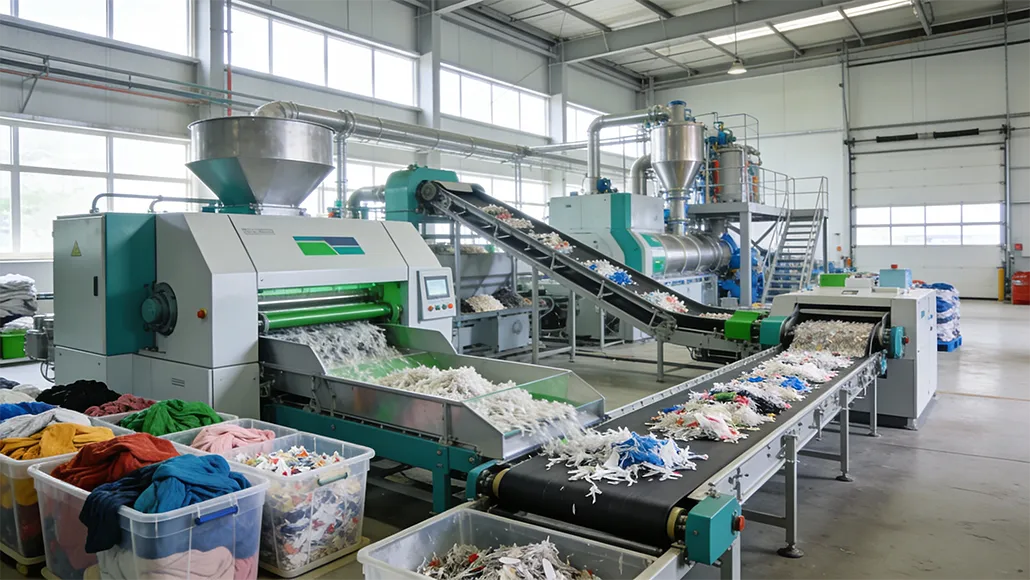
Effective circular textile systems require sophisticated waste management infrastructure extending from consumer level through industrial recovery and regeneration. The first critical phase involves product disassembly and component separation. Before fibers can be recycled, garments must be stripped of non-fibrous elements—buttons, snaps, zippers, embellishments, leather patches, and studs. Innovative automation technologies demonstrated at recent industry exhibitions can identify and mechanically separate these components from fabric pieces with remarkable efficiency. Valvan’s Trim-clean™ system removes fasteners and embellishments with precision that rivals manual processing while operating at industrial scale, pulling contaminated pieces from the product stream while allowing clean fabric to advance toward shredding and fiber separation stages.
Infrastructure for collection, the second critical component, determines whether circular systems operate at meaningful scale. Currently, only 20% of global textile waste enters formal collection and recycling systems, while the remaining 80% disperses into landfills, incinerators, or unregulated informal channels. Advanced logistics systems, extended producer responsibility (EPR) programs, and consumer engagement initiatives work collectively to improve recovery rates. Successful programs typically combine convenient drop-off locations, incentive structures encouraging participation, clear consumer education about material types, and seamless information systems tracking materials through collection and processing chains.
Benefits and Environmental Impact of Circular Systems
The environmental advantages of circular textile systems extend far beyond waste diversion metrics. A single garment produced through fiber-to-fiber recycling processes conserves approximately 134 liters of water compared to conventional manufacturing. For context, producing a new cotton T-shirt typically requires 2,700 liters of water. This conservation becomes increasingly critical as global water stress intensifies and freshwater availability declines in major textile manufacturing regions across Asia, India, and Bangladesh.
Energy consumption benefits are equally substantial. Because recycled fibers bypass the resource-intensive cultivation, harvesting, and initial processing stages required for virgin materials, energy demands decrease significantly. Fiber-to-fiber processes typically reduce carbon emissions by 30-50% compared to virgin fiber production, depending on the source materials and the specific recycling methodology employed. As electricity grids globally shift toward renewable sources, these advantages compound exponentially.
Chemical usage in circular systems contrasts dramatically with conventional textile production. Virgin cotton production relies on approximately 16% of global pesticides applied to only 2.5% of cultivated land, creating significant ecosystem toxicity and agricultural worker health impacts. Synthetic fiber production generates synthetic chemical byproducts requiring careful environmental management. Circular systems bypass these upstream chemical requirements entirely, though specific recycling processes may employ solvents or processing chemicals. Closed-loop systems capture and recycle these chemicals, preventing environmental release while reducing chemical consumption per unit of fiber produced.
Water pollution reduction represents another compelling environmental benefit. Conventional textile dyeing and finishing operations contaminate water with heavy metals, synthetic dyes, and chemical residues that persist in aquatic ecosystems for decades. Water bodies receiving textile industry discharge exhibit substantially elevated pollution levels, harming aquatic species and potentially compromising human water security. Circular systems prevent this source of water contamination by capturing fibers before the dyeing stage, allowing new fibers to be dyed using cleaner, more controlled processes.
Global Adoption Patterns and Regional Variations
Different regions demonstrate varying engagement levels with circular textile systems, influenced by regulatory frameworks, consumer preferences, economic development levels, and existing industrial infrastructure. North America’s 35% market share reflects advanced consumer awareness, premium pricing acceptance for sustainable products, and regulatory incentives supporting circular business models. Major fashion brands headquartered in the region compete actively on sustainability credentials, driving investment in circular technologies and developing supply chain relationships with circular manufacturers.
Europe’s 25% market share correlates with the region’s comprehensive regulatory environment. The European Union’s Circular Economy Action Plan and emerging Extended Producer Responsibility regulations create economic incentives for brands to adopt circular approaches or face regulatory penalties. These policy frameworks accelerate technology adoption and infrastructure development more rapidly than market forces alone would achieve. Individual member states compete to establish themselves as circular fashion hubs, attracting investment in recycling facilities and research institutions.
Asia Pacific presents the most dynamic growth trajectory, expanding at rates exceeding 9% annually. Rapid economic development, growing middle-class populations, and increasing environmental awareness among younger consumers drive circular fashion adoption. However, the region’s dominance in global textile manufacturing creates unique opportunities. Circular infrastructure development in major manufacturing hubs—India, Vietnam, Bangladesh, and Indonesia—directly impacts global circular textile availability. Investment in local fiber-to-fiber recycling capacity creates employment, improves economic resilience, and reduces transportation distances between collection and manufacturing points.
Technical and Economic Challenges in Scaling Circular Systems
Despite significant technological advances and growing market momentum, fiber-to-fiber recycling faces technical and economic barriers that must be addressed to achieve true large-scale operation. Mixed-fiber blends, while increasingly separable through advanced chemical and mechanical processes, remain more expensive to process than single-fiber materials. Economic viability requires sufficient volumes of specific material combinations to justify dedicated processing lines. Secondary materials markets fluctuate based on virgin material prices; when virgin polyester or cotton prices drop significantly, recycled materials become economically disadvantageous unless brand premium positioning, regulatory requirements, or consumer preference justifies price premiums.
Quality consistency across batches poses another challenge in large-scale operations. Unlike virgin fiber production, which operates under tightly controlled conditions producing standardized materials, recycled fibers exhibit variability based on source composition, aging, prior chemical treatment, and pre-processing contamination. Manufacturers must invest in quality control systems capable of managing this inherent variability while maintaining product specifications. Advanced fiber analysis and blending systems address this challenge but increase capital and operational costs.
Collection logistics present perhaps the most profound scaling barrier. Fiber-to-fiber recycling requires sufficient feedstock volumes concentrated in geographic proximity to processing facilities. Current global collection infrastructure remains inadequate to supply multiple large-scale processing facilities operating simultaneously. The gap between available post-consumer textile waste and processing capacity continues widening as new facilities enter operation, creating potential supply constraints that could limit growth despite strong demand.
Future Trajectory and Market Evolution
The circular textile systems landscape continues evolving rapidly, with emerging technologies and business models addressing current limitations. Distributed microfactory concepts suggest that localized, medium-scale fiber-to-fiber recycling facilities situated near major urban centers could improve collection logistics and reduce transportation distances. Such facilities would process regional textile waste streams into high-quality recycled fibers available to local apparel manufacturers, shortening supply chains and increasing transparency.
Regulatory frameworks appear likely to accelerate circular adoption rates substantially. Extended Producer Responsibility legislation, similar to models proven effective in Europe, increasingly spreads to Asia Pacific and North American regions. These frameworks create economic incentives for brands to design garments for recyclability, use recycled content, and establish collection infrastructure. Some regulatory proposals specifically target fiber composition, encouraging manufacturers to simplify fiber blends and eliminate problematic material combinations that resist recycling.
Consumer education and engagement represent underutilized levers for accelerating circular system development. Market research indicates that many consumers desire sustainable products but lack clear information about circular fashion, fiber-to-fiber recycling, and their personal roles in supporting circular systems. Brands investing in transparent communication about circular credentials and collection participation generate increased consumer engagement with recycling programs while building brand loyalty and justifying premium pricing for circular products.
The convergence of technology advancement, regulatory momentum, market growth, and consumer demand suggests that circular textile systems will progress from niche initiatives toward industry mainstream within the next five to ten years. Organizations investing in circular infrastructure today position themselves advantageously to capture market share in this expanding sector. For consumers, supporting circular fashion through product purchases, participation in take-back programs, and advocacy for extended producer responsibility legislation represents tangible contribution toward transforming the global textile industry toward genuine sustainability.