
































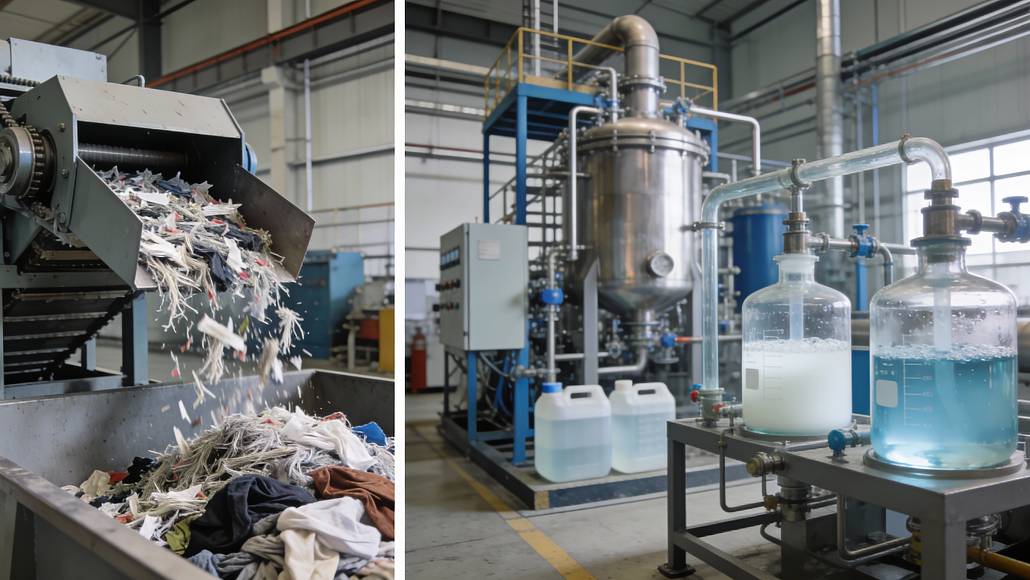

The textile recycling industry faces a critical fork in technological development: mechanical versus chemical recycling. These approaches represent not merely different processing techniques but rather fundamentally different philosophies toward material recovery, each with cascading implications for fiber quality, economic viability, environmental impact, and long-term circular economy feasibility.
Understanding this distinction is essential for stakeholders across the textile value chain: manufacturers evaluating waste processing partnerships, brands assessing recycled material sourcing strategies, recyclers planning facility investments, and policymakers designing circular economy frameworks. The mechanical versus chemical debate is not academic—it directly determines infrastructure development, economic models, and environmental outcomes for decades to come.
Mechanical Recycling: The Accessible Approach
Mechanical recycling represents the most mature and accessible textile recycling approach. The process converts textile waste into fibers through mechanical shredding, carding, and respinning without breaking polymer bonds or fundamentally altering material chemistry.
The mechanical recycling process unfolds sequentially. First, collected textiles are sorted by fiber type and color. Pre-sorted materials are shredded into small pieces, typically 5-10 millimeters in size. These fragments are then carded a process dating back centuries to traditional wool processing where fibers are separated and aligned into parallel orientation. Carded fiber is subsequently respun into yarn through conventional textile machinery.
The attractions of mechanical recycling are substantial. Capital investment requirements are dramatically lower than chemical alternatives a facility capable of processing 100 tons daily might require USD 2-5 million investment compared to USD 10-25 million for equivalent chemical capacity. Operational complexity is moderate; mechanical recycling requires no specialized chemistry expertise or hazardous chemical management. Processing speed is rapid mechanical facilities achieve throughput of 100+ tons daily relatively easily.
From a geographic accessibility perspective, mechanical recycling technology is accessible to developing regions where capital availability is limited. A mechanical recycling facility can be established in secondary and tertiary cities without sophisticated supporting infrastructure. This geographic accessibility explains why mechanical recycling dominates in South Asia, particularly India, where thousands of small and mid-scale mechanical recycling operations exist.
The Mechanical Recycling Limitation: Fiber Degradation
However, mechanical recycling carries a fundamental technical limitation: it degrades fiber properties with each cycle. The mechanical stress of shredding, carding, and respinning shortens fiber length and disrupts crystalline polymer structure. These property degradations are irreversible additional processing cycles compound damage.
Typical fiber length reduction: virgin polyester fibers average 20-25 millimeters; mechanically recycled polyester fibers average 8-12 millimeters. This length reduction fundamentally limits end-market applications. Shorter fibers cannot be spun into conventional yarns; instead, they are processed into nonwoven fabrics for lower-value applications: insulation, wadding, geotextiles, automotive interior trim, industrial applications.
Tensile strength similarly degrades. Virgin polyester tensile strength averages 70-90 megapascals (MPa); mechanically recycled polyester achieves 40-50 MPa. This 30-40% strength reduction prevents use in apparel applications requiring durability and performance.
Color also presents challenge. Mechanically recycled fibers retain dyes from original textiles. While this could theoretically be advantageous colored fibers without requiring redyeing in practice, mixed-color waste produces murky gray or brown fibers unsuitable for premium applications. Redyeing is necessary, but recycled fibers require higher dye concentrations to achieve color intensity equivalent to virgin fibers.
Downcycling as End Result
These property degradations mean mechanical recycling achieves at most 2-3 reuse cycles before fibers degrade beyond processability. This limitation creates downcycling outcome: a polyester shirt becomes insulation, which becomes low-grade felt, which ultimately enters landfill. Material value progressively decreases; genuine circular closed-loop cycling remains impossible.
From circular economy perspective, downcycling represents failure of fundamental circularity principle. True circular systems require indefinite material cycling; mechanical recycling’s inherent property degradation prevents this achievement.
Chemical Recycling: Molecular-Level Recovery
Chemical recycling fundamentally differs by breaking polymer chains at molecular level, recovering constituent monomers that serve as feedstock for new polymerization. Rather than attempting to preserve shortened fibers, chemical recycling deconstructs the material to its chemical building blocks.
The chemical recycling pathway varies by polymer type. Polyester depolymerization employs several approaches: glycolysis (reaction with glycols), hydrolysis (reaction with water), or methanolysis (reaction with methanol). Each approach breaks polyester into its component monomers (dimethyl terephthalate, ethylene glycol, or terephthalic acid), which are purified and repolymerized into virgin polyester indistinguishable from petroleum-derived material.
Aquafil’s depolymerization process exemplifies chemical recycling maturity. Their proprietary hydrolysis chemistry transforms polyester waste into purified BHET (bis-hydroxyethyl terephthalate) achieving 99%+ purity, suitable for direct repolymerization into virgin-equivalent polyester fiber. Renewcell’s Circulose® technology similarly dissolves cotton into cellulose pulp, which fiber manufacturers transform into regenerated cellulose fibers matching virgin specifications.
The Chemical Recycling Advantage: Virgin Quality, Indefinite Cycling
The critical advantage of chemical recycling: recovered material exhibits virgin-equivalent properties indefinitely. Polyester recovered through depolymerization can theoretically cycle through production-use-recovery-regeneration sequences countless times without property degradation. Fiber length, tensile strength, and color consistency remain constant across cycles.
This capability fundamentally enables true circularity. A chemical-recycled polyester fiber could support 10+, 100+, or theoretically infinite reuse cycles. Economic value persists across all cycles. Environmental benefit accumulates across multiple generations of product lifecycles.
For premium applications, this distinction is critical. High-performance activewear, technical textiles, and luxury apparel require material properties that mechanical recycling cannot provide. Chemical recycling enables these premium applications to achieve circular positioning.
Economic Realities: Cost Dynamics
Capital investment dramatically favors mechanical recycling. A mechanical facility processing 100 tons daily requires approximately USD 3-5 million capital investment. Chemical facilities of equivalent throughput require USD 15-25 million, representing 4-6x cost premium.
Operational cost similarly differs. Mechanical recycling operational cost runs approximately USD 0.30-0.50 per kilogram of material processed. Chemical recycling operational cost ranges USD 0.80-1.50 per kilogram, reflecting greater processing complexity, energy input, and chemical management overhead.
These cost dynamics create economic challenge for chemical recycling. A mechanical facility producing nonwoven fiber at cost of USD 0.50-0.80 per kilogram competes directly with virgin nonwoven material at similar cost. Chemical recycling producing premium fiber at cost of USD 1.20-1.80 per kilogram must achieve price premium reflecting quality advantage.
However, cost dynamics are changing. As chemical recycling capacity scales, unit costs decline through economies of scale. Contemporary polyester recovered through chemical depolymerization increasingly reaches cost parity with virgin polyester a threshold critical for market adoption. Within 2-3 years, chemical recycling cost competitiveness should improve substantially.
Processing Capacity and Throughput
Mechanical recycling’s simplicity enables high throughput. Modern mechanical facilities achieve 100-150 tons daily processing capacity with relatively straightforward equipment. Distributed network of mechanical facilities can process waste at regional scale cost-effectively.
Chemical recycling capacity is inherently lower due to process complexity. A state-of-the-art chemical facility might process 30-50 tons daily maximum, sometimes less. This lower throughput requires fewer, larger facilities creating geographic concentration and raising logistics costs for feedstock collection.
However, chemical recycling’s lower throughput per facility is offset by higher output value. Chemical recycling produces higher-grade fiber suitable for premium applications, generating greater revenue per ton processed. Economic returns may exceed mechanical recycling despite lower volume throughput.
Environmental Impact: Energy and Chemical Considerations
Mechanical recycling generally requires less energy than chemical approaches no high-temperature reactions, no solvent recovery systems, no hazardous chemical handling. For pure process energy, mechanical recycling typically consumes 0.5-1.5 kilowatt-hours per kilogram of material processed.
Chemical recycling requires higher energy for heating, distillation, solvent recovery, and polymerization. Energy consumption typically ranges 2-4 kilowatt-hours per kilogram, representing 2-4x mechanical recycling energy intensity. However, if energy derives from renewable sources, this advantage diminishes.
Chemical handling presents distinct tradeoff. Mechanical recycling generates no hazardous chemical waste but produces lower-value output. Chemical recycling requires careful solvent and catalyst management but produces virgin-quality material. Environmental benefit calculation requires considering complete lifecycle impact, not merely processing energy.
Market Segmentation: Optimal Applications
Rather than one approach universally “winning,” optimal strategies likely involve market segmentation. Mechanical recycling excels for applications tolerating lower fiber properties: nonwoven insulation, geotextiles, industrial textiles, lower-grade fashion applications. Mechanical recycling’s cost advantage makes it economically optimal for these segments.
Chemical recycling excels for premium applications: apparel requiring durability and performance, technical textiles, luxury fashion. The quality premium justifies higher processing cost.
This segmentation explains emerging hybrid approaches. Mechanical pre-processing shredding and carding waste into fiber followed by chemical processing of mechanically produced fiber, offers potential cost and efficiency compromise between pure mechanical and pure chemical approaches.
The Regulatory and Policy Influence
Regulatory frameworks increasingly favor chemical recycling through extended producer responsibility (EPR) and circular economy mandates emphasizing genuine material cycling capability. EU regulations, for instance, recognize fiber-to-fiber recycling (achievable through chemical methods) as superior to downcycling. This regulatory preference may gradually shift economic incentives toward chemical approaches despite higher initial cost.
Long-Term Industry Trajectory
By 2030, industry projections suggest approximately 60% mechanical, 35% chemical, 5% hybrid recycling infrastructure distribution globally. This distribution reflects mechanical recycling’s current dominance and near-term cost advantage alongside growing chemical recycling capacity addressing premium market segments and circular economy requirements.
By 2040, as chemical recycling technology matures and costs decline, this distribution will likely shift toward greater chemical recycling proportion as genuine circular capability becomes economic imperative. The mechanical versus chemical debate will likely resolve through complementary coexistence rather than winner-take-all competition.