































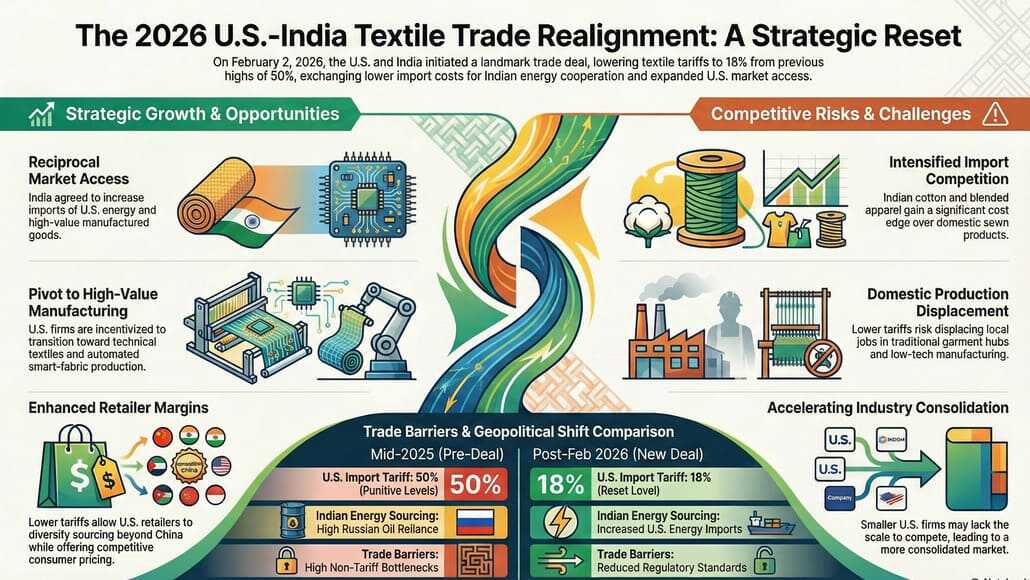

On February 2, 2026, the United States and India announced a landmark trade agreement that will reduce U.S. tariffs on Indian imports to 18%, a drastic shift from punitive levels that reached up to 50% in mid-2025. For the U.S. apparel and textile industry historically protective due to concerns over import competition this deal triggers both opportunities and structural challenges.
The U.S. textile and apparel sector is deeply tied to domestic manufacturing, labor markets, and geopolitical trade policy. This tariff reset comes amid broader pressures: supply-chain realignments, inflation headwinds, China-plus-one sourcing strategies, and shifting consumption patterns. The key questions for U.S. stakeholders are: Does reducing tariffs improve domestic competitiveness? Or does it intensify import competition at the expense of local jobs and capacity?
The Economic Logic Behind the Deal
From Washington’s strategic standpoint, the arrangement has several drivers:
1. Political and Strategic Alignment:
The tariff reduction was tied to India agreeing to halt purchases of Russian oil and increase imports of U.S. energy and manufactured goods. This aligns with U.S. geopolitical goals to reduce Russian influence and strengthen energy and defense trade ties.
2. Tackling Non-Tariff Barriers:
In addition to tariff cuts, the deal calls for reduced non-tariff barriers — regulatory, compliance, certification, and standards bottlenecks — that U.S. exporters have long cited as obstacles.
3. Broadened Market Access:
Lower tariffs incentivize U.S. manufacturers of intermediate textile inputs (e.g., machinery, fibers, chemicals) to engage in deeper trade with India, potentially boosting exports of high-value goods upstream in the supply chain.
Impacts on U.S. Textile & Apparel Manufacturers
While the headline a lower tariff on Indian imports might seem disadvantageous to U.S. domestic producers, a broader industry economic analysis reveals four key dimensions:
1. Competitive Imports vs Domestic Production
For years, U.S. textile firms have competed with cheaper imports from Asia (China, Vietnam, Bangladesh). Indian products especially cotton and blended apparel had an edge even at prior tariff levels due to quality and scale. With tariff reduction to 18%, Indian goods are now more cost-competitive than those from some peers.
However, 18% is still a meaningful duty and significantly higher than the tariffs facing apparel imports from Southeast Asia under certain trade programs (e.g., trade preference programs). This reduced but non-zero tariff might still preserve some domestic price buffer.
Net effect: Increased market share for Indian imports in the U.S., but domestic manufacturers retain some protection.
2. Domestic Input Costs & Supply Chains
U.S. textile manufacturing is heavily oriented toward technical textiles, specialty fibers, and advanced materials rather than mass garment assembly. These sectors may benefit from:
-
Cheaper intermediate imports from India.
-
Expanded two-way supply relationships (U.S. exports) into Indian production ecosystems.
This suggests more complex integration rather than pure import substitution.
3. Labor and Regional Production Dynamics
The U.S. textile and apparel industry employs tens of thousands in specialized roles. Lower tariffs on Indian imports might shift some demand away from domestic sewn apparel and volume textiles. However, a realistic transition will take years, and the industry could adjust by:
-
Focusing on high-value segments (technical textiles, protective fabrics).
-
Strengthening automation and advanced manufacturing.
-
Leveraging reshoring incentives outside traditional garment hubs.
The tariff reset incentivizes the U.S. industry to upgrade rather than directly compete on price, a structural shift requiring investment, training, and innovation.
4. Impact on Retailers and Consumers
U.S. retailers from fast fashion brands to major department stores are likely to welcome lower tariffs as it enhances margin or price competitiveness, especially in value segments. Lower costs could translate to:
-
Competitive pricing for consumers.
-
More diversified sourcing strategies beyond China and Southeast Asia.
-
Innovation in product lines due to cost savings.
Retailers may thus act as a bridge between import-centric efficiency and domestic production sustainability.
Broader Implications for the U.S. Textile Sector
Export Potential
The deal does more than reduce Indian imports it creates new export opportunities for U.S. textile machinery, industrial fabrics, and chemical inputs into Indian value chains. Companies in these niches may benefit disproportionately.
Innovation Pressure
To remain competitive, U.S. firms will need to increase investments in:
-
Smart textiles and functional fabrics.
-
Sustainability and circular supply chains.
-
Digitalization of manufacturing processes.
Strategic Risks and Concerns
1. Domestic Job Displacement: Partial loss of domestic sewn apparel production could occur if Indian imports significantly expand.
2. Industry Consolidation: Smaller U.S. textile firms might struggle to compete, accelerating consolidation.
3. Trade Policy Precedent: Questions remain about the long-term tariff framework, especially if political priorities shift.
Conclusion — A Nuanced Outcome
From the U.S. perspective, the tariff reduction to 18% is a strategic recalibration rather than a concession. It balances geopolitical interests, global supply-chain integration, and domestic industry resilience.
The key for U.S. textile and apparel stakeholders will be:
-
Reorienting toward high-value, technologically advanced segments.
-
Leveraging export opportunities created by reciprocal tariff reductions.
-
Collaborating with downstream partners for efficient supply networks.
In sum, this trade deal could represent a transition point — not a defeat for U.S. producers, but a call to elevate competitiveness in an increasingly integrated global textile market.