




























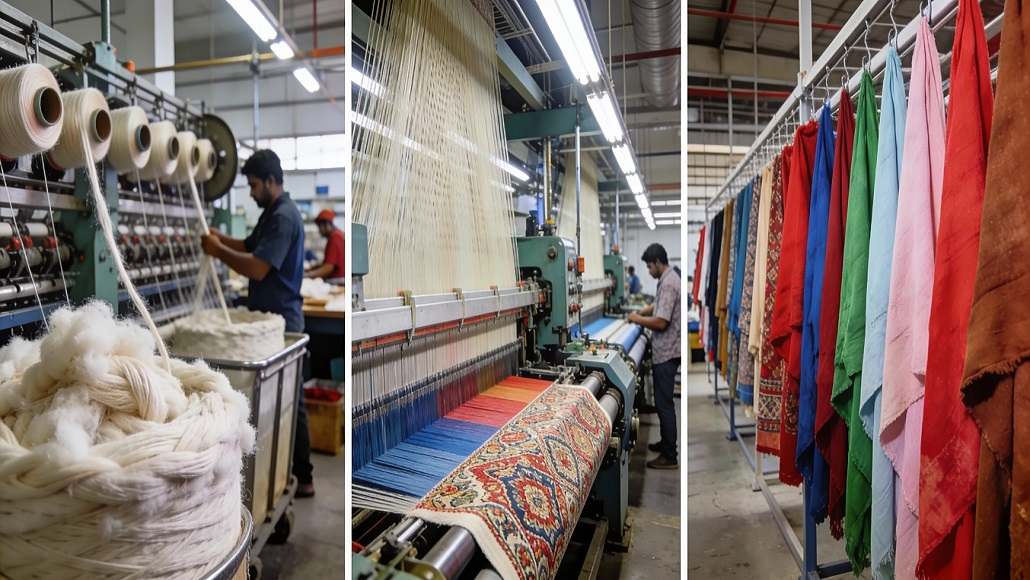

The textile industry operates across three interconnected yet distinct production stages-spinning, weaving, and processing each representing a specialized segment with unique technical requirements, equipment needs, and professional expertise. Collectively, these three fundamental types transform raw fibers into finished textile products ready for consumer use. Understanding these divisions provides essential insight into the global textile production process, highlighting why certain countries specialize in particular stages and how vertical integration across all three can create competitive advantages for major producers.
Overview of the Three Types of Textile Industry
The three types of the textile industry function sequentially, with each stage building upon the outputs from the previous one. Raw fibers produced in the fiber production stage enter spinning, where they are twisted into yarn suitable for fabric creation. This yarn then moves into weaving, where the interlacing of yarns forms the fabric. Finally, in the processing stage, finishing treatments, colors, and patterns are applied to create textiles that meet specific performance and aesthetic requirements. The sequential nature of these stages means disruptions at any point can significantly affect subsequent processes, making supply chain coordination critical to the industry’s efficiency.
Spinning: The Foundation of Yarn Production
Spinning is the first transformation stage in the textile production process, converting prepared raw fibers into continuous yarn that can be used for weaving or knitting. The spinning process encompasses several steps, including fiber preparation, cleaning, carding (to align fibers), drawing (to achieve uniform fineness), and finally spinning where fibers are twisted together to form cohesive yarn.
Modern spinning mills operate complex machinery capable of producing hundreds of spindles simultaneously, with varied yarn specifications based on fiber type, thickness, and twist. While often overlooked by consumers who focus on finished garments, the quality of yarn produced in spinning directly influences the fabrics created later. Spinning mills must maintain precise control over a host of variables, including fiber moisture content, machine temperature, spindle speed, and tension parameters, to ensure consistent quality. Advanced facilities employ computerized systems that monitor performance in real-time, adjusting variables automatically to maintain specifications and detect issues preemptively.
The spinning sector divides into two main types short-staple spinning, typically processing natural fibers like cotton, and long-filament spinning, which deals with synthetic fibers extruded from chemical processes. Short-staple spinning is more technically challenging, requiring precise fiber preparation and alignment, while long-filament spinning, though faster, generally lacks the versatility of natural fiber processing.
Developing nations, where labor costs are lower, dominate the global spinning industry. Countries like India and Pakistan excel in spinning cotton due to their substantial production, while China leads in synthetic fiber spinning, capitalizing on its petrochemical resources. Emerging players such as Indonesia, Vietnam, and Bangladesh are increasingly competitive, benefitting from geographic advantages or integration with larger textile complexes.
Weaving: Creating Fabric from Yarn
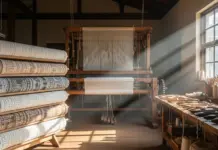
Weaving is the second fundamental stage in the textile industry, transforming yarn into fabric by interlacing two yarn systems at right angles. Warp yarns run lengthwise through the loom, while weft yarns are inserted perpendicularly, creating the interlocked structure that provides fabric strength and aesthetic characteristics.
The weaving industry boasts remarkable diversity in equipment and product types, ranging from basic plain weave structures to advanced jacquard looms capable of producing intricate multi-color patterns. Modern weaving facilities utilize computerized looms that can manage complex patterns and fabrics with minimal setup time. These technological advancements represent significant investments; state-of-the-art weaving mills often cost hundreds of millions of dollars to establish.
The geographic concentration of weaving reflects economic geography, with significant complexes in China, India, Vietnam, and Turkey. These countries benefit from integrated textile complexes where spinning mills feed directly into weaving operations, minimizing transportation costs and enabling tight supply chain coordination. Developed nations like Germany and Italy maintain specialized weaving segments focusing on high-count fabrics, technical textiles, and other premium offerings.
Processing: Finishing and Transformation
Processing, also referred to as finishing, represents the final transformation stage in textile production. It involves applying colors, patterns, and performance characteristics that determine the textile’s ultimate value and functionality. Greige fabric emerging from weaving is often plain and incomplete, lacking desired colors and features.
The processing stage encompasses several distinct operations. Dyeing applies color to entire fabric pieces by submersion in dye baths, achieving consistency while meeting fastness quality standards. Various printing techniques, such as screen printing, rotary printing, and digital printing, apply color in specific patterns across the fabric’s surface. Modern digital printing allows for virtually unlimited variations, facilitating rapid design iterations.
Chemical finishing applies treatments that impart specific performance characteristics, including water repellency or flame retardancy. Mechanical finishing includes operations such as heat setting to stabilize dimensions, calendering to adjust texture, and shearing or napping to create soft surfaces.
Increasing regulatory scrutiny surrounds processing due to water consumption, chemical usage, and wastewater. Many facilities are investing in closed-loop systems and effluent management solutions to reduce environmental impact. As brands increasingly demand documentation of sustainable practices, environmental responsibility becomes a business necessity.
Classification of Textiles: Fiber Type and Composition
Textiles can be classified through various frameworks, with fiber type representing a fundamental classification system. Natural fibers, such as cotton, wool, linen, hemp, and silk, derive from plant or animal sources. Cotton is the largest segment, prized for its comfort and breathability. Wool provides thermal insulation, while silk commands premium pricing for its luxurious feel. Linen emphasizes durability, and hemp appeals to sustainability-conscious consumers.
Conversely, synthetic fibers like polyester, nylon, and acrylic represent textiles created through chemical processes. Polyester dominates synthetic production due to its durability and low cost. Nylon is valued for strength and elasticity, especially in activewear, while acrylic mimics wool’s appearance. Regenerated cellulose fibers, including viscose and lyocell, bridge natural and synthetic categories, offering unique properties through chemical processing.
Blended textiles combine different fiber types to achieve superior performance characteristics. Cotton-polyester blends balance comfort and durability, while pure wool-synthetic blends maintain thermal benefits at reduced costs. Technical textiles may incorporate performance fibers such as spandex, optimizing stretch and functionality.
Types of Textile Design
The three main types of textile design printed, woven, and mixed media reflect different creative approaches.
Printed Textile Design
Printed textile design focuses on applying patterns and colors onto fabric through various printing techniques. This consumer-facing aspect of textile design directly influences garment aesthetics. Techniques range from traditional screen printing to advanced digital printing that enables rapid design evolution. Categories of printed designs include floral, geometric, and world cultures designs, each with unique consumer appeal.
Digital printing technology has revolutionized the field, allowing for intricate patterns and photographic imagery to be incorporated directly into fabric. This advancement has opened creative possibilities that alter how textiles are designed and marketed.
Woven Textile Design
Woven textile design creates distinctive fabric structures and textures through specific interlacing patterns of warp and weft yarns. Patterns originate from the weave structure itself, rather than being applied afterward. The simplest, plain weave interlaces yarns in a basic alternating pattern. More complex designs like twill and sateen enhance fabric texture and durability.
Advanced woven structures such as jacquard allow for intricate multi-color patterns and high-end decorative fabrics. These complex designs often require specialized looms and higher production costs, but their durability and intrinsic aesthetic qualities add considerable value.
Mixed Media Textile Design
Mixed media textile design employs embroidery, embellishment, and manipulation techniques beyond traditional weaving or printing. Techniques like embroidery add texture and complexity, while appliqué creates layered effects. Quilting combines fabric padding and stitching for dimensional surface results.
Additional techniques such as laser cutting and fabric manipulation can create intricate designs, often justifying premium pricing due to their labor intensity and need for specialized expertise.
Lean Manufacturing and the 5S Methodology
The 5S methodology, rooted in Japanese manufacturing philosophy, is increasingly adopted within the textile industry. The acronym stands for Sort, Set in Order, Shine, Standardize, and Sustain. When applied effectively, it enhances workplace organization and promotes continuous improvement.
- Sort (Seiri): Identifying and removing unnecessary items creates a workspace that facilitates focus on essential operations.
- Set in Order (Seiton): Organizing necessary tools and materials within logical locations improves efficiency and quick retrieval during production.
- Shine (Seiso): Regular cleaning and maintenance ensure equipment reliability and help identify potential issues early.
- Standardize (Seiketsu): Establishing standards for organized work ensures consistency and smooth operations across shifts.
- Sustain (Shitsuke): Maintaining adherence to established standards through audits and employee engagement secures long-term benefits of the 5S process.
Benefits of 5S Implementation
Implementing the 5S methodology in textile operations yields numerous advantages. Reduced search time enables quicker material location, enhancing productivity. Improved safety results from organized workspaces, while robust quality control mechanisms help in detecting anomalies early. Employee engagement increases as workers see their contributions lead to tangible improvements.
The Top Global Manufacturers in the Textile Industry
China: The Global Leader
China stands as the world’s largest textile manufacturer and exporter, commanding approximately 32-35% of global textile exports with annual values reaching $267-303 billion. The country benefits from integrated textile complexes that streamline production stages, improving supply chain efficiency.
China’s dominance stems from significant government investment in infrastructure and textile development. Chinese companies have embraced automation and advanced technology, maintaining competitiveness despite rising labor costs.
India: Expertise and Production Scale
India ranks second in textile manufacturing, with exports exceeding $36 billion. The country excels in natural fibers, particularly cotton, due to extensive local production and cultural heritage in textiles. Indian textile mills feature considerable spinning and weaving capabilities, along with a growing processing industry focused on quality.
India’s competitive edge lies in its emphasis on premium quality and efficiency, indicating potential for increased global market share.
Vietnam: Growth in Apparel Production
Vietnam is the third-largest textile exporter, with annual exports exceeding $41 billion. The nation benefits from geographic proximity to raw material sources and a growing production capacity that includes integrated textile-apparel operations.
Reputation for reliable, high-quality production has attracted significant foreign investment in Vietnam’s textile sector. The country’s exports continue to grow as they move into higher-value segments while maintaining strong performance in volume production.
Conclusion
The three types of textile industry spinning, weaving, and processing play crucial roles in transforming raw fibers into finished products. Understanding these stages provides valuable insight into the logistics of global textile production. Countries like China, India, and Vietnam lead the industry, each leveraging unique advantages that make them formidable players in the textile market. As the textile industry continues to evolve, integrating lean practices and innovative designs will remain essential for maintaining competitiveness in a rapidly changing landscape.