



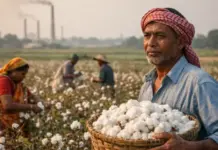





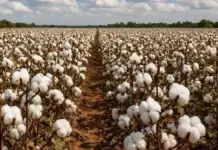




















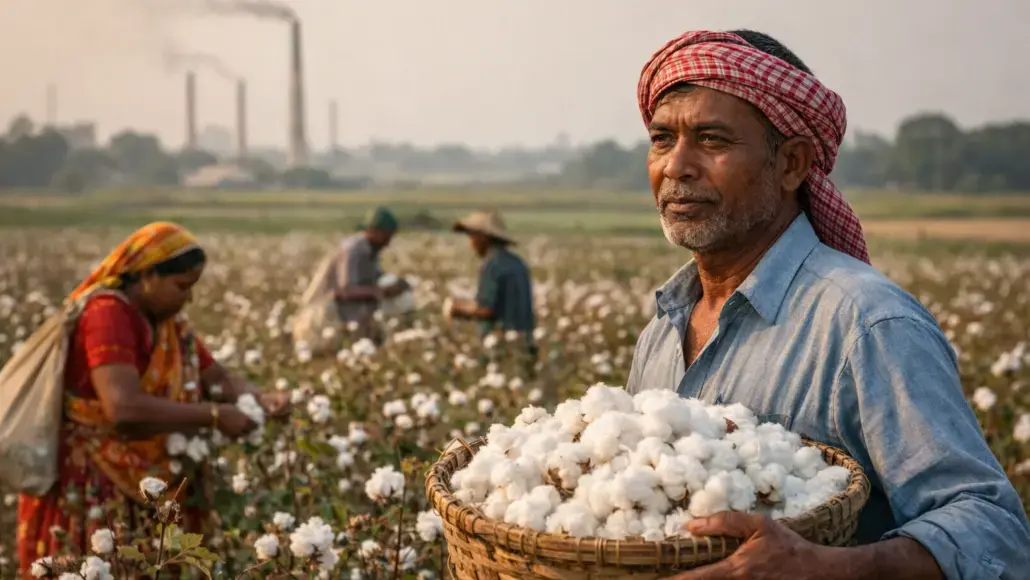
Bangladesh has unveiled a sweeping plan to increase domestic cotton production more than eightfold — from the current 224,000 bales to 1.9 million bales by 2050 — as the country moves to reduce its near-total dependence on imported raw cotton for its textile and apparel industries.
The government-backed roadmap, developed by the Cotton Development Board (CDB), calls for expanding cotton cultivation from 39 to 53 of the country’s 64 districts. The plan is structured across short-, medium- and long-term phases, with interim targets set for 2029 and 2040.
A Phased Roadmap for Cotton Cultivation Growth
The CDB has charted a clear production timeline: 500,000 bales of lint cotton within the next four years, one million bales by 2040, and the full target of 1.9 million bales by 2050. Lint cotton refers to the clean, raw fibre separated from cotton seeds following the harvesting process.
CDB Executive Director Md Rezaul Amin confirmed the scope of the initiative in remarks to the state-run Bangladesh Sangbad Sangstha. “We have taken short-, medium- and long-term plans to boost cotton production” by around 8.5 times, he said, referring to the planned expansion of cotton cultivation across additional districts.
The long-term target also includes expanding the total cultivation area to 200,000 hectares. Districts identified for expansion include Moulvibazar, Habiganj, Cumilla, Chandpur, Noakhali, Lakshmipur, Barishal, Bhola, Barguna, Chattogram, Feni, Cox’s Bazar and Nilphamari, among others.
The Weight of Cotton Imports on Bangladesh’s Economy
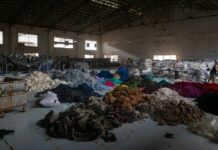
Bangladesh ranks among the world’s leading exporters of ready-made garments, yet remains almost entirely reliant on imported raw cotton to sustain its textile and apparel industries. The country is simultaneously one of the world’s largest cotton importers, with annual demand estimated at close to eight million bales.
Domestic cotton production currently meets only three to four percent of total national requirements, though locally grown cotton covers approximately 18 to 20 percent of fibre used in manufacturing fabrics for the domestic market.
Official figures show that Bangladesh spent Tk 80,000 crore — equivalent to approximately $6.51 billion — importing 7.3 million bales of raw cotton and yarn during the 2025–26 fiscal year. The scale of this import expenditure has intensified government focus on developing a stronger domestic raw material base.
Expanding Cultivation Across New Agricultural Frontiers
The CDB’s expansion strategy targets land that has not traditionally been used for cotton cultivation. Plans include promoting cotton farming on elevated riverine islands — known locally as chars — in the northwestern Barind region, on suitable hilly terrain, and on comparatively less fertile or low-productivity agricultural land. Saline and drought-prone zones have also been designated as potential production areas.
Bangladesh currently produces two varieties of cotton: upland cotton and hill cotton, each suited to different soil conditions. CDB officials noted that cotton cultivation could also be introduced alongside vegetables, pulses and spices within orchards, providing farmers with additional options to diversify income.
Political and Parliamentary Momentum
The initiative gathered traction following a September 13 meeting between Prime Minister Tarique Rahman and officials from the Ministry of Agriculture. At that meeting, the CDB was directed to prepare a detailed proposal after assessing the country’s full potential for expanding cotton cultivation.
Three days later, the parliamentary standing committee on the agriculture ministry issued a recommendation for swift and effective measures to raise domestic cotton output and reduce the significant financial burden of cotton imports.
Cotton as a Profitable Cash Crop for Farmers
CDB officials have highlighted both the economic and environmental case for expanding cotton farming. Dr Md Gazi Golam Mortuza, a soil nutrition and water management specialist at the CDB, described cotton as one of Bangladesh’s most profitable cash crops, particularly given the decline of jute cultivation in recent years.
“No other crop in the country is now as profitable as cotton,” he said, noting that higher production could improve farmer incomes while simultaneously reducing cotton imports. According to Mortuza, cultivating cotton on one bigha of land costs approximately Tk 15,000, with farmers able to earn Tk 60,000 by harvesting 15 maunds of raw cotton — one maund being equivalent to 37.32 kilograms.
Mohammad Mofazzal Hossain, a senior ginning officer at the CDB, also pointed to soil health benefits that cotton cultivation can bring, particularly in areas where continuous farming of the same crop — such as maize — has caused soil degradation over time.
Staffing Gaps Pose a Challenge to Implementation
Despite the ambition behind the expansion plans, the CDB faces a significant internal challenge: a serious shortfall in technical staffing. The organisation currently employs 483 people against 864 approved positions — a gap that officials acknowledge could complicate the effective rollout of the programme. Recruiting additional technical specialists has been identified as a necessary step before the cotton cultivation targets can be fully pursued.
A History of Cotton Development in Bangladesh
Bangladesh’s efforts to develop domestic cotton production stretch back to the period immediately following independence. The Cotton Development Board was established in those early years to help meet the raw cotton needs of local textile industries. The country’s first cotton was grown in the Rangpur region in 1976.
In 1978, during the government of President Ziaur Rahman, Bangladesh imported cotton seeds from the United States for the first time and began expanding cotton research. By 1980, the government had established the Cotton Research Center and Seed Production Farm at Jagadishpur in Chowgacha upazila of Jashore district.
Institutional growth continued in 1994 under former Prime Minister Begum Khaleda Zia, when three major CDB farms were renamed as Cotton Research, Training and Seed Multiplication Farms and a separate Cotton Farm was established at Sripur in Gazipur district.
The latest roadmap builds on this institutional foundation, representing a renewed effort to expand the role of domestic cotton cultivation in Bangladesh’s agricultural economy while reducing the Bangladesh textile industry’s dependence on foreign suppliers.
Achieving the targets will require expanding cotton cultivation into suitable new territories, strengthening research capacity, and filling the technical workforce gaps that currently constrain the Cotton Development Board’s operational ability.