
























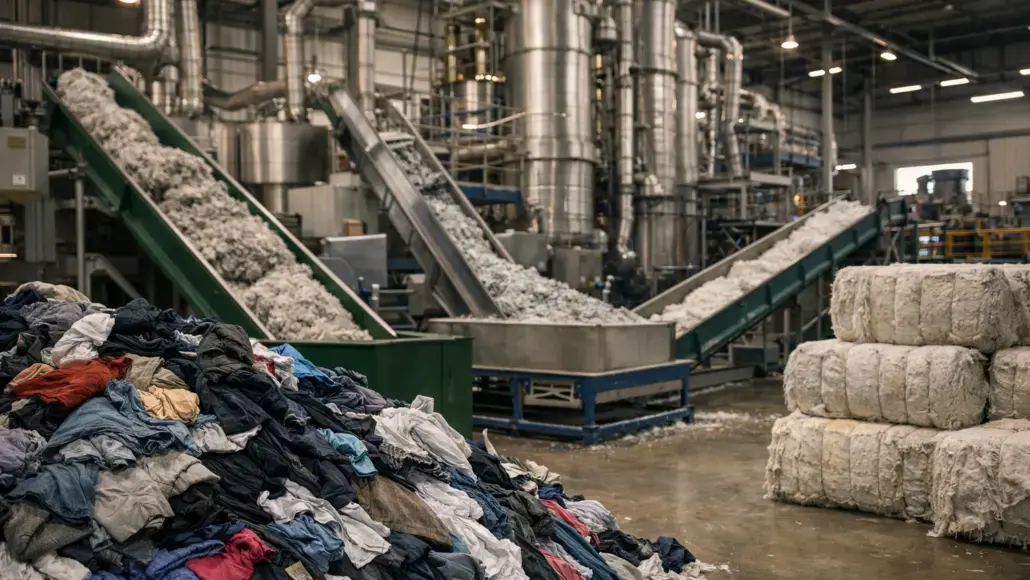
For years, fashion brands have talked about circularity. Yet turning that ambition into functioning industrial infrastructure has remained one of the sector’s most persistent failures. A newly announced partnership between U.S.-based textile recycling company Circ and Chinese advanced materials group Huafon is now putting that challenge directly to the test — at a scale the industry has rarely seen attempted before.
New Regulatory Pressures Are Forcing the Industry’s Hand
The timing of the announcement is tied closely to shifting regulatory conditions in Europe. The European Union’s rules restricting the destruction of unsold apparel came into effect for large companies this year, and its revised Waste Framework Directive now requires member states to establish extended producer-responsibility systems for textiles. These policies do not automatically build a functioning recycling industry, but they raise the financial stakes for brands considerably: what happens to products that cannot be sold, reused, or repaired?
That question is becoming harder for fashion companies to sidestep, and it is increasingly directing investment and partnership decisions toward textile recycling solutions that can operate at commercial scale.
Circ and Huafon: A Partnership Built for Industrial Scale
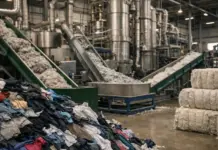
Circ, which began operations in the United States and has started the permitting process for a facility in France, has now announced a multi-phase textile-to-textile recycling project in China in partnership with Huafon. The first phase of the China facility is designed to process approximately 200 metric tons of textile waste per day.
Circ’s technology targets cotton-polyester blended fabrics — one of the most commonly used material combinations in the apparel industry and one of the most difficult to recycle. Polyester and cotton are blended widely because the combination offers durability, affordability, and versatility. However, most existing recycling systems work best with single-material or polyester-heavy inputs. Cotton-polyester garments typically end up downcycled, incinerated, sent to landfill, or routed into an opaque global secondhand market.
Circ’s process is designed to separate the two materials from blended garments and convert them into inputs for new polyester and new cellulose-based fibers such as lyocell. That output has clear industrial relevance, since polyester monomers can enter established polymerization lines and cellulosic pulp can feed viscose and lyocell production — integrating into manufacturing systems that already exist rather than requiring an entirely new industrial ecosystem to be built around them.
Why China Is Central to This Initiative
China is among the world’s largest centers for textile and apparel manufacturing. Peter Majeranowski, co-founder and chief executive of Circ, has stated that China’s position in global textile production makes it a critical location for scaling textile-to-textile recycling. Keeping fiber-to-fiber recycling confined to small demonstration facilities makes it structurally difficult to reshape the supply chains responsible for producing the majority of the world’s garments.
The choice of China for this scale-up is therefore not incidental. It is directly tied to where the feedstock is generated, where the manufacturing infrastructure already exists, and where the recycled outputs can most efficiently re-enter production.
What Huafon Brings Beyond a Manufacturing Site
What distinguishes this partnership from typical recycling announcements is the depth of what Huafon contributes. The company is investing directly in the project and brings existing chemical production facilities, engineering and procurement systems, logistics networks, operating teams, and established relationships across China’s textile industry — resources that early-stage recycling ventures typically lack.
Huafon also owns Covation Biomaterials, formerly DuPont’s biomaterials business, which provided the group with experience commercializing bio-based materials including Sorona, a partly corn-based performance fiber used in carpeting and apparel. That commercial experience was a material factor in Circ’s decision to work with them.
Feifeng You, vice president of Huafon Group and chairman of Huafon Microfibre Shanghai Tech Co. Ltd., noted that Circ had already moved beyond laboratory scale, had materials in the market, and had accumulated meaningful operational and engineering data. You said the company had seen little comparable technology focused on cotton-polyester blends, even as polyester-to-polyester recycling continues to expand in China.
“By combining Circ’s innovation with our industrial strength and investment, we can turn textile waste into high-quality materials at a scale the industry needs,” You stated.
The Economics: Not Yet Settled, But a Five-Year Horizon
The partnership does not resolve the economic gap between recycled and virgin materials overnight. Low-cost virgin polyester remains tied to fossil fuel markets, and fashion procurement teams remain acutely price sensitive. Majeranowski has been direct on this point: Circ still needs scale to approach price parity with virgin materials and predicts it can reach that parity within five years of the first plant becoming operational.
You acknowledged that customers may accept a price premium during early commercialization but emphasized that long-term, widespread adoption will require recycled fibers to compete with virgin alternatives on both performance and cost. Plant utilization rates, energy costs, capital expenditure, feedstock quality, and operating efficiency will all determine whether that threshold is reached.
The broader industry dynamic that has held back textile recycling for years is well recognized. Investors want evidence that brands will commit to purchasing recycled materials before financing new facilities. Brands want reliable supply and competitive pricing before they commit to procurement. And recyclers cannot bring down costs without the production volumes those brand commitments would generate.
Circ’s Approach: Embedding Technology in Existing Infrastructure
Circ’s strategic response to that stalemate is to place its recycling technology inside an industrial partner already embedded in the market it wants to serve. Rather than building every operational capability from the ground up, the company can use Huafon’s existing chemical and materials footprint as the foundation for deployment.
Majeranowski described the current moment in textile recycling as a transition from the proving phase to the deployment phase. “Now, six, seven years later, they’re ready to deploy,” he said of the broader field. “What’s difficult is the industry is so non-concentrated. Even your biggest brand is responsible for less than 1% of what’s produced every year in textiles. So no one really wants to take the first step.”
He has also described the company’s evolving role in broader terms: “We’re not a technology company anymore. We’re a coordination company.”
Feedstock Remains a Critical Unsolved Challenge
Even with industrial infrastructure in place, the Circ-Huafon project faces an ongoing challenge that is not unique to this partnership: a reliable, organized supply of post-consumer textile waste. The apparel industry remains poorly structured around collecting, sorting, and routing discarded clothing into textile recycling systems. Mills, distributors, waste handlers, retailers, and consumers each control different segments of the chain, and most fashion brands are not currently equipped to aggregate their own waste at meaningful scale.
The new facility will require consistent inbound streams of cotton-polyester blended textiles to operate at the capacity its first phase is designed to achieve. How the partnership addresses feedstock procurement will be as consequential as the recycling process itself.
Industry Voices on the Broader Significance
Nicole Rycroft, founder and executive director of Canopy, noted that the Circ-Huafon collaboration arrives as both fashion brands and man-made cellulosic fiber producers are actively seeking materials that reduce their exposure to forest-derived inputs, fossil-based production, and volatile supply chains. “Partnerships between global suppliers and leading innovators is exactly the direction fashion brands need their supply chains to go,” she said.
Canopy’s modeling has found that reaching just 5% use of next-generation inputs in viscose production could unlock substantial savings for brands over the coming decade and set the sector toward far greater adoption by 2036. Whether those projections materialize will depend on whether projects such as this one deliver actual material to the market, not only promising samples.
A Real-World Test for Fashion’s Circular Ambitions
The central question this project poses is no longer whether cotton-polyester blends can be technically separated and reprocessed. Circ has already demonstrated that capability. The question now is whether a recycler, a chemical manufacturer, brands, and suppliers can coordinate quickly and effectively enough to build a functioning commercial market around the recycled output.
For an industry that has spent years announcing circular collections without building much circular infrastructure, the partnership between Circ and Huafon — and its China-based textile recycling facility — represents a direct test of whether industrial-scale circularity can move from concept to operation.