

























CHANDIGARH, India — Indian recycled-yarn manufacturer Usha Yarns Limited has secured a growth equity investment from the Fullerton Carbon Action Fund as the company prepares to expand production and strengthen its position in the global sustainable textiles market.
Managed by Fullerton Fund Management, the Fullerton Carbon Action Fund invests in established mid-market businesses across Emerging Asia that have the potential to accelerate decarbonisation. The investment provides Usha Yarns with capital to expand its recycled-yarn operations and respond to rising demand from international apparel and textile brands.
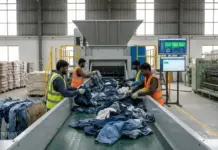
Founded in 1995, Usha Yarns operates recycling and yarn manufacturing facilities near Chandigarh. The company processes post-industrial cotton waste and recycled PET into yarn marketed under its Puneh brand.
Its yarns are coloured during the recycling process, allowing customers to reduce the need for subsequent dyeing. The company also maintains chain-of-custody systems and sustainability credentials supported by several international certifications and industry benchmarks.
The new funding will be used to increase recycled-yarn manufacturing capacity, strengthen traceability across its raw-material supply chain and expand the company’s customer base among apparel and textile brands in international markets.
Traceability becomes increasingly important
The investment comes as global fashion and textile companies face growing pressure to demonstrate where their raw materials originate and how recycled materials move through their supply chains.
For apparel brands, recycled yarns supported by verifiable sourcing and traceability are increasingly becoming an operational requirement rather than simply a sustainability differentiator. Usha Yarns is seeking to capitalise on this shift by expanding its production capabilities while maintaining consistent quality and traceability.
“Over more than two decades we have built deep expertise in turning textile waste into high-quality, affordable recycled yarns,” said Anurag Gupta, Managing Director of Usha Yarns. “Fullerton understood our business from the first conversation — not just the financials, but what it actually takes to produce recycled yarn at consistent quality and scale. We look forward to building the next chapter of Usha Yarns together — taking our products to more brands across global markets, with the traceability and reliability they increasingly expect.”
Fullerton backs expansion of recycled materials
Fullerton sees mechanical recycling as an area where additional capacity will be needed as apparel companies move from voluntary sustainability commitments towards more stringent material requirements.
“Mechanical cotton recycling at consistent, brand-grade quality is one of the hardest things to do in textiles, and Usha Yarns is among the very few that have demonstrated it, at scale. As global brands move from sustainability pledges to binding requirements, demand for recycled materials will outpace supply — and our role is to help Usha scale to meet it, adding capacity, broadening the product range and customer base, and backing the promoters with long-term capital, capabilities and networks to build an enduring, institutional-grade business,” said Akhil Jain, Partner at Fullerton Carbon Action Fund.
The partnership is expected to help Usha Yarns accelerate capacity additions while widening its product portfolio and international customer network.
The move also reflects a broader shift within the textile industry towards circular production models, in which post-industrial waste and recycled materials are increasingly incorporated into new products. For manufacturers, the ability to combine recycled content with consistent quality and reliable documentation is becoming increasingly important as brands face tighter sustainability and supply-chain requirements.
India’s recycled-yarn sector gains momentum
The investment strengthens the role of Indian manufacturers in the global recycled-textile supply chain. With international brands increasingly looking for recycled fibres and yarns backed by credible traceability systems, producers with established recycling infrastructure could benefit from expanding global demand.
For Usha Yarns, the priority will now be to translate the investment into additional production capacity, stronger feedstock traceability and wider access to global apparel and textile customers. Its focus on recycled cotton and PET yarns positions the company within a market expected to play a growing role in the industry’s transition towards circularity.