



























China’s textile industry is finding a new growth opportunity in the rapidly expanding humanoid robotics sector, where advanced fabrics and functional materials are becoming essential components of robot design. As humanoid robot manufacturers move toward large-scale production, demand for robot skin textiles is increasing, creating a new market for textile producers, material developers and sensor manufacturers.
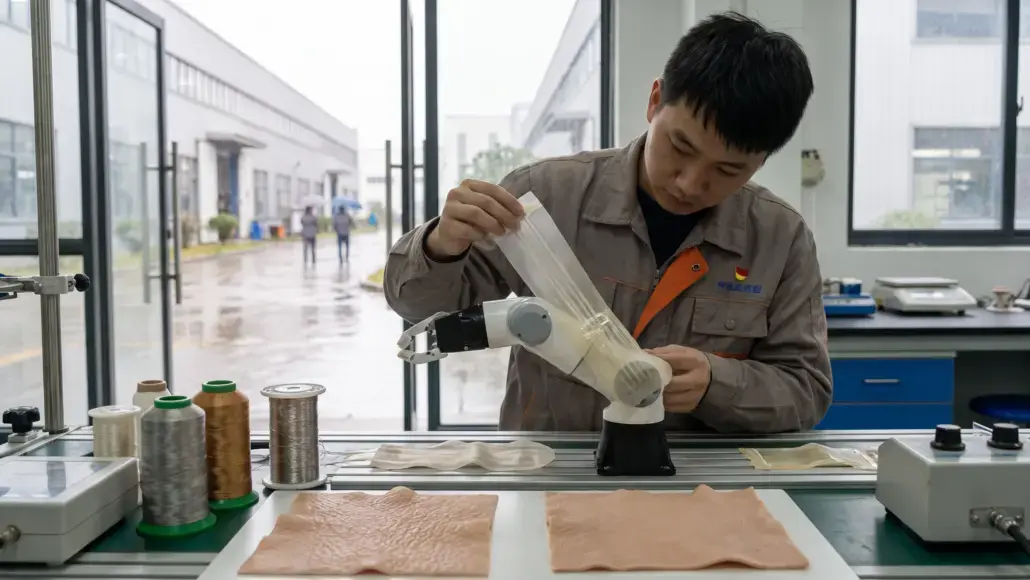
The trend is already visible in Jiangsu province, where a textile equipment manufacturer reportedly received 13,000 orders in a single month for specialised soft materials used in robot coverings. These materials are designed to conduct heat, reduce static electricity and cushion impacts—functions that go far beyond traditional textile applications.
Unlike conventional fabrics, robot skin textiles must be engineered to work around robotic joints and moving components. The materials need to combine strength, elasticity and flexibility while supporting heat dissipation and protecting internal systems. Frequent movement at shoulders, elbows and knees requires coverings that can bend repeatedly without losing performance.
The growing demand is closely linked to the expansion of China’s humanoid robot industry. Companies such as ENGINEAI, XPENG and Leju Robotics are establishing automated production lines capable of manufacturing robots at higher volumes. As production scales up, manufacturers require standardised materials that can be integrated into efficient assembly systems.
This shift is opening new possibilities for the textile sector. Textile manufacturers are adapting expertise in technical fabrics, coatings and functional materials to meet the needs of robotics. Advanced fibres, conductive fabrics and flexible composite materials are becoming part of a broader supply chain that includes electronics, sensors and automation technologies.
Flexible sensing layers are another area where textiles play an important role. Thin-film pressure sensors integrated into robot coverings allow machines to detect touch and adjust gripping force. Such technologies can enable robots to handle delicate objects and interact more naturally with people.
Industry observers believe robot skin is emerging as a distinct category within technical textiles. Suppliers are increasingly combining textile engineering with electronics and smart material technologies to create products designed specifically for humanoid robots.
As robot manufacturing moves toward mass production, consistency and quality will become increasingly important. Textile companies capable of delivering durable, high-performance and standardised materials may find new opportunities in this evolving market.
The rise of humanoid robotics highlights how the textile industry is expanding beyond traditional sectors into advanced manufacturing. By applying expertise in functional fabrics and material innovation, textile companies are helping shape the next generation of intelligent machines.