


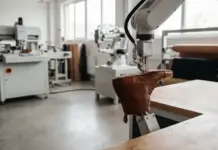


























The European footwear and leather technology sector stands at a crossroads shaped by rapid technological change, evolving customer expectations, and intensifying global competition. A new study conducted by Gherzi, commissioned by VDMA Textile Care, Fabric and Leather Technologies, offers a detailed look at where the industry is headed and what strategic decisions companies must make today to remain competitive tomorrow.
“The future of European footwear and leather technology will largely depend on how successfully companies combine automation, digitalization and new business models,” said Elgar Straub, Managing Director of VDMA Textile Care, Fabric and Leather Technologies. “The study identifies where the greatest opportunities for innovation and growth lie and highlights the strategic decisions companies need to take today.”
What the Gherzi Study Covers
The study examines the long-term development of three core markets: footwear manufacturing, automotive interiors, and leather goods. Its key focus areas span automation solutions, digital technologies, artificial intelligence, and new data- and service-based business models.
The analysis finds that European manufacturers can strengthen their competitiveness particularly through technological leadership, specialisation, and delivering high customer value. Connected production systems and digital services across the value chain are identified as increasingly important enablers of this competitiveness.
Beyond the traditional application fields, the study also points to meaningful growth potential in adjacent segments, including automotive interiors and leather goods, broadening the strategic outlook for companies operating within the footwear leather technology space.
Rising Demands on Machinery Suppliers
Changing customer requirements, shorter innovation cycles, and the accelerating digitalization of manufacturing processes are collectively raising the bar for machinery suppliers. The study makes clear that future success in this space will require integrated solutions that intelligently combine machinery, software, data, and services rather than treating these as separate offerings.
European machinery manufacturers are finding that speed of innovation, quality, application expertise, and proximity to customers are becoming decisive competitive differentiators. Companies that can effectively blend traditional engineering strengths with digital technologies and automation are well positioned to hold and grow their market standing over the long term.
Positive Economic Signals from VDMA TFL
The latest economic data from VDMA TFL points to a healthy growth trajectory for the sector. Between August 2025 and July 2026, order intake rose by 5.5 per cent in real terms compared to the previous year, while sales grew by 5.4 per cent over the same period.
The momentum was even more pronounced in the three-month window from May to July 2026, during which order intake climbed 14.3 per cent above the prior year’s level, while sales surged by 26.1 per cent — figures that reflect strengthening demand for footwear leather technology solutions across key markets.
Global Export Landscape in 2025
On the global market for footwear and leather technology, China remained by far the largest supplier in 2025, recording exports totalling €454.1 million (approximately $522 million). Italy followed in second position with exports of €245.6 million (approximately $282 million), while Germany recorded exports of €51.1 million (approximately $58.7 million), remaining largely in line with the previous year’s level.
Italy’s Key Export Markets
Italy’s most important destination for footwear and leather technology exports in 2025 was China, which received imports worth €25.5 million (approximately $29.3 million). France ranked second at €20.8 million (approximately $23.9 million), with Spain and the United States each accounting for approximately €16.7 million (approximately $19.2 million).
Germany’s Key Export Markets
German exports were primarily directed toward the United States, which accounted for €10.9 million (approximately $12.5 million), followed by Mexico at €6.8 million (approximately $7.8 million). France, Italy, Switzerland, and the United Kingdom also featured among Germany’s important export destinations in 2025.
The Strategic Imperative Ahead
The global competitive conditions for European machinery manufacturers have shifted considerably in recent years. The Gherzi study reinforces that the path forward for companies in the footwear leather technology space lies in combining automation, artificial intelligence, and digitalization with deep domain expertise and strong customer relationships. Those that can deliver integrated, intelligent solutions across machinery, software, data, and services will be best placed to capture the growth opportunities the sector presents.

