
























The global fashion industry is entering a decisive phase where aesthetics alone no longer dictate material development. In 2026, fashion’s influence on textile innovation is becoming deeper, faster, and more technologically integrated than ever before. Designers are no longer merely selecting fabrics from seasonal catalogs; they are actively shaping fiber engineering, material science, and manufacturing technologies from the earliest stages of development.
The fashion trends influencing fabric innovation in 2026 reflect a broader transformation across consumer behavior, sustainability regulations, digital commerce, climate adaptation, and artificial intelligence-driven design. Textile manufacturers worldwide are responding with fabrics that are smarter, lighter, regenerative, multifunctional, and emotionally engaging.
What makes 2026 especially significant is the convergence of luxury fashion, performance apparel, sustainability mandates, and digital technology into a unified material strategy. Fabric innovation is no longer isolated within technical textiles or sportswear. It now drives mainstream fashion, premium retail, and even fast-moving commercial collections.
Climate-Adaptive Fabrics Move Into Mainstream Fashion
One of the strongest developments shaping textiles in 2026 is the rise of climate-responsive fabrics. Consumers increasingly demand garments capable of adapting to fluctuating temperatures, humidity, and environmental conditions without sacrificing comfort or style.
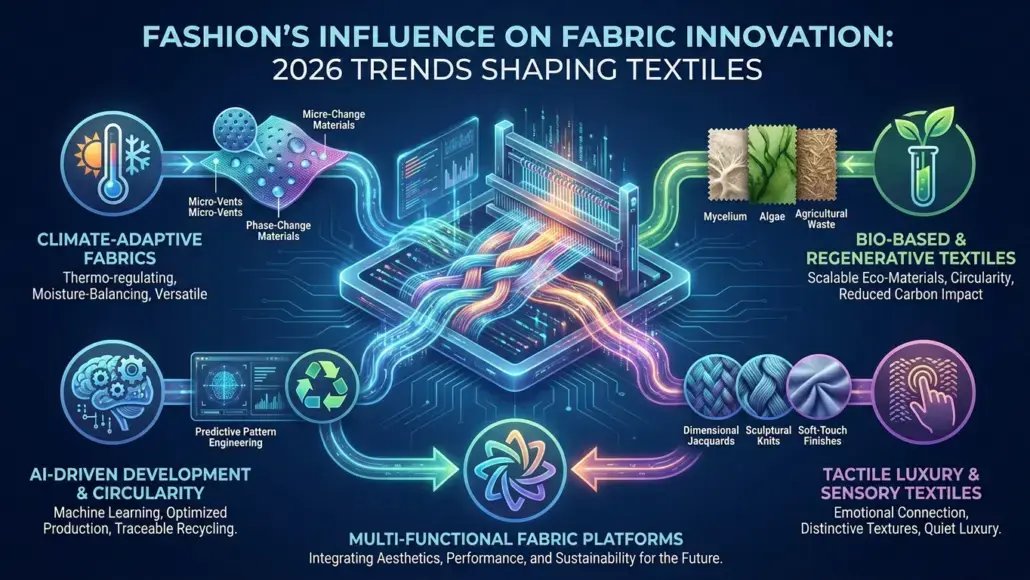
This shift is pushing textile manufacturers toward thermo-regulating fibers, moisture-balancing constructions, and phase-change materials capable of automatically adjusting insulation levels. Previously limited to sportswear and military applications, these technologies are now entering luxury fashion and everyday apparel.
Global fashion houses are increasingly designing collections around versatility. Consumers want fewer garments that perform across multiple situations — work, travel, commuting, and leisure. As a result, fabrics must deliver wrinkle resistance, breathability, odor control, and lightweight protection simultaneously.
Advanced synthetic blends are evolving alongside bio-based alternatives to meet these expectations. The market is witnessing greater investment in cooling yarns, adaptive knit structures, and breathable laminates that maintain aesthetic softness while improving technical functionality. Industry analysts note that smart textile research is accelerating rapidly as AI-enabled wearable systems become commercially viable.
Bio-Based Textiles Gain Commercial Scale
Sustainability continues to dominate textile development, but 2026 marks a shift from experimental eco-materials toward scalable industrial adoption.
The fashion industry is aggressively investing in bio-based fibers derived from agricultural waste, algae, fungi, fruit residues, bacterial cellulose, and regenerative crops. Mycelium leather, orange-peel cellulose, banana fiber, and pineapple-based textiles are no longer niche concepts limited to innovation showcases. They are becoming commercially integrated into premium collections and accessible fashion lines.
Fashion brands increasingly recognize that future competitiveness depends on reducing reliance on petroleum-based textiles while improving supply-chain transparency. European sustainability policies and circularity regulations are accelerating this transition globally.
Importantly, consumers are becoming more educated about material sourcing. Younger buyers now examine fabric composition, recyclability, biodegradability, and carbon impact before purchasing garments. This consumer awareness is forcing textile producers to innovate beyond traditional sustainability messaging.
In 2026, regenerative cotton, closed-loop viscose systems, recyclable polyester alternatives, and low-water dye technologies are becoming standard expectations rather than premium differentiators.
The growing demand for circular fashion ecosystems is also driving innovations in fiber traceability. AI-powered textile sorting systems and hyperspectral identification technologies are improving recycling accuracy and enabling higher-quality fiber recovery from post-consumer waste streams.
The fashion trends influencing fabric innovation in 2026 therefore extend far beyond design aesthetics; they are reshaping entire textile supply chains.
AI-Driven Fashion Is Reshaping Textile Development
Artificial intelligence is becoming one of the most influential forces in textile innovation. Fashion forecasting, material testing, digital prototyping, and consumer analytics are increasingly guided by machine learning systems capable of identifying emerging preferences before they reach the mainstream market.
AI tools now assist designers in predicting which textures, drapes, colors, and fabric performances will resonate with specific demographics and geographic markets. This reduces development risks and shortens production cycles significantly.
At the manufacturing level, AI-enabled systems optimize fabric cutting, weaving efficiency, and waste reduction. Some emerging technologies can reduce material waste by more than half through predictive pattern engineering and automated production planning.
The integration of AI with wearable textiles is also opening new commercial possibilities. Smart fabrics embedded with responsive sensors can monitor body temperature, movement, hydration, or physical stress while remaining lightweight and fashionable. Research in AI-driven wearable textiles suggests the boundary between garments and intelligent devices will continue to blur throughout the decade.
This convergence of fashion and intelligent materials is particularly relevant for sportswear, healthcare textiles, luxury travel apparel, and industrial protective clothing.
Tactile Luxury and Sensory Textiles Rise
Interestingly, while technology drives many textile advancements, 2026 fashion trends also reveal a growing consumer desire for emotional connection and tactile richness.
Minimalism is evolving into what many forecasters describe as “quiet sensory luxury.” Consumers increasingly seek fabrics that feel distinctive, comforting, textured, and visually dimensional. This trend is encouraging mills to develop three-dimensional jacquards, brushed surfaces, sculptural knits, engineered crinkles, matte-luster contrasts, and soft-touch finishes.
According to industry trend forecasts, tactile fabrics such as tulle, textured denim, sequined surfaces, and dimensional weaves are seeing growing popularity as consumers move away from purely minimalist aesthetics.
Luxury fashion is especially influencing this direction. Designers want fabrics that communicate craftsmanship, individuality, and emotional warmth while remaining commercially scalable. Advanced digital weaving technologies now allow manufacturers to create artisanal-looking surfaces with industrial precision.
This trend also aligns with the broader movement toward slower, investment-driven fashion purchasing. Consumers increasingly prefer garments with sensory depth and lasting emotional value rather than disposable fast-fashion pieces.
Circular Manufacturing Becomes a Competitive Necessity
In 2026, circularity is no longer simply an environmental ambition; it is becoming an operational requirement.
Fashion brands are demanding recyclable mono-material fabrics, modular garment construction, digital product passports, and traceable raw-material sourcing. Textile producers capable of supporting these requirements are gaining strategic advantages in global supply chains.
Digital product passports, expected to become more widespread under emerging European regulations, will allow consumers and retailers to trace fiber origins, production methods, repairability, and recycling pathways throughout a garment’s lifecycle.
Meanwhile, innovations in chemical recycling, fiber separation, and biodegradable elastics are addressing long-standing challenges in textile circularity. Textile innovators are particularly focused on replacing hard-to-recycle blended fabrics with alternatives that maintain performance while improving end-of-life recyclability.
The fashion trends influencing fabric innovation in 2026 are therefore accelerating the transformation from linear manufacturing models toward regenerative textile ecosystems.
The Future Belongs to Multi-Functional Fabrics
Perhaps the defining characteristic of 2026 textile innovation is multifunctionality.
Consumers increasingly expect a single garment to deliver style, comfort, sustainability, durability, and technical performance simultaneously. This demand is reshaping fabric engineering across every apparel category.
Fashion in 2026 is no longer divided between technical wear and luxury wear. The future belongs to hybrid textiles that combine both worlds — fabrics that look refined yet perform intelligently.
For textile manufacturers, this shift presents enormous opportunities alongside significant challenges. Mills capable of integrating sustainability, smart functionality, emotional appeal, and scalable production into a single fabric platform will define the next generation of industry leadership.
As global fashion continues evolving at unprecedented speed, textile innovation will increasingly determine which brands remain competitive in the years ahead. In many ways, fabrics themselves are becoming the central storytellers of modern fashion — carrying narratives of technology, sustainability, craftsmanship, and identity within every fiber.