























Benin, one of Africa’s largest cotton producers, has long exported nearly all of its raw cotton harvest to countries in Asia and the West, where it is transformed into fabrics, garments, and other high-value products. That deeply entrenched trade pattern is now being challenged by an ambitious initiative built around a special economic zone designed to process cotton domestically — from field to finished product — and in doing so, reshape the country’s economic trajectory.
The Vision Behind the Glo-Djigbé Industrial Zone
Roughly 40 kilometres from Cotonou, the capital of Benin, a sprawling industrial estate known as the Glo-Djigbé Industrial Zone is at the heart of this transformation. The project represents a deliberate effort to reverse a centuries-old economic model in which African nations export raw materials and import finished goods at far higher prices.
The zone is a joint venture between the government of Benin and Arise Integrated Industrial Platforms, a Dubai-based company experienced in building industrial parks across the region. According to Faki Adje, the deputy general manager of GDIZ, the project was conceived during the tenure of former President Patrice Talon, who served from 2016 to 2026 and whose personal fortune was built in the cotton industry.
“He wanted to change the paradigm of the economy of the country, to move it from exporting our raw commodities to Bangladesh and elsewhere and to add value to the commodities by processing them. That was the pillar of his idea for industrialisation,” Adje explained.
Benin cotton processing is central to this vision. The country produces between 650,000 and 750,000 tons of seed cotton annually, making it Africa’s largest producer of that crop. Cotton accounts for approximately 40 percent of the national GDP and 80 percent of its exports. Yet Benin lacked the industrial base and technical expertise to develop large-scale processing capacity on its own. Partnering with Arise IIP, which had previously developed an industrial zone in Gabon, the government formally established GDIZ in February 2020.
Scale and Structure of the Zone
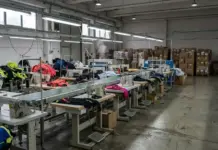
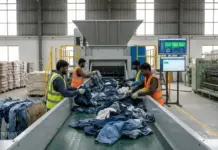
The park covers some 1,648 hectares and is being developed in three phases. The first 400 hectares have been fully developed, attracting around 40 investors. Nineteen factories are already operational, processing cotton, soya, beans, palm oil, cashew, chia, clay, and other raw materials into finished products destined for markets across the region and beyond.
The operating company generates revenue through services provided to investors, including electricity, gas, and optical fibre connectivity, along with development and management fees covering infrastructure construction, maintenance, and ongoing management.
To date, the special economic zone has attracted approximately €1.4 billion in investment. Investors have responded to a comprehensive package of incentives offered under Benin’s special economic zone regime. These include full exemption on imported equipment and commercial materials during the construction phase, corporate tax holidays ranging from 12 to 17 years, salary-tax exemptions, and guarantees enabling investors to repatriate revenues. The government also subsidises electricity within the zone, with the current tariff set at roughly $0.10 per kilowatt-hour and a target of reducing it to between $0.07 and $0.08.
Workforce Development Through an Unusual Incentive
One particularly distinctive measure supports textile manufacturing Africa has rarely seen at this scale. The government pays the salaries of workers under 35 during their first nine to twelve months, while they acquire the skills needed by factory operations. So far, 1,500 people have been trained through this programme.
“Some of them started as operators, and now they are supervisors; they are quality managers. They are smart, and we just need to identify them and give them the training,” Adje said.
This approach to cotton value addition through workforce development has helped build a pipeline of skilled workers essential for sustaining the park’s growth.
From Raw Cotton to Finished Garments
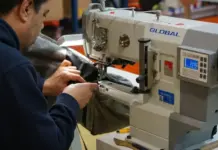
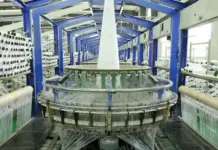
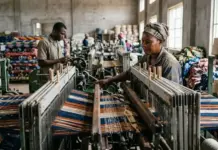
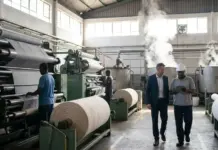
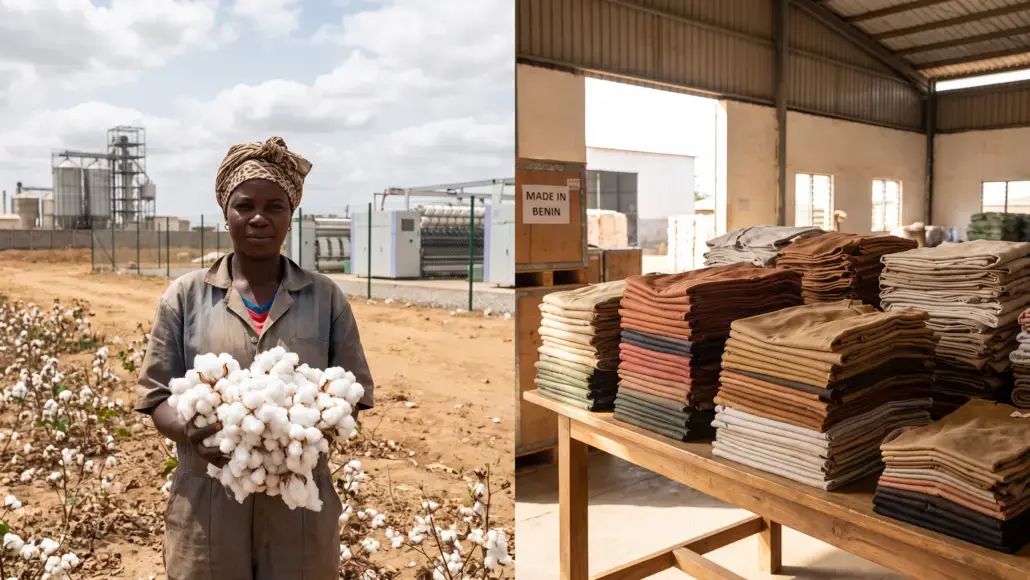
Raw cotton harvested from fields across the country is delivered to the park, where it passes through several companies and processing stages before emerging as clothes, bedsheets, towels, and other finished products. These goods are sold in shops across Benin and exported to markets in Africa, Europe, the Americas, and even South America.
Adje noted that approximately 30 percent of Benin’s cotton is currently being processed by three textile production operations within the zone — a significant achievement considering that textile manufacturing Africa-wide at this integrated level only began at GDIZ two years ago.
“We are working to be able to process all the cotton that we produce in the country,” Adje said, adding that the complete development of the textile ecosystem could generate up to 300,000 jobs. The target is to reach this milestone by 2030.
Competitive Advantages and Persistent Challenges
The zone benefits from several inherent strengths. Raw materials are plentiful and readily accessible. Geographically, West Africa is considerably closer to major consumer markets in Europe and the Americas than competing manufacturing centres in Vietnam, Bangladesh, or China. As Adje pointed out, “We are 15 shipping days away from Europe and America. Asia is 30-45 days away.” Additionally, as wages rise in traditional manufacturing hubs across Asia, Africa’s large working-age population could become increasingly attractive to cost-conscious manufacturers.
However, significant obstacles remain. Energy supply and infrastructure stand out as the most pressing constraints. “That is the only area in which Africa finds it difficult to compete,” Adje observed.
Beyond energy, global competitiveness requires markets large enough to support economies of scale, efficient roads, ports and shipping connections, workers and managers with the right qualifications, and trade rules that allow goods to move freely across the continent. Despite the aspirations embodied by the African Continental Free Trade Area, the reality of fragmented markets and trade barriers persists.
Global Brands and a FIFA World Cup Connection
Nevertheless, the park has already secured partnerships with major international brands. H&M, US Polo Association, and several European football clubs are outsourcing portions of their production to Benin Textiles and the Garment Training Centre based at GDIZ. In a notable achievement, FIFA selected the park to produce some of the jerseys for the 2026 FIFA World Cup — a development that underscores the zone’s growing credibility in textile manufacturing Africa has long aspired to develop.
African Industrialisation and the Obale Store Launch
Benin cotton processing for foreign brands is only one dimension of the broader ambition. In the last week of July, George Elombi, the president of the African Export-Import Bank, launched the Obale Store, a retail outlet dedicated to high-end fashion pieces produced within the park. The bank is a major financial supporter of the zone, and Elombi expressed confidence that Africa can capture a significantly larger share of the global textile industry, which is estimated to be worth $2 trillion by 2030.
“Under the vision we have set for the Bank, we are determined to move Africa from exporting raw potential to exporting finished value. As one of the world’s major cotton producers, Africa already holds the raw material advantage, making textiles a natural and strategic entry point for rapid value-added transformation,” Elombi said at the launch.
He went further, declaring that “Made in Africa, branded in Africa, owned in Africa, and distributed to Africa and to the world” is the ultimate ambition — a statement that captures the essence of the African industrialisation agenda that GDIZ embodies.
A Replicable Model for the Continent?
GDIZ is attracting attention from governments and institutions across the continent. In the week preceding the Obale Store launch, Kashim Shettima, the Vice-President of Nigeria, visited Benin to observe the zone firsthand.
The question of whether the model can be replicated elsewhere in Africa is one that Adje believes has a clear answer. He says it is entirely possible, but two conditions must be met. The first is that any similar initiative must be built around a country’s own comparative advantages. The second, and perhaps more difficult requirement, is political commitment.
“The strong commitment and willingness to make it happen,” he said, is essential — including the capacity to overcome vested interests that benefit from the status quo. This, he acknowledged, may ultimately prove the most difficult hurdle of all.
The Glo-Djigbé Industrial Zone stands as a compelling example of what cotton value addition and deliberate policy can achieve. Whether its success can catalyse a broader wave of African industrialisation will depend on whether other nations can summon the same combination of resources, partnerships, and political will that brought this special economic zone to life.