
























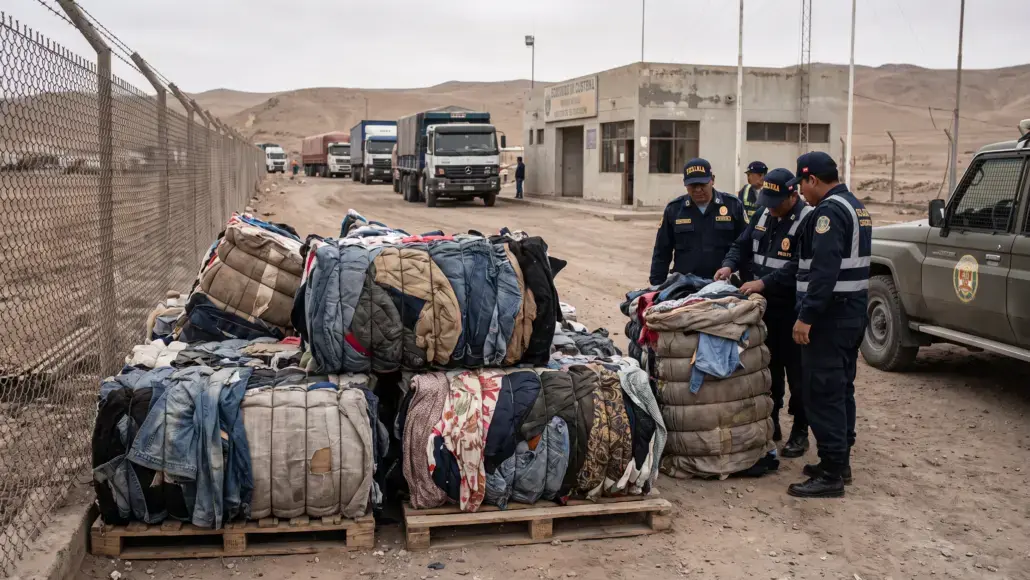
A new study has cast a sharp light on the illicit trade of used clothing flowing from Chile into Peru, revealing a sophisticated international criminal chain that involves smuggling, document fraud, corruption, and widespread environmental damage. The findings, prepared by the Institute of Criminology and presented by Peru’s Observatory against Illicit Trade (OLCI), are urging immediate legal reforms and a significant overhaul of customs infrastructure to address the growing crisis.
Chile at the Centre of South America’s Used Clothing Trade
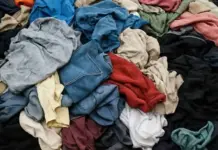
Chile has been identified as the principal entry point for used clothing into South America. According to data from the Central Bank of Chile, the country imported used clothing valued at $143.3 million in 2023 alone, with an annual average of 136,095 tons entering the country between 2021 and 2023.
Much of this clothing does not remain within Chile. The study, titled “The Supply Chain of Used Clothing in Peru: Trafficking, Smuggling and Pollution of Textile Waste,” reveals that a substantial portion is subsequently smuggled across the border into Peru — primarily through crossings shared with Chile and Bolivia — using cargo trucks, interprovincial buses, private vehicles, and other means of transport.
A Criminal Chain of 11 Links, 32 Activities, and 88 Tasks
The investigation did not stop at the border. OLCI’s findings confirm that the illicit chain extends well into Peru, where used clothing is stored, sorted, and distributed by organised networks of wholesalers and retailers. These networks exploit digital platforms, social media, and courier services to reach buyers across various regions, making enforcement considerably more difficult.
The Institute of Criminology’s Public Affairs Director, Nicolás Zevallos, detailed that the study maps an international criminal chain comprising 11 links, 32 activities, and 88 tasks, all involving networks engaged in illicit trafficking, document fraud, corruption, and illegal sales. The study further identifies 24 locations within Peru where used clothing is disposed of as waste, generating significant environmental impacts at multiple stages of the process.
Zevallos underscored a particularly alarming dimension of the investigation: “A key finding of our investigation is that in Peru there are no isolated routes for each type of crime. There isn’t one route exclusively for used clothing, another for illegal gold, and another for drug trafficking. They all share corridors and logistics operators. The same transport that brings in used clothing across the southern border can also bring in illegal mercury, weapons, or be used for human trafficking or cocaine. Logistics operators diversify their criminal activities in a complementary way.”
Disruption to Local Industry and the Environment
Beyond its security implications, the illicit trade of used clothing is causing measurable harm to Peru’s domestic textile and fashion industries. These sectors face unfair competition from smuggled goods that bypass tariffs, regulatory standards, and quality controls.
The environmental consequences are equally serious. Textile waste pollution stemming from unmanaged disposal of used clothing is aggravating environmental degradation across multiple regions, with the 24 identified dumping sites representing only the documented scale of the problem.
Ricardo Gutiérrez Rojas, President of the National Society of Industries’ (SNI) Commission for Combating Illicit Trade, was unambiguous in his assessment: “The study demonstrates that we are not facing an isolated informal trade, but rather an international chain linked to illicit trade, document fraud, corruption, environmental pollution, and dynamics associated with organised crime.”
What OLCI Is Recommending
OLCI’s recommendations are built around three core pillars. The Observatory’s principal call is to equip Customs with state-of-the-art risk management systems supported by digital tools and data intelligence — a direct response to the scale and sophistication of the used clothing smuggling networks identified in the study.
The second recommendation focuses on enforcement priorities. OLCI advocates for law enforcement agencies, the Public Prosecutor’s Office, and the judiciary to direct their efforts toward large-scale criminal operations rather than concentrating resources on informal market vendors, who represent the most visible but least significant part of the chain.
The third pillar involves local governance. The proposal calls on municipal governments to actively monitor and shut down outlets selling prohibited used clothing in line with existing municipal regulations.
Gutiérrez Rojas summarised the overarching message of the study: “The fight against illicit trade and the protection of the environment are one and the same agenda; the supply chain crosses multiple countries and jurisdictions, therefore international cooperation must be a pillar to face this problem.”
The conclusions drawn by OLCI make clear that customs modernisation, cross-border coordination, and a unified legal and environmental agenda are essential responses to an illicit trade network that has grown far beyond informal commerce into organised criminal activity.

