





























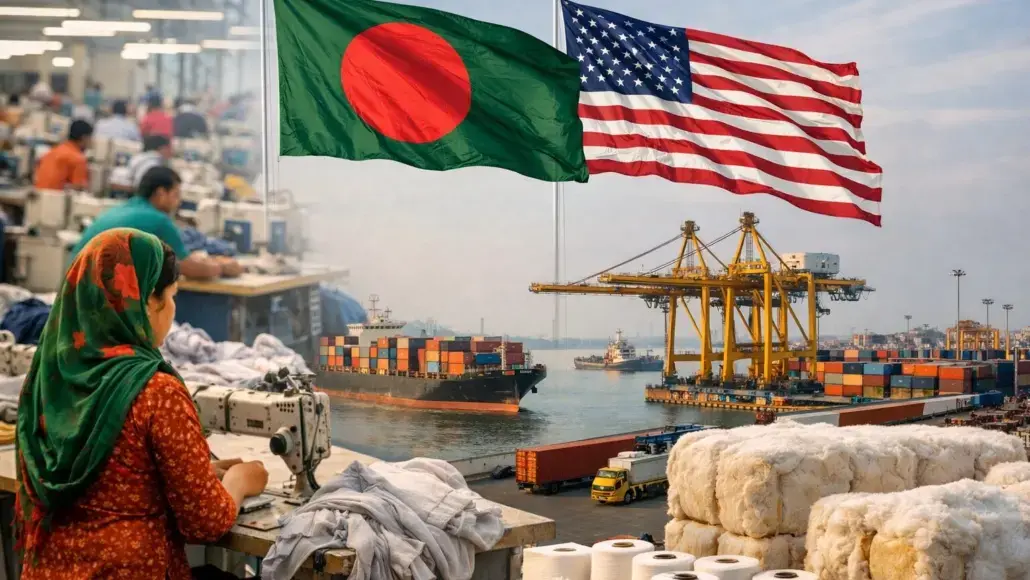
The average unit price of Bangladesh apparel exports to the United States declined by 2.26% year-on-year during the first seven months of 2026, as exporters were forced to absorb a portion of the additional tariff burden introduced by the Trump administration. The data, sourced from the US Office of Textiles and Apparel and cited by Bangladesh Apparel Voice (BAV), an independent intelligence hub for the Bangladesh apparel sector, points to mounting financial strain on manufacturers already dealing with rising production costs.
Export Value and Volume Also Take a Hit
Alongside the fall in unit prices, Bangladesh apparel exports to the US recorded a 6.50% decline in overall export value during January to July 2026. Shipment volumes fell by 4.34% over the same period. Notably, export prices dropped at a faster rate than shipment volumes, indicating that manufacturers were compelled to lower prices more aggressively than they reduced the quantity of goods shipped — a dynamic that has added pressure on already squeezed margins.
Tariff Regime at the Center of Price Decline
Exporters have directly attributed the decline in unit prices to the US reciprocal tariff structure. Prior to the introduction of reciprocal tariffs, Bangladeshi apparel entering the US market was subject to a most-favoured-nation tariff of more than 15%. In April 2025, the US administration imposed an additional 10% reciprocal tariff, which was subsequently raised to 20%. Although a US court later struck down the reciprocal tariffs, the Trump administration maintained a 10% tariff in their place.
During the period covered by the latest data, Bangladesh apparel exporters faced a 20% reciprocal tariff from January through March 2026, and a 10% tariff from April through June 2026.
Shovon Islam, Managing Director of Sparrow Group, explained the direct impact of this tariff regime on export pricing. “Exporters had to face part of the reciprocal tariff burden. As a result, we had to reduce apparel prices to some extent, which affected unit prices,” he told.
Burden Shared Unevenly Between Buyers and Exporters
The additional tariff burden was not distributed uniformly across the industry. In many instances, the cost was shared between US buyers and Bangladeshi exporters, with exporters absorbing roughly one-third of the additional tariff in some cases, and as much as half in others. To retain orders and maintain buyer relationships, many exporters agreed to offer lower prices, further compressing their profit margins.
Rising Production Costs Compound the Challenge
Mohammad Hatem, President of the Bangladesh Knitwear Manufacturers and Exporters Association, described the situation as increasingly difficult. “Production costs are rising continuously, but instead of increasing, product prices have declined,” he said. He noted that some factory owners have accepted orders at a loss simply to keep operations running and retain their workforce.
Hatem also pointed to operational challenges, including electricity and gas shortages, which have forced factories to rely on diesel at costs reportedly three to four times higher than normal. At the same time, buyers continue to demand lower prices, creating a squeeze from both ends. He warned that more factories could be forced to shut down if conditions do not improve.
Exporters Begin to See Signs of Recovery
Despite the difficult conditions experienced through the early part of 2026, exporters are now expressing cautious optimism. Shovon Islam indicated that the pressure to accommodate tariff-linked discounts has begun to ease, with US buyers no longer pressing for price reductions in the same manner as before. “We are no longer being asked by US buyers to provide discounts,” he said, adding that order volumes are on the rise.
He expressed hope that Bangladesh apparel exports to the US will recover in the months ahead, with better prices expected as market conditions stabilise and the tariff burden becomes more settled. For the broader Bangladesh apparel exports industry, the expectation is that the combination of easing discount demands and growing order pipelines will translate into an upturn in both unit prices and overall export revenue in the near term.