




















Most significant challenges faced by a brand in its production process often originate much earlier, upstream, within the product development phase – an area rarely categorized under risk. The seemingly simple silk slip dress offers a prime example. What appears straightforward on the design board – two bias-cut panels and minimal seams – frequently reveals complexities upon bulk fabric arrival. Seams can twist, and a hem that was perfectly true on the approval sample may drop unevenly because the bias-cut cloth continues to shift under its own weight. Furthermore, a deep jewel tone approved on a small swatch might return from the production dye lot a distinct shade off, rendering it a different garment in the context of luxury fashion. These issues are not factory errors; they are direct consequences of fabric decisions made months in advance, with the factory merely making these inherent properties visible.
The BSI’s MESH resilience survey indicated that over half, precisely 54%, of respondents experienced a major apparel supply chain disruption in the past year. This figure is often perceived as a judgment on logistics, encompassing ports, freight, geopolitics, and the broader push for resilience. From a brand’s perspective, disruption often appears as an external, unwelcome event. However, a closer look reveals a different reality.
Understanding Supply Chain Disruption from Within
From an operational standpoint, the landscape of disruption shifts. Mill lead times dictate the entire calendar, and the cut-and-sew floor simply inherits this schedule. The majority of what a brand classifies as a factory problem can be traced back weeks earlier to the product development stage, an area not typically flagged for risk management. This reframing offers a sharper perspective than the common understanding that “resilience is built upstream.” The premium-specific version highlights a crucial distinction: on signature fabrics central to a brand’s identity, the standard commodity playbook of diversification, dual-sourcing, and spreading exposure is fundamentally flawed. A signature fabric is the design; a second source often means a different garment entirely. For luxury fashion, seeking a second supplier can paradoxically introduce fragility.
Brands that effectively absorb shocks are not necessarily those with the most suppliers, but rather those that integrate risk management into their product development processes. When late orders are analyzed by their actual causes, the ranking is counter-intuitive: fabric-related issues constitute the single largest cause, accounting for roughly half of all delays. This includes extended mill lead times, dye-lot variations, and the necessity to re-dye deep-tone silks that fail to match approved samples. Factory scheduling and quality rework collectively form a clear second category. Surprisingly, customs and shipping – areas that typically generate the most industry anxiety – represent the smallest band of all. This prioritization of causes is even more pronounced in premium than in commodity apparel.
A high-volume program commits sufficient yardage to a single dye lot, allowing the mill to schedule it efficiently and absorb variance across the run. In contrast, a premium line operates against protective measures: small quantities, fabric-led design, the most demanding materials, and limited leverage at the mill. Thus, the fabric risk that scale dilutes in commodity production becomes highly concentrated in small-batch luxury fashion. This is not an isolated operational quirk; it is a structural cost inherent in how premium goods are made.
The Nuances of Fabric and Color
Consider the most exposed element in this breakdown: color. A lab dip approved on a small swatch can drift significantly during bulk production. Dyeing is a batch chemistry process, not a photocopier; factors like bath temperature, liquor ratio, and dyestuff lot all influence the final outcome, with deep jewel tones on silk being particularly susceptible. A shade deemed acceptable on a single meter can fail across two thousand. Worse, it might pass under a studio’s daylight lamp but fail under the warm LED lighting common in boutiques – a phenomenon known as metamerism, a structural oversight a brand cannot identify at the approval stage.
This deferral of risk has a specific anatomy. A fabric may be quote-confirmed in a proposal but still not be on the mill’s confirmed-stock list. A mill might confirm material quality but not a production slot for the required week; availability and scheduled run timing are distinct confirmations, only one of which secures the calendar. And a factory, facing a stalled supply, might quietly substitute a material that meets the specification sheet but lacks the desired “hand.” By the time any of these issues surface, it’s often six weeks too late, with substantial financial implications. A fabric chosen purely for its appearance on a mood board, without a confirmed mill, a realistic lead time, or a tested dye lot, is not a decision but a deferral with a photograph attached.
The equally challenging aspect of this problem, often overlooked in resilience literature, is not abstract geography but the specific fabric type. Commodity wovens and basic jerseys can be processed by dozens of interchangeable mills, offering a wide and forgiving supply corridor. However, the qualities defining a premium brand – fine-gauge jacquards, specific laces, cutwork, or specialty silks at precise weights – typically rely on a select handful of specialist mills. This constitutes a naturally narrow supply corridor. A lace mill, for instance, generally won’t produce a custom quality below its minimum yardage, silently restricting smaller fashion orders. This forces brands to over-buy to meet minimums, await shared dye runs, or forgo the quality entirely. This concentration is most acute for hero fabrics – those with no viable substitute and often no second source at all, such as mill-exclusive jacquards, specific silk “hands,” or a lace house’s proprietary pattern. For these, the effective risk management strategy within the apparel supply chain is not to thin relationships but to commit earlier – to greige, to yarn, to a booked production run – and for truly irreplaceable cloths, to hold stock.
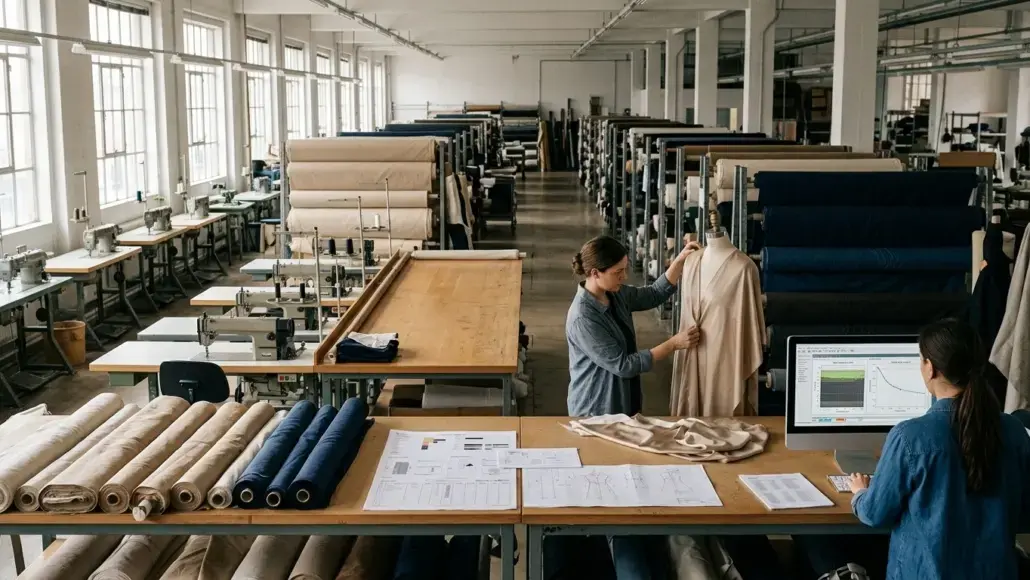
The handoff from product development to production is a critical fault line because a swatch differs fundamentally from a production run; the gap is physical, not clerical. A lace or jacquard struck off on a sample loom will behave differently on a bulk machine, where changes in gauge and tension alter its “hand.” A fine-gauge merino or cashmere knit might sample beautifully but fail on shrinkage and recovery at bulk. A bias-cut silk that measures correctly when flat will drop and twist once hung. Furthermore, a sample sewn by a skilled tailor with unlimited time merely certifies that an item can be made, not that it can be produced by a piece-rate operator – a completely different claim for intricate details like a hand-rolled hem or consistent smocking tension. Sampling is not a dress rehearsal; it is where the load-bearing decisions are actually made.
Development as Risk Management
To genuinely integrate risk management into product development requires separating two failure modes commonly bundled by the industry. Availability risk – where the cloth exists but arrives late – can be mitigated through earlier commitment and, where genuinely possible, a second source. Performance risk – where the cloth arrives on time but its hand, drape, shrinkage, or color is incorrect – cannot be fixed by a second source; it is hedged only by rigorously testing the bulk quality before approval. Confusing these two distinct risks leads to principled but ineffective action plans.
From this understanding, several practical steps emerge, none requiring new technology:
- Grade every hero fabric by its existence, not merely its appearance. The most certain option is cloth already in hand – held stock. Next is cloth a mill can confirm to a specific run date based on an existing relationship – booked. The least certain is cloth still to be sourced on the open market – open. The sampling clock should begin at sourcing, not after.
- Perceive your fabric corridor as an exposure, not merely a convenience. Map each hero cloth back to its specific mill, transforming hidden concentrations into deliberate choices.
- Ensure sample approval signifies production-readiness, not just photo-readiness. Approve samples cut from bulk-delivered cloth and sewn on the actual production line. This should be against a bulk lab dip checked under multiple lighting conditions, and accompanied by a wash-and-shrinkage test on the final quality – not just a swatch sewn by a master in the sample room.
- Shift timeline expectations upstream. The weeks that determine on-time order shipment are the product development weeks, not the cut-and-sew weeks. Applying late pressure on the factory cannot compensate for careless fabric decisions made early in the process.
None of these measures are glamorous. They represent the upstream, pre-production discipline that ultimately dictates whether a brand spends its future years firefighting or successfully shipping. The broader resilience conversation has historically focused on the visible end of the apparel supply chain – freight, ports, borders – because that is where disruption announces itself most overtly. However, the critical decisions that determine an order’s survival through challenging periods are made much earlier, in quiet rooms, over cloth and patterns, long before anything reaches a container. Therefore, the true test for enduring resilience is narrower than merely “building resilience.” The brands that exhibit genuine resilience will not be those that reacted fastest downstream; they will be the ones who meticulously separated availability risk from performance risk and graded every hero fabric before becoming enamored with it.