





























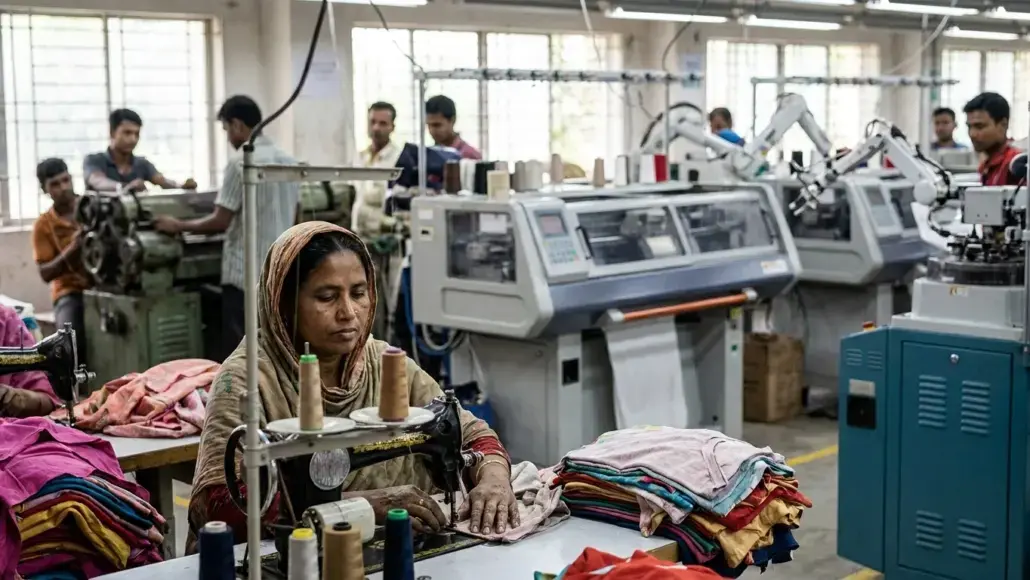
A recent study indicates that rapid technological adoption in Bangladesh apparel automation could displace nearly 1.22 million jobs by 2041 if not matched by parallel investments in skills, policy reforms, and worker protection. Women are projected to be disproportionately affected, with as much as 60 percent of existing female employment at risk as manual operations increasingly give way to automated production systems.
The warning arrives at a sensitive moment for the country, which is preparing for its graduation from least developed country status. The apparel industry has long served as one of its largest employers and a key driver of export earnings, making large-scale workplace disruption a matter of significant economic and social impact.
Labour Market Indicators and Education Disconnect
The broader labor market is already showing signs of strain. National employment shrank by approximately 1.3 million jobs in 2024, with female workers accounting for nearly nine out of every ten positions lost. While manufacturing output has continued to rise, total employment within the sector has remained virtually frozen at around 8.1 million workers.
To analyze potential future outcomes, researchers examined 27 domestic and global indicators to model labor market scenarios through 2035. Across varying assumptions, all scenarios pointed to consistent themes: rapid digitisation, escalating demand for higher-value skills, persistent skill shortages, vulnerability to international economic shocks, and the need for stronger institutional capacity to navigate the transition.
Vocational Education Deficit
The research highlights a growing gap between current educational output and industrial requirements. Technical and vocational education continues to attract under one-fifth of secondary-level students, while public expenditure on human capital development remains modest compared to the speed of technological change. Without improved workforce preparation, many workers may remain ill-equipped for the positions created by advanced manufacturing.
Balancing Modernisation with Worker Safeguards
The challenge extends beyond factory floors. Although technology is projected to generate millions of digital roles globally, it will simultaneously displace millions of traditional roles. In Bangladesh apparel automation, displaced workers face the risk of shifting into low-paying, informal, or gig-based positions offering minimal social protection.
However, the report notes that automation does not need to be viewed purely as a threat. Supported by modern vocational training, continuous reskilling programs, robust labor market data systems, workforce development incentives, and protection for vulnerable groups, technology could boost productivity while maintaining inclusivity.
Industry Initiatives and Future Outlook
Taking steps toward technological integration, Ha-Meem Group, a prominent domestic garment producer, signed a Memorandum of Understanding (MoU) with a robotics and automation firm. The partnership aims to accelerate Industry 4.0 adoption and prepare for AI and automation through three core pillars: workforce development, industrial automation, and strengthened industry-academia collaboration.
Ultimately, Bangladesh apparel automation functions as a double-edged sword. While it offers potential for greater operational efficiency and long-term industrial competitiveness, the absence of prompt policy measures and sustained workforce training could risk unravelling a major employment foundation.