


























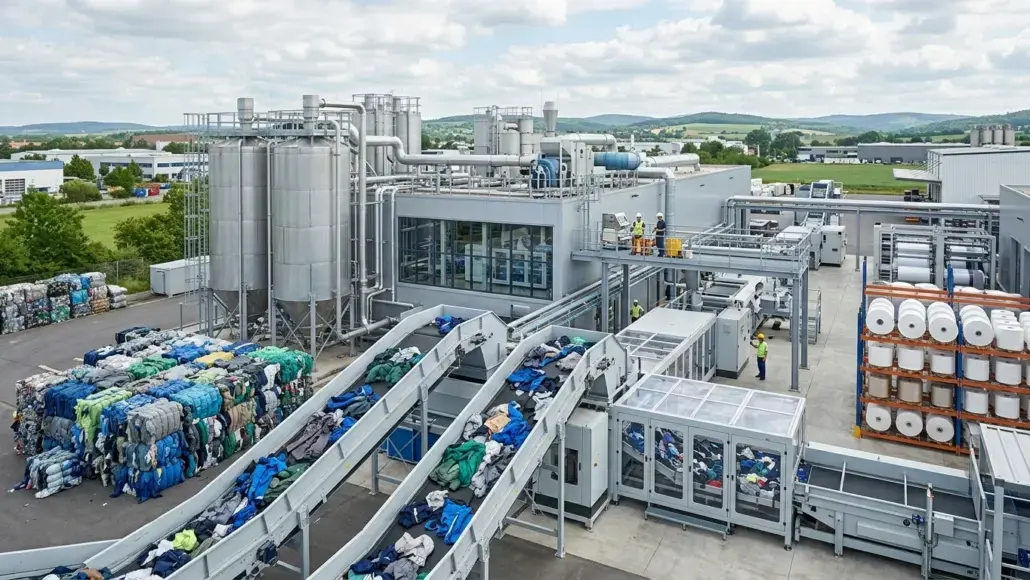
A research initiative supported by the German government is reporting a significant textile recycling breakthrough, addressing one of the most substantial challenges facing the textile sector. This advancement, if successfully scaled, promises to revolutionize how used workwear is transformed into high-performance textile products, thereby moving the textile industry innovation closer to full circularity.
Scientists involved in the project, known as TheKey, have announced the successful recovery of high-quality polyester raw materials from complex blended textile waste. Crucially, this was achieved under conditions that closely mimic industrial production environments. Polyester-cotton fabrics are ubiquitous in items such as workwear, protective apparel, and sportswear, valued for their durability and comfort. However, the efficient textile recycling of these blended materials has long been a hurdle. Traditional mechanical recycling often compromises material quality, while chemical processes can lead to undesirable material loss. Discovering superior solutions is paramount for fostering a truly circular textiles economy.
High-Quality Standards Achieved in Polyester Recovery
Funded by the German Federal Ministry for Research, Technology, and Space, TheKey project has specifically demonstrated the successful polyester recovery of its original constituent building blocks – terephthalic acid (TA) and ethylene glycol (EG) – from polyester-containing textile waste. The project team confirms that the recovered materials not only meet stringent industry quality standards but are also suitable for producing new polyester.
Diana Wolf, R&D manager in environmental and process engineering at Mewa, a key project partner, stated, “We have now established the groundwork for manufacturing high-quality PET fibers from used textiles.” This marks a crucial step in advanced textile recycling.
Scaling Technology for Future Circular Textiles
The proprietary process developed within TheKey project is currently undergoing further refinement. Efforts are focused on enhancing its robustness, reproducibility, and overall material recovery rates. The subsequent phase of the project will prioritize scaling this technology towards a continuous industrial operation, aiming for widespread adoption in circular textiles.
While the milestone of polyester recovery represents a major achievement, researchers are also actively engaged in efforts to recover cotton from these blended fabrics. Although cotton can presently be extracted, its quality is not yet deemed sufficient for direct re-entry into existing cotton production streams. By the project’s conclusion, the collaborating partners aspire to implement a comprehensive circular solution for polyester-cotton textiles. Their overarching goal is to facilitate the production of new PET fibers from the recovered polyester monomers and high-quality cellulose pulp derived from cotton, suitable for manufacturing new textile fibers, further demonstrating textile industry innovation. This commitment to sustainable workwear practices is at the forefront of their objectives.
Collaborative Expertise Powers Innovation
TheKey project is a collaborative effort involving eight partners, each contributing specialized expertise across textile technology, chemical engineering, and materials science. The consortium includes Mewa Textil-Service, JAKO, matterr, the Research Institute for Textile and Clothing at Hochschule Niederrhein, the Institute for Chemical and Thermal Process Engineering at Technische Universität Braunschweig, the Ifeu Institute for Energy and Environmental Research Heidelberg, Klopman, and Hero-Textil. Their combined efforts are driving this significant textile recycling breakthrough.