






























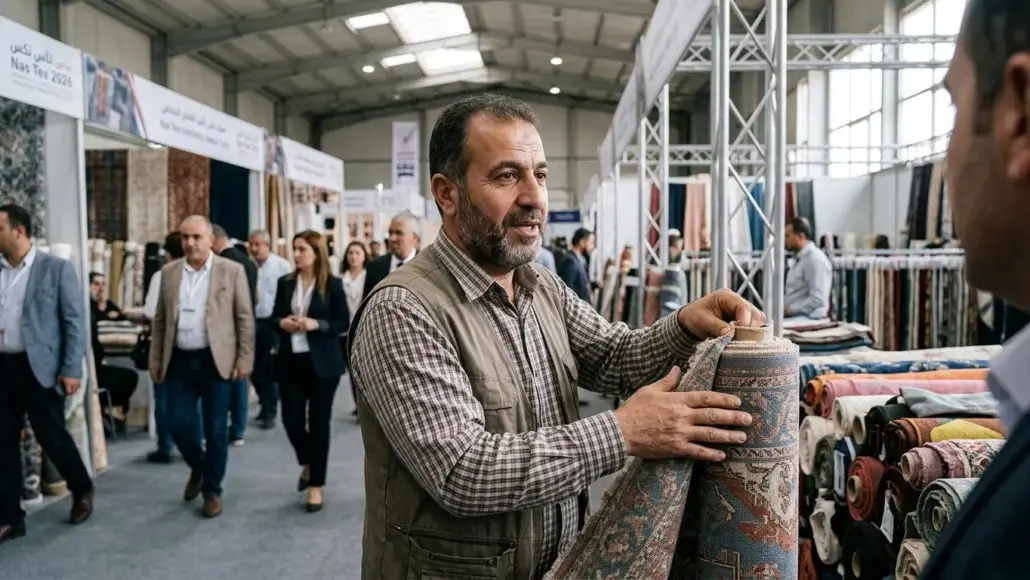
The industrial fairgrounds in Aleppo welcomed more than 300 companies from approximately 20 countries for the four-day Nas Tex 2026 exhibition. Government officials and business leaders framed the event as an initial step toward rebuilding the Syrian textile industry, which had suffered widespread destruction during years of internal conflict.
For decades, commercial centers in Aleppo and Damascus were recognized for high-grade fabric manufacturing. Syrian garment makers supplied domestic and international buyers across Arab and European markets, even producing fabric used for the wedding gown of Britain’s Queen Elizabeth II. The sector relied on locally grown high-quality cotton, a skilled workforce, and competitive pricing structures to drive Syrian textile exports.
The outbreak of conflict in 2011 severely disrupted these operations. Factory buildings were destroyed or heavily damaged, while skilled personnel and factory owners relocated to neighboring countries, taking production knowledge with them. Industry representatives previously alleged that manufacturing machinery from northern facilities was moved to Turkey, a claim Ankara has consistently denied. Raw cotton production, which stood at approximately 1 million tonnes per year during the early 2000s, declined drastically.
Comparative Cost Advantages and Labor Dynamics
Wissam Muhaysin, representing the textile equipment firm Sardaro Muhaysin, noted that regional industries in Turkey and Egypt grew significantly after 2010 due to the inflow of skilled Syrian workers. He emphasized that labor dynamics remain central to restoring textile production in Syria.
Muhaysin outlined current wage comparisons, stating that monthly minimum wages in Turkey stand at approximately $1,000 excluding benefits, while workers in China average around 5,000 renminbi ($800 to $900). By comparison, Syrian labor remains skilled yet significantly lower in cost with strong productivity levels. He added that geographic proximity to European and Gulf markets offers shorter shipping times and lower freight costs compared to suppliers in Asia.
Investments and Industrial Infrastructure Development
Syrian-Chinese Business Collaboration
Progress on infrastructure development was highlighted at the Aleppo industrial fair. Makram Shattahi, vice-president of the Syrian-Chinese Business Council, confirmed the signing of a twinning agreement with Suzhou Land Group. The partnership aims to develop the Sheikh Najjar industrial city in Aleppo, establish a specialized furniture industrial zone, and construct a technical training center for factory workers.
Shattahi noted that early signs of operational recovery are emerging, as investors who previously operated in Egypt and Turkey begin returning. Strong sales of machinery and production lines recorded during the Nas Tex 2026 trade fair indicate that numerous factory owners are preparing to restart manufacturing facilities.
Operational Constraints and Traditional Crafts Revival
Despite positive momentum, manufacturers continue to face operational hurdles. Hussam Othman, whose family has operated a clothing and fabric printing enterprise for nearly 70 years, explained that local yarn quality limits current output, requiring firms to import raw yarn primarily from India. High fuel and energy costs present ongoing challenges, while domestic consumption remains insufficient to sustain production without higher trade volume.
Efforts to restore historic crafts were also visible during Nas Tex 2026. Local producer Ahmed Dubeik displayed initiatives to revive silkworm breeding and traditional silk dyeing. Dubeik noted that work is currently conducted with manual machinery, adding that modern reeling equipment will be necessary to standardize product quality and support expanded Syrian textile exports.
Industry Statistics and Policy Framework
Official government statistics indicate that the country recorded over 24,000 textile facilities in 2024, accounting for nearly 19% of all industrial operations nationwide. However, only 56.8% of these establishments are currently active, leaving more than 10,000 facilities out of service.
Minister of Economy and Industry Nidal al-Shaar indicated that annual cotton yields could reach between 300,000 and 400,000 tonnes if sufficient investment is secured to reactivate dormant processing plants. Development efforts remain centered on three primary manufacturing zones:
- Sheikh Najjar industrial city in Aleppo
- Adra industrial zone in the Damascus countryside
- Hassia industrial city in Homs
The removal of Western sanctions earlier this year has lowered entry barriers for prospective foreign investors. With sanctions lifted, industry leaders anticipate the return of fully integrated production lines encompassing every stage from raw yarn spinning to finished textile manufacturing, reinforcing the overall recovery of the Syrian textile industry.

