




























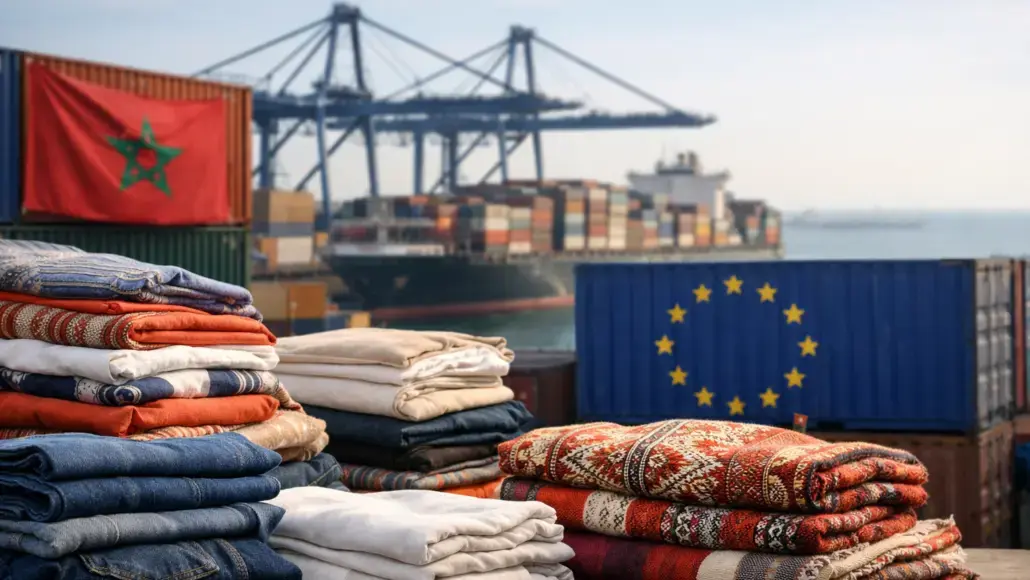
Morocco has recorded a strong start to 2026 in terms of its textile and apparel trade with Europe. The country exported more than €1.05 billion worth of textiles and ready-made clothing to European Union member states during the first five months of the year, securing its position as the eighth-largest supplier to the bloc. The figures were compiled by the Istanbul Apparel Exporters’ Association using data sourced from Eurostat, the official statistical office of the European Union.
Volume and Value of Morocco Textile Exports
In terms of shipment volume, Moroccan exports to the EU reached more than 40,000 metric tons between January and May 2026. To put this in context, full-year volumes stood at 111,000 metric tons in 2024 and rose to 114,000 metric tons in 2025, according to the same association data.
The value trajectory of Morocco textile exports has also shown consistent upward momentum over recent years. Exports to the EU surpassed €2.5 billion in 2024 and climbed further to more than €2.79 billion in 2025, reflecting sustained demand from European buyers for Moroccan-made garments and fabrics.
Market Share and Price Trends
Despite the growth in absolute export value, Morocco’s share of total EU textile and clothing imports experienced a marginal dip, moving from 2.8% in 2024 to 2.7% in 2025. That share held steady at 2.7% during the January–May 2026 period, though it represented a year-over-year increase of 3.3% compared to the same five months of the previous year.
One of the more notable developments in the data relates to pricing. The average price per kilogram of Morocco textile exports to the EU reached €25.90 during the first five months of 2026, up from €24.40 per kilogram in 2025 and €25.10 the year before. This upward pricing trend indicates a gradual shift toward higher unit-value goods within Moroccan export shipments.
EU Textile Imports Fall Sharply in Early 2026
The broader backdrop for these figures is one of declining overall EU demand for imported textiles and clothing. Total EU imports of textiles and clothing fell by 11.9% year over year during the first five months of 2026, dropping to €38.65 billion. This sharp contraction across the bloc’s overall import volumes gives added significance to Morocco’s ability to maintain and grow its export value during the same period.
Top EU Apparel Suppliers
Among the leading EU apparel suppliers, China retained its position at the top of the rankings with more than €11 billion in exports to the EU during the January–May 2026 period. Bangladesh followed in second place with €7.43 billion, while Turkey ranked third with €3.4 billion.
Turkey, however, faced a considerably more difficult period. Its exports to the EU fell approximately 15.8% during the first five months of 2026, and the country has shed 2.2 percentage points of its EU textile and clothing market share over the past two years. This decline has occurred alongside a wider market movement away from low-cost suppliers within the EU apparel import mix. Simultaneously, the average price of Turkish textile and clothing imports edged higher, rising from €20.40 per kilogram in 2025 to €20.80 during the first five months of 2026.
Breakdown by Clothing Category
Within the EU’s ready-made clothing import figures for the January–May 2026 period, women’s clothing accounted for the single largest category, with imports valued at approximately €9.5 billion. Men’s clothing imports, by contrast, declined 14% year over year, falling to €6.2 billion during the same period.
The overall picture from the Eurostat-derived data, as compiled by the Istanbul Apparel Exporters’ Association, shows Morocco textile exports holding firm and growing in value even as broader EU import volumes contract — a performance that reinforces the country’s established and growing presence among the EU’s key ready-made clothing and textile supply partners.