


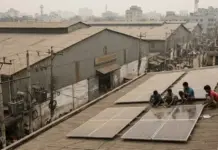




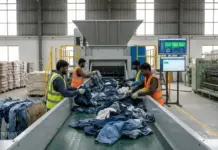
























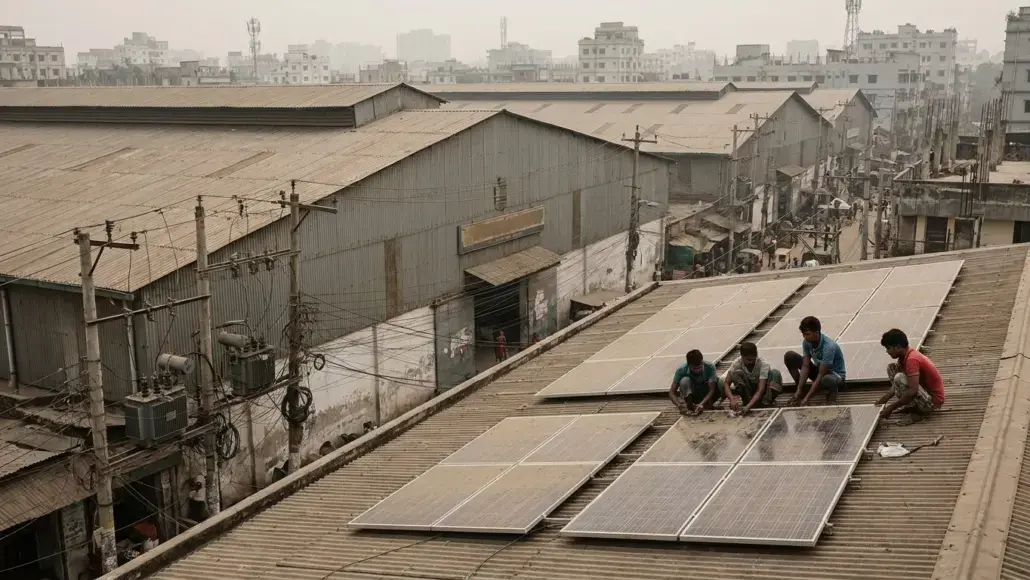
A new study has found that Bangladesh’s garment sector is significantly behind on its renewable energy commitments, with only 3 percent of electricity currently sourced from renewable energy — a stark contrast to the 35 percent target mandated by 2035 under global sustainability frameworks. High installation costs, limited rooftop space, and persistent policy bottlenecks are identified as the primary barriers holding the sector back.
The study was prepared by Mapped in Bangladesh (MiB) of the Centre for Entrepreneurship Development (CED) at BRAC University, based on a survey of 878 factories across Gazipur and Narayanganj. Its findings were presented at an event held at Sheraton Dhaka.
The EU Due Diligence Directive and What It Demands
The EU Corporate Sustainability Due Diligence Directive (CSDDD), which came into effect last year, requires garment factories in Bangladesh to generate 35 percent of their power from renewable energy sources by 2035 to maintain uninterrupted access to Western export markets. Global buyers are simultaneously tightening their sustainability requirements and increasing pressure on exporters to reduce emissions across their supply chains.
On the ground, the reality remains far removed from these expectations. The garment sector continues to lean heavily on conventional energy, with 61.5 percent of energy use coming from the national grid and 35.5 percent from captive generation. Only 3 percent currently comes from renewable energy, underlining how wide the gap remains with just under a decade to close it.
Key Barriers to Renewable Energy Adoption
The findings, presented by Md Faizul Islam, Senior Programme Manager, and ANM Ata Ullah, Lead Stakeholder Engagement and Collaboration Specialist, highlight a clear pattern of financial and structural obstacles.
Among the surveyed factories, 88 percent cited high installation costs as their primary barrier to renewable energy adoption, while 42 percent pointed to high maintenance costs. Around 28 percent noted a lack of awareness, 16 percent cited unfavourable policies, and 14 percent flagged limited space within smaller factory premises.
Adoption rates also vary significantly by geography. Renewable energy use stands at just 0.9 percent in Narayanganj, compared to 3.6 percent in Gazipur — a gap that reflects differences in factory size, infrastructure, and available rooftop area.
Rooftop Solar Potential Versus Present Reality
The study estimated total floor space across the surveyed factories at 155,065,398 square feet, of which approximately 9,073,089 square feet is available for rooftop solar installation. Given that one square foot of solar panel can produce around 1.10 kWh per month, the maximum potential electricity generation from available space is estimated at 69,862,278.5 kWh per month. This could reduce carbon emissions by approximately 9.84 percent.
However, physical constraints remain considerable. Only about 5.8 percent of total floor space is suitable for solar installation, and even full utilisation of all available rooftop space would meet only around 14 percent of the sector’s total energy demand under current efficiency levels.
The surveyed factories consume approximately 70.2 million kWh of electricity each month and produce an estimated 46.1 million kilograms of carbon dioxide emissions. The scale of the sector’s carbon emissions underscores the urgency of accelerating the shift toward renewable energy.
Around 80 percent of factories currently receive less than 1 percent of their total energy from renewable sources, and only 5 percent of factories source more than 10 percent. Larger factories show greater diversification in energy use, while small and micro factories remain almost entirely dependent on the national grid, with renewable energy use falling below 1 percent in these units.
Policy Recommendations from the Study
The study puts forward a series of recommendations to help the garment sector close the gap between current usage and the 2035 renewable energy target. It calls for the establishment of a dedicated green finance window for ready-made garment factories to access funding for rooftop solar and energy-efficient technologies. The study also recommends introducing energy grading for industrial equipment and developing factory-level energy and carbon reporting systems.
Additional recommendations include using carbon credits and carbon exchanges to finance verified emission reductions, forming an RMG energy transition taskforce, and creating an independent monitoring body to track sector-wide progress. The authors also advocated for decarbonising the national grid, enabling offsite renewable energy procurement, and promoting energy-efficient machinery. Reducing diesel dependency through hybrid systems, battery storage, and more efficient captive generation was also highlighted as a priority.
The study noted that Bangladesh is moving toward a more ambitious renewable energy transition through the Renewable Energy Policy 2025 and updated climate commitments, which include increased renewable energy generation and wider promotion of rooftop solar systems in industrial facilities. In this context, the ready-made garment sector is central to this transition, given its high electricity consumption and its critical importance to Bangladesh’s export earnings and industrial growth.
Industry and Government Response
Vidiya Amrit Khan, Vice-President of the Bangladesh Garment Manufacturers and Exporters Association, noted that 4.75 percent of electricity is currently generated from renewable energy sources within the sector. She added that reaching the 35 percent target by 2035 would not be unachievable, provided that adequate government policy support is included in the next national budget.
Power, Energy and Mineral Resources Minister Iqbal Hassan Mahmood called for duty waivers on the import of solar panels and related equipment, citing it as a practical measure to speed up renewable energy installation across the garment sector and help factories meet the 2035 deadline under EU due diligence requirements.

