



























Zara’s parent company Inditex recorded USD 46.3 billion in revenue and USD 7.2 billion in net profit for fiscal 2025, driven by a calculated shift toward higher-tier apparel and a deliberate move away from the price-war tactics favoured by ultra-fast fashion rivals. The Spanish retail group operated 5,444 stores across 215 markets as of July 2026, with the Zara banner contributing approximately 70 percent of group sales alongside Zara Home and the value-focused sub-brand Lefties.
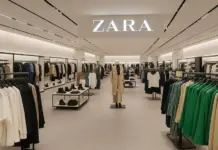
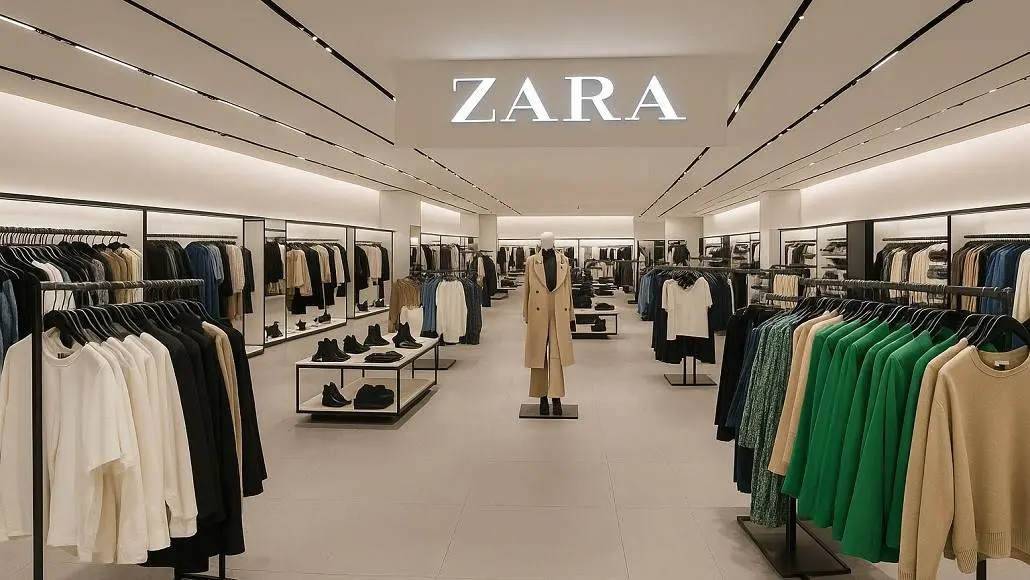
Total Zara store numbers stood at 1,487 locations by July 2026, a figure that reflects the group’s ongoing strategy of closing smaller outlets in favour of larger, high-capacity flagship locations that are purpose-built to integrate physical retail with online fulfilment logistics. The Zara family of labels also encompasses Zara TRF, Zara Studio, Zara SRPLS, and a dedicated beauty range that launched in 2021.
Zara Premium Strategy: Competing on Quality, Not Just Speed
Inditex chair Marta Ortega Pérez has steered the Zara brand toward premium fabrics and longer-lasting product lines, consciously ceding the lowest price points to cross-border e-commerce platforms such as Shein and Temu. The direction of this Zara premium strategy marks a shift in competitive positioning — away from raw production speed and toward greater flexibility and improved unit margins.
Supporting this approach is the value subsidiary Lefties, which operates across 223 stores and caters to budget-conscious shoppers without requiring Zara itself to compete on rock-bottom pricing. The group’s scale provides pricing leverage that smaller regional fast-fashion operators struggle to replicate. Long-term supplier contracts allow the company to procure higher-grade textiles at lower unit costs, while internal policies restrict markdowns to just two defined sale periods per year — an approach that helps protect full-price sell-through rates.
On Interbrand’s 2025 global brand rankings, Zara secured 41st position, ahead of Japanese competitor Uniqlo, which placed 47th. The group achieves approximately 85 percent of full ticket prices across its retail floors — a metric that underscores the commercial discipline embedded in its pricing model.
One structural challenge, however, is worth noting. The time required to move an entirely new design from concept through to store delivery has extended to five weeks, compared with the 15-day turnaround the group achieved in its early growth years. This widened production window creates an opening for digitally native competitors to capture younger shoppers during the gap.
Centralised Logistics and a Split Manufacturing Network
To support its Inditex global expansion and growing omnichannel commitments, the group has invested more than USD 1 billion annually across both 2024 and 2025 in warehouse capacity. The new Zaragoza II distribution centre was brought into service in 2025. A 200,000-square-metre design and operations hub opened in Arteixo in October 2025, consolidating women’s and children’s design teams under one roof.
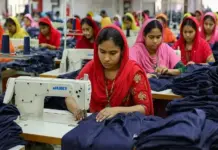
The group’s production network operates on a split-sourcing model. Roughly half of all manufacturing comes from suppliers located close to Spain — primarily in Portugal, Morocco, and Turkey — enabling faster replenishment of fashion-forward lines. Volume basics such as cotton T-shirts are sourced from a long-term supplier network spanning Asia, across a total of 6,684 vendor plants globally.
Trend teams based in Arteixo monitor market signals fed through satellite offices in Shanghai, Tokyo, and New York, using that intelligence to tailor stock allocations at a micro-market level. Japanese stores receive distinct size profiles, Middle Eastern outlets carry adapted womenswear assortments, and individual store inventories are calibrated to reflect local shopping habits. The central Ginza location in Tokyo, for instance, carries inventory profiles closer to those of a Fifth Avenue flagship than to suburban retail floors.
For mall landlords across major Asian metropolitan markets including Tokyo, Zara’s migration toward large-format flagship layouts consolidates prime ground-floor space into fewer, higher-yielding long-term leases — a structural shift that reshapes retail property dynamics in premium shopping corridors.
In-Store Technology and Digital Retail Innovation
Inditex has rolled out a range of technology deployments across its physical store estate with the aim of reducing operational bottlenecks and improving the customer experience. Hard security tags were replaced with soft tags across all stores by mid-2026, expediting checkout processes company-wide. These changes are supported by RFID inventory systems capable of tracking stock down to the level of individual garments.
On the digital side, Zara introduced an artificial intelligence-powered virtual fitting tool in December 2025, now active across 43 markets. The tool enables shoppers to preview collections on digital avatars constructed from personal photographs, adding a personalisation layer to the online shopping experience.
Ownership Structure and Brand Portfolio Expansion
Founder Amancio Ortega’s holding vehicle, Pontegadea, retains a 59 percent controlling stake in Inditex. Beyond fashion, Pontegadea holds significant commercial real estate assets in London, Seattle, Paris, and South Korea. Ortega, who opened the first Zara store in A Coruña in 1975, ranked 15th on the Bloomberg Billionaires Index as of March 2026.
As part of the group’s broader Inditex global expansion plans, Bershka — one of the group’s youth-oriented labels with an 849-store global footprint — opened its first United States location in Miami in August 2026. The move signals the next phase of internationalisation for the group’s non-Zara banners, with store counts across that segment being realigned toward high-profile foreign flagship properties.