






























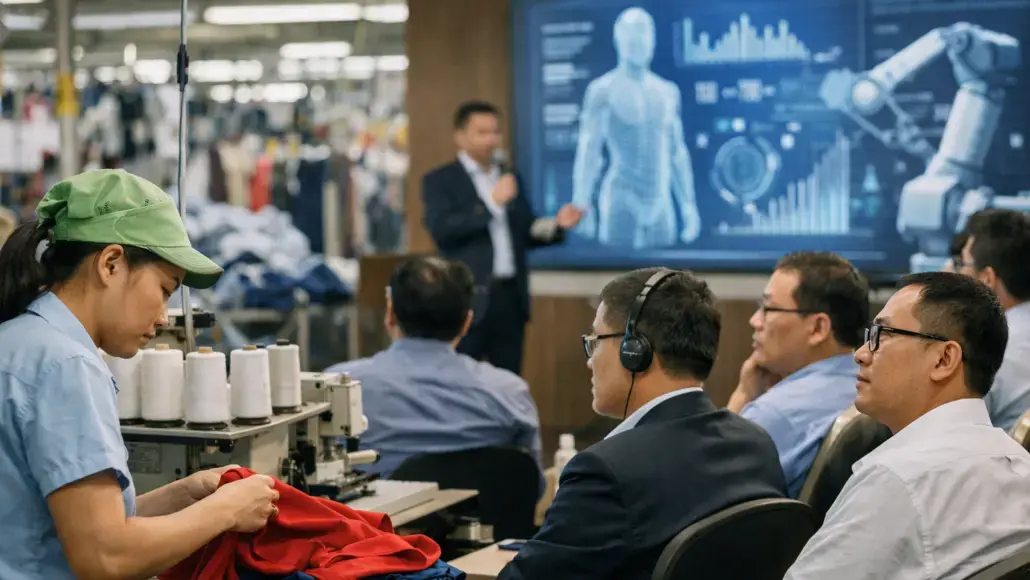
Data and artificial intelligence are rapidly emerging as critical tools for Vietnam’s textile and garment sector, offering a pathway to improved productivity, lower operational costs and greater value addition at a time when global buyers are raising the bar on quality, sustainability, and supply chain transparency. These expectations were front and centre at a conference held in Hà Nội, where industry leaders, academics and technology experts gathered to chart the industry’s digital future.
Industry Under Pressure to Evolve
Trương Văn Cẩm, vice president of the Vietnam Textile and Apparel Association (VITAS), acknowledged that while Vietnam stands among the world’s three largest textile and garment exporters, the industry is facing growing headwinds. Rising customer expectations, shorter product cycles, escalating costs, and increasingly stringent requirements around environmental protection, traceability and supply chain transparency are placing substantial strain on manufacturers.
Cẩm emphasised that science and technology, digital transformation and innovation must now serve as core drivers of productivity, product quality and added value — capabilities essential to strengthening Vietnam’s standing in international markets. He stressed that digital transformation should not be reduced to mere investment in machinery or software. It must extend to changes in management practices, production organisation and the way businesses operate day to day.
Data, he argued, should sit at the heart of this transformation — enabling companies to track orders in real time, optimise raw material usage, improve labour productivity, reduce costs and arrive at faster, more accurate business decisions. Vietnam textile AI adoption, in this context, is not optional but a competitive necessity.
Conference Agenda: From EU Digital Product Passport to AI in Fashion
The conference covered a wide range of forward-looking subjects, including technology and innovation strategies to improve competitiveness, the technical requirements of the European Union’s Digital Product Passport (DPP) for textile and garment products, production data platforms, and the expanding potential of artificial intelligence across the industry and in fashion e-commerce. Delegates also explored practical measures to boost productivity, reduce operating costs and sharpen the competitive edge of Vietnamese companies in global markets.
Shifting from Processing to Value-Added Production
Dr Nguyễn Thu Phượng, vice rector of Hanoi Industrial and Trade University, outlined the structural shift the Vietnam textile industry must undertake — moving away from a processing-based model toward higher value-added production capable of meeting increasingly stringent international standards on sustainability and traceability.
Drawing on experience from major manufacturers, she noted that investment in advanced equipment delivers its strongest results when paired with management reform and meaningful workforce skills development. The evidence from the factory floor supports this view.
Results from Leading Manufacturers
Garment 10 Corporation recorded a 52 per cent increase in labour productivity and an 8 per cent reduction in defects following the implementation of lean manufacturing practices, while also cutting working time by one hour per day. At Duc Giang Corporation and its member companies, labour productivity rose between 8 per cent and 10 per cent, while production-line defect rates dropped sharply from 25 per cent to between 10 and 12 per cent — a clear demonstration of what structured operational reform can deliver.
SME Barriers Remain a Significant Challenge
Despite these gains, the path to automation is not straightforward for the majority of the sector. More than 70 per cent of businesses in Vietnam’s textile and garment industry are small- and medium-sized enterprises, and financial constraints combined with gaps in organisational expertise limit their ability to access advanced automation solutions.
Dr Phượng advised that such companies should prioritise digitising and standardising their data and adopting lean management practices before committing to large-scale automation investment. She also called for broader support from the government, regulatory agencies, industry associations and universities, alongside an enabling legal framework for science and technology, to allow businesses to safely test new technologies and manage the risks involved.
VITAS Chairman: A New Phase Demands a New Approach
Vũ Đức Giang, chairman of VITAS, described the industry as entering a new phase in which international buyers now expect far more than fast delivery and competitive production costs. Greater emphasis is being placed on product quality, social responsibility and sustainability — standards that demand deeper transformation from Vietnamese manufacturers.
He also pointed to rising domestic production costs as a threat to the industry’s traditional low-cost labour advantage, making the adoption of digitalisation, automation, robotics and artificial intelligence increasingly necessary rather than aspirational. Businesses, he said, should upgrade factory infrastructure to meet international standards and expand automation to optimise production costs and improve labour productivity. Vietnam textile AI integration, in his view, is central to the sector’s ability to remain globally relevant.
Export Performance Reflects Industry Resilience
Despite the challenges, the Vietnam textile industry has shown resilience in export performance. According to VITAS data, textile and garment exports reached US$35.72 billion in the first nine months of 2026, representing a 3.3 per cent increase compared to the same period a year earlier. The industry has set a full-year garment exports target of between $48 billion and $49 billion for 2026 — an ambition that underlines the scale of the sector’s global reach and the urgency of the digital transformation agenda supporting it.