





















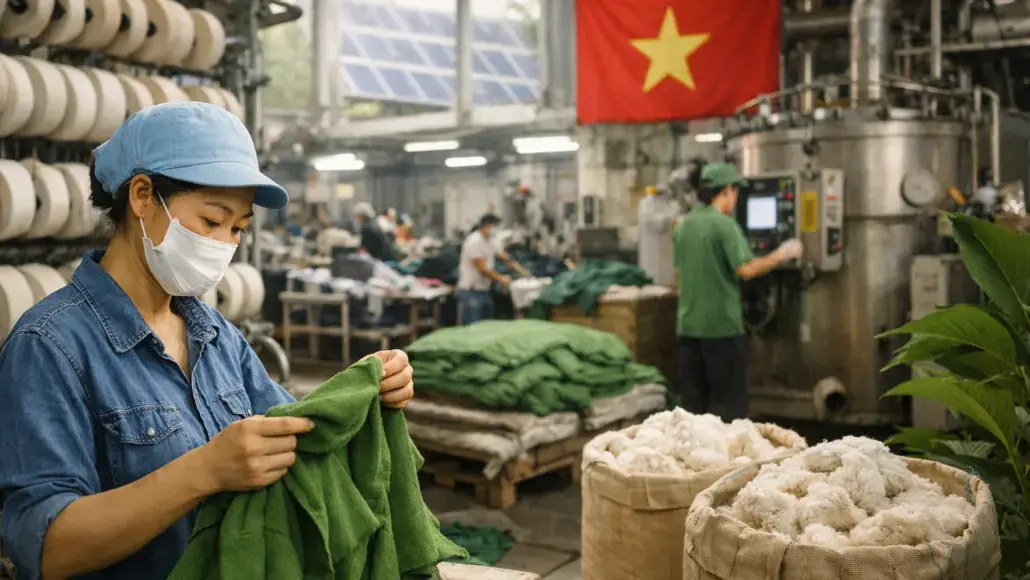
The European Union has designated textiles as a priority category under its Eco-Design for Sustainable Products framework and is actively preparing to roll out a roadmap for digital product passports. Against this backdrop, developing the production of yarn, fabric, dyeing, finishing, and raw materials that comply with environmental standards has become an urgent necessity for Vietnam’s textile and garment businesses seeking to maximize the benefits of free trade agreements and sustain stable order volumes.
Maintaining Domestic Supply Chains
Data from the Ministry of Industry and Trade shows that in the first nine months of 2026, Vietnam’s textile and garment exports are estimated to have reached over US$36.4 billion, reflecting a 3.2% increase compared to the same period in 2025, despite notable fluctuations in global market conditions. Vietnam continues to hold its position among the top three largest textile and garment exporting countries in the world.
The sheer scale of this industry — measured in tens of billions of US dollars — means that even incremental improvements in productivity, cost efficiency, or added value can yield a substantial economic impact nationwide.
Truong Van Cam, Permanent Vice Chairman and General Secretary of the Vietnam Textile and Garment Association (VITAS), noted that textile and garment export turnover has grown from US$1.96 billion in 2001 to US$46.2 billion in 2025, an increase of more than 23 times over the period. Looking ahead, the industry needs to redirect its focus toward improving the quality of growth through technological innovation, digital transformation, and production modernization.
This requirement carries added urgency as businesses simultaneously navigate fluctuations in raw material availability, logistics disruptions, evolving sustainable development standards, and the growing demand for traceability — all while product lifecycles grow shorter, order sizes shrink, and delivery timelines tighten.
Pham Van Quan, Deputy Director of the Department of Industry under the Ministry of Industry and Trade, acknowledged that textiles and garments remain a key export industry that generates significant employment across the economy. However, he pointed out that the sector still depends heavily on imported raw materials and components, with production largely concentrated in the processing stage. As a result, the overall added value retained domestically remains limited.
At the same time, major import markets are imposing increasingly stringent requirements around green production, supply chain transparency, traceability, and rules of origin. These factors collectively push the textile and garment industry toward a transition — from growth driven by order volumes to growth anchored in productivity, technology, and value addition.
In this context, industry experts recommend that textile and garment businesses proactively secure raw materials to satisfy rules of origin requirements, maintain stable production in the face of external disruptions, and retain a greater share of added value within domestic operations. Priority should be placed on developing fabric, dyeing, and finishing processes that meet environmental standards, supplying compliant auxiliary materials, and advancing mechanical engineering, automation, and specialized software capabilities. Investments in these areas must be integrated with wastewater treatment systems and energy efficiency measures, and closely aligned with the practical requirements of garment manufacturing businesses.
In-Depth Investment for Sustainable Growth
Vu Duc Giang, Chairman of VITAS, stated that the textile and garment industry is facing meaningful opportunities from new-generation free trade agreements, which he described as fundamental conditions for a stable, long-term development strategy. He added that the convergence of technology, automation, robotics, and artificial intelligence is opening up new avenues for growth. In this environment, the business community is encouraged to participate in events that connect investors active in yarn spinning, dyeing, and garment manufacturing, with the objective of forming a closed and integrated supply chain domestically.
Establishing this form of supply chain linkage is viewed as essential to satisfying the stringent requirements embedded in new-generation FTAs, and to optimizing the economic benefits available to Vietnamese businesses under these agreements.
Dr. Hoang Xuan Hiep, Rector of Hanoi University of Industry and Trade, advised businesses to carefully select the free trade agreements most suited to each individual order, based on document codes, rules of origin, raw material sourcing, and compliance costs. He recommended that businesses construct a matrix that links each order with the relevant agreement and the corresponding raw material source, enabling them to accurately calculate compliance costs, applicable tariff rates, and associated risks. This approach supports informed decision-making on sourcing and production organization from the outset — rather than evaluating tariff incentives only after contracts have already been finalized.
Experts broadly agree that, over the longer term, improving productivity, strengthening supply chain management, and proactively securing raw materials will reduce the industry’s dependence on external disruptions. At the same time, businesses will need to enhance their capacity to meet origin, quality, and standards-related requirements of import markets in order to sustain relationships with international buyers.
Preparing for 2027 and the Road Ahead
As Vietnam’s textile industry moves into 2027 and beyond, the global economy is projected to face continued and unpredictable fluctuations driven by geopolitical conflicts, intensifying trade competition, and tariff barriers. This environment makes it imperative for businesses to invest in advanced technologies that can raise both productivity and the overall value of their products.
Vietnam textile exports have demonstrated consistent resilience and growth over the past two decades. The ongoing drive to align with digital product passports requirements, comply with green production standards, and build transparent supply chains reflects where the industry’s immediate priorities now lie. Meeting these standards is not simply a compliance exercise — it is the pathway through which Vietnamese businesses can derive the full value of Vietnam textile FTA benefits and secure their competitive standing in key international markets.