



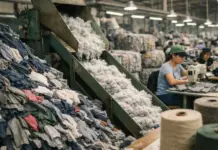
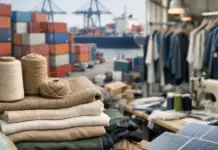

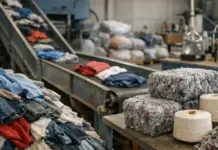









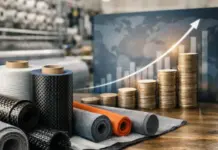


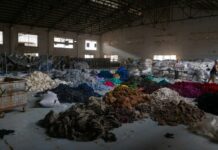





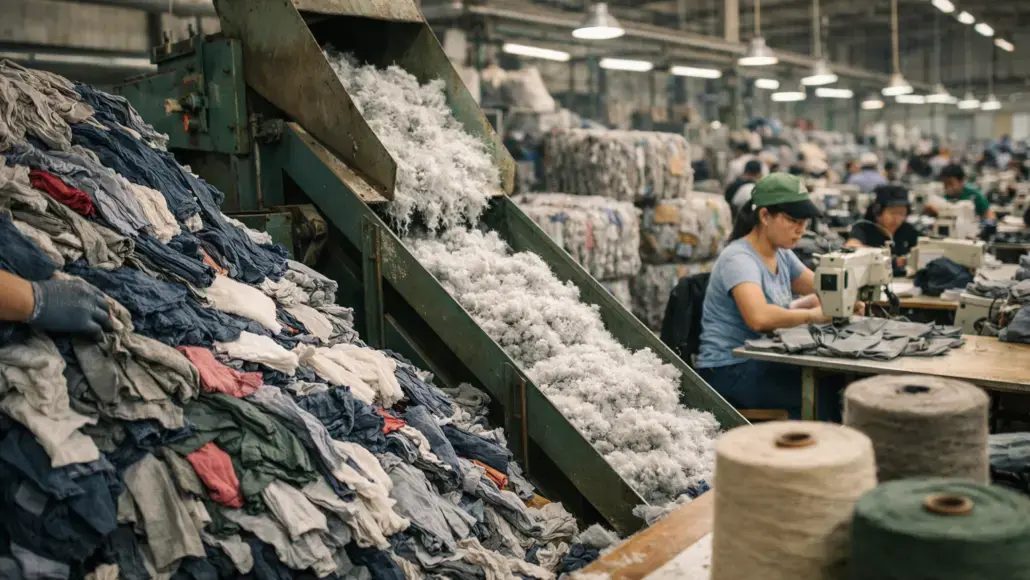
In the global push to green the textile industry, recycled materials are no longer just an encouraged option. They have become a direct factor influencing a business’s ability to secure and retain orders. Yet within Vietnam’s garment sector, a telling paradox persists — hundreds of thousands of tons of fabric scraps are generated every year, and a significant portion of this resource continues to go underutilized. Technological barriers, weak management mechanisms, and limited traceability capabilities are holding back the development of circular supply chains from being converted into real, tangible economic value.
The Growing Demand for Recycled Materials
The textile industry is facing mounting pressure to transform. International brands are increasingly placing emphasis on environmental responsibility across their entire supply chains. Beyond the conventional benchmarks of cost, quality, and delivery time, global partners now demand transparency from manufacturers regarding raw material sources, production processes, and traceability standards. In this shifting landscape, recycled materials have emerged as a crucial link for businesses seeking to meet sustainable development requirements.
According to Textile Exchange, a global non-profit organization that promotes positive climate impact across the fashion and textile industry, recycled fibers currently account for 7.6% of total global fiber production. In practical terms, for every 13 kilograms of fiber produced, approximately 1 kilogram originates from recycled sources. While the proportion may still appear modest, recycled materials are steadily becoming an integral component of the textile supply chain worldwide.
Mr. Dinh Quoc Duy, an expert at Audit Manager IDFL Vietnam, noted that global demand for recycled polyester fiber stands at 11.8%, while brands’ demand for recycled fibers used in their products reaches as high as 76%. The significant gap between these two figures reveals that demand for recycled materials within the supply chain cannot be assessed purely through the lens of overall market demand. Brand commitments to sustainability are generating specific requirements on suppliers, compelling textile businesses to be more proactive in both material selection and production organization.
Vietnam’s Recycling Paradox — Waste Without Value Recovery
While demand for recycled materials continues to rise, Vietnam’s textile industry still faces the paradox of producing large volumes of waste that have not been converted into high-value input materials. Ms. Dang Thuy Duong, Director of the To the Finish Line (TFL) program, stated that approximately 60% of textile waste is currently recycled into products of lower value than the original material — such as insulation panels, sofa stuffing, or pillow fillings. This phenomenon, widely known as “downcycling,” reflects limitations in technological expertise and the inability to restore or improve fiber quality after recycling.
Domestic mechanical recycling technology currently produces fibers suited primarily for low-cost product lines, failing to meet the standards required for re-entry into the high-quality garment supply chain. This means that the economic value embedded in waste materials is not being fully extracted, while also limiting the potential for forming a genuinely closed-loop circular supply chain within the industry.
The Sorting and Processing Challenge
The challenge does not lie in collection alone — it extends to the ability to sort and appropriately process materials. Textile scraps can contain a range of fiber components, additives, dyes, and coatings. Without rigorous sorting at the source, the recycling process struggles to produce materials of consistent quality that meet the technical specifications of finished products. As a result, increasing the volume of collected scrap does not automatically translate into improved recycling efficiency, particularly when the majority continues to be channelled into low-value applications.
To change this reality, the textile industry needs to shift its mindset — moving away from waste treatment and toward the development of secondary raw materials. Investment in sorting technology, improvement of recycled fiber quality, and research into appropriate processing solutions for different material types are all necessary steps. When fabric scraps can be recycled into raw materials that meet the standards for producing new yarns and fabrics, recovered value increases and dependence on virgin raw materials is reduced.
Transparency of Origin — A Non-Negotiable Condition for Retaining Orders
Beyond technology, the ability to prove the origin of raw materials remains a significant bottleneck that the industry must address. According to Mr. Dinh Quoc Duy, what differentiates competitive businesses today is their capacity to demonstrate the provenance of their materials and the degree to which they comply with customer-required standards. International brands do not merely seek out materials marketed as recycled — they require suppliers to substantiate those claims through documentation, purchase orders, and recognized certifications.
Businesses, therefore, cannot stop at simply incorporating recycled materials into their production. They must ensure the accuracy of this information throughout the entire supply chain. This necessitates comprehensive management spanning the source of scrap materials and recycling facilities all the way through to fiber production, dyeing, and final garment manufacturing. Raw material records, sales documentation, supplier information, and production data all need to be organized and synchronized for verification during customer assessments or audits.
Traceability as a Commercial Advantage
Without reliable traceability mechanisms, recycled materials — even when of good quality — will struggle to fully realize their commercial advantages. Conversely, businesses that build transparent governance systems will be better positioned to strengthen trust with partners, reduce compliance risks, and deepen their participation in the global value chain. A credible sustainable supply chain backed by documented traceability is increasingly becoming the standard expectation rather than a differentiating feature.
Building a Coordinated, Higher-Value Recycling Ecosystem
Textile industry experts underscore that effectively utilizing textile waste requires coordinated action among manufacturing businesses, recycling units, raw material suppliers, and regulatory agencies. Several priorities have been identified to support this transition.
Businesses must begin sorting fabric scraps at the source, minimizing the mixing of materials with differing fiber compositions — a step that fundamentally improves input quality and reduces downstream processing costs. At the same time, investment in research and innovation in recycling technology must be actively promoted to develop fibers of sufficient quality for reuse within the garment production process.
Equally important is the improvement of management mechanisms and the removal of legal barriers surrounding the collection, transportation, and recycling of waste materials. Establishing clear standards and quality control procedures across the recycled materials pipeline will provide the consistency and reliability that industries and buyers demand.
The Role of Supply Chain Linkages
Supply chain integration is also critical. When garment businesses, recycling units, and fiber manufacturers operate in isolation, it becomes difficult to sort waste materials in alignment with actual production needs, and recycling facilities lack the stable output required to justify investments in new technology. Long-term linkage contracts and data-sharing mechanisms, on the other hand, can support the formation of a higher-quality, larger-scale, and more stable recycled raw material market — one that serves the circular supply chain ambitions of both domestic producers and their international brand partners.
The path forward for Vietnam’s textile industry lies in recognizing recycled textile materials not as a compliance burden, but as a competitive asset — one that, when managed with precision and transparency, has the potential to unlock new levels of market access, brand trust, and long-term sustainability.