


























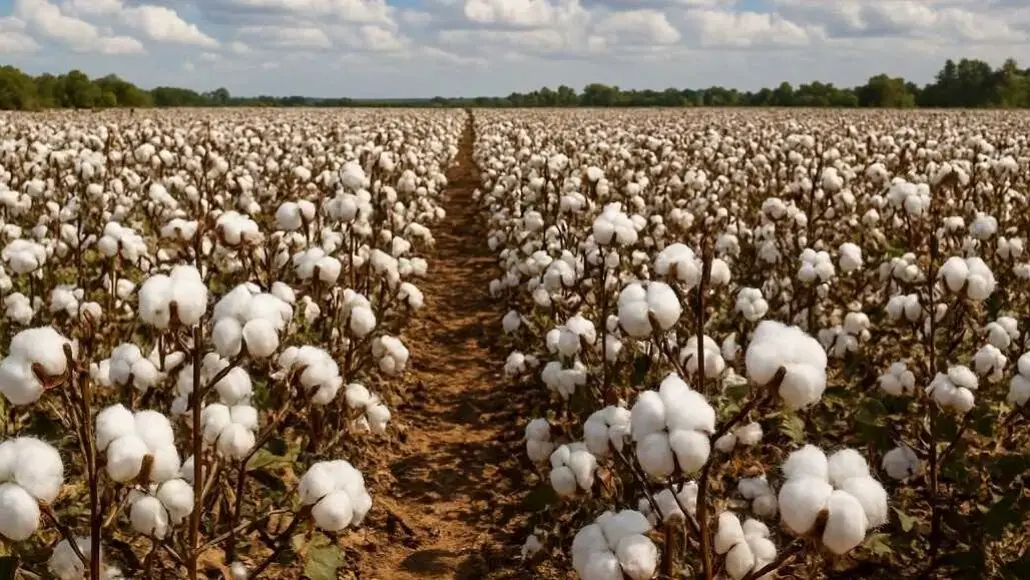
The US Department of Agriculture has unveiled a new programme designed to stabilise and rebuild the economics of US cotton, after growers endured five straight years of negative returns. Announced on 28 May 2026 by Secretary of Agriculture Brooke L. Rollins, the Great American Cotton Plan is positioned as a broad package meant to respond to rising input costs, tightening margins and intensifying competition from synthetic fibres.
USDA’s own outlook underscores why Washington is moving now. The department forecasts that cotton producers could face losses of around $2.6 billion across roughly 9 million planted acres in the coming crop year—an industry-wide deficit large enough to threaten long-term planting decisions and rural employment tied to the crop.
The structural squeeze is also visible beyond the farm. Cotton processing capacity has eroded significantly over time, with the number of gins falling from 2,254 in 1980 to 446 today. Domestic textile manufacturing has likewise diminished over recent decades, weakening the downstream ecosystem that historically anchored cotton demand inside the US and adding to concerns about the sector’s durability.
Synthetic fibres are the central competitive pressure
The federal government’s diagnosis places heavy weight on the rise of oil-based textiles. USDA notes that synthetic materials now account for roughly 70% of global fibre consumption, dominated by petroleum-derived products such as polyester and nylon. From USDA’s perspective, the shift has created a market environment where cotton must compete not only against other natural fibres, but against cheap and scalable synthetics whose pricing often sets the benchmark for mass-market apparel.
Rollins framed the plan as a reset in both policy and posture, linking cotton’s past role to its future competitiveness. “Since 1607, cotton has helped build and sustain rural America. Our farmers grow some of the highest-quality cotton in the world, but over the last several years, America’s cotton growers have been crushed by rising costs, unfair foreign competition, and a flood of cheap synthetic products. In 2023, we lost our status as the world’s top cotton exporter to Brazil. This change starts today.”
Four pillars: consumption, production, trade and risk protection
USDA says the Great American Cotton Plan is built around four tracks of action.
The first is demand-building at home. USDA, working with the Department of Health and Human Services, is promoting a “Plant Not Plastic” message intended to strengthen consumer awareness of natural fibres. The department also plans to maintain funding for the BioPreferred Programme, enabling eligible biobased goods—including cotton products—to continue carrying the BioPreferred label. In addition, USDA will apply higher marketing loan rates for upland and extra-long staple cotton, as authorised under the Working Families Tax Cuts Act.
The second track aims to strengthen domestic capacity and throughput. USDA said it will prioritise cotton processors and manufacturers under Rural Development’s Business and Industry Guaranteed Loan Program to support expansion. It will also lift the Economic Adjustment Assistance for Textile Mills payment rate from $0.03 to $0.05 per pound of cotton processed. The department added that it will continue engaging Congress on the bipartisan Buying American Cotton Act.
The third pillar is export and trade leverage. USDA will use the administration’s Three-Point Trade Plan to expand market access for US cotton. Cotton Council International joined an Agribusiness Trade Mission to Indonesia earlier this year for the first time in the programme’s history. USDA said it has also worked with the Office of the United States Trade Representative to secure commitments from Indonesia and Bangladesh intended to support future purchases of US cotton and textile manufacturing using US fibre. Export promotion will continue through mechanisms including the Market Access Program and COTTON USA licensing.
The final pillar addresses farm-level risk, including agronomic threats and revenue protection. USDA’s Agricultural Research Service is advancing work to combat the cotton jassid pest. Producers will also have broader access to Supplemental Coverage Option insurance. In parallel, the Working Families Tax Cuts Act increased the seed cotton reference price used in ARC and PLC programmes by 14% from autumn 2026.
USDA said the plan will depend on sustained coordination across the value chain. “USDA will continue coordinating with industry stakeholders, manufacturers, cotton growers, retailers, and Congress to advance policies that strengthen the cotton supply chain from the field to the fabric,” the Department stated.