

























Vietnam’s textile and garment sector has been actively strengthening its market diversification efforts, ramping up domestic sourcing, and accelerating green and digital transformation — all in response to increasingly volatile global demand and tighter international trade requirements. With a clear export revenue target of $47 billion to $47.5 billion for 2026, the industry recorded a preliminary turnover of $33.66 billion as of September 15, reflecting steady forward momentum across multiple fronts.
Vietnam textile exports now reach 137 countries and territories worldwide, with the United States alone accounting for approximately 40 per cent of total overseas shipments. Alongside the US market, the European Union, the Republic of Korea, Japan, China, and ASEAN nations continue to serve as well-established export destinations. Regions such as Africa and the Middle East have also emerged as promising corridors for market diversification, offering the industry additional avenues for growth beyond its traditional strongholds.
Flexible Strategies and Enterprise Adaptability at the Core
Vietnam Textile and Apparel Association (VITAS) chairman Vu Duc Giang credited the sector’s performance to a combination of flexible strategies, enterprise adaptability, and meaningful advances in both green and digital transformation. These factors, he noted, have collectively shaped the industry’s ability to navigate an increasingly complex and demanding global trade environment.
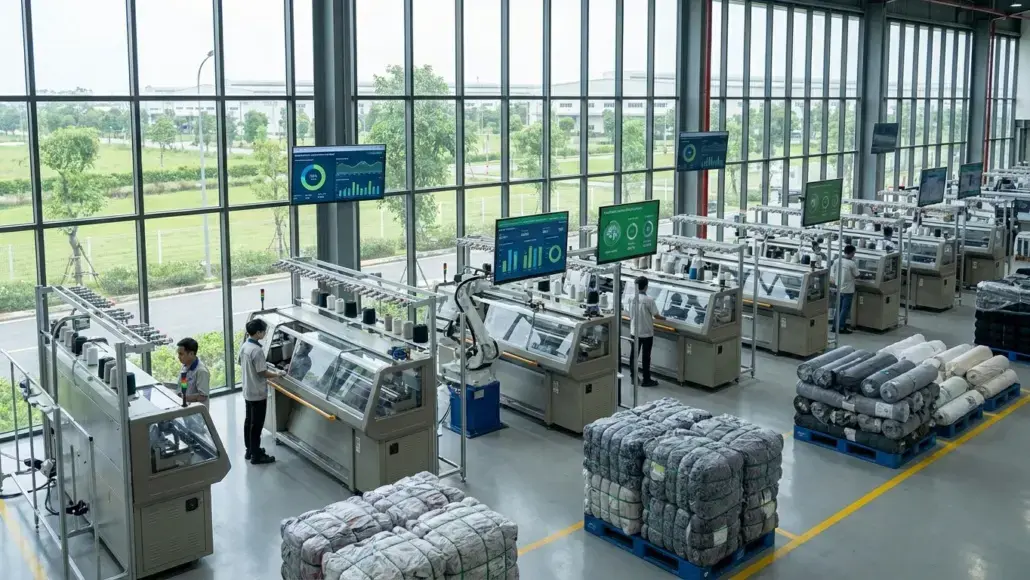
According to Giang, green and digital transformation have become essential pillars of the sector’s development roadmap for 2026–2030, extending further into a longer-term vision reaching 2035. Enterprises across the garment industry are progressively integrating automation, robotics, and artificial intelligence into both production processes and management systems. Notably, investment in infrastructure, artificial intelligence, and robotics now accounts for roughly 65 to 68 per cent of total investment at many enterprises within the sector — a clear indication of how seriously the industry is embracing technological modernisation.
Sustainability Investments Align With Vietnam’s Net-Zero Goals
Beyond digital upgrades, manufacturers have also been directing investment toward sustainability-focused initiatives. Rooftop solar power installations, upgraded wastewater treatment systems, and an increased reliance on environmentally friendly materials are among the measures being adopted across the garment industry. These steps are closely aligned with Vietnam’s national commitment to achieving net-zero emissions by 2050.
Giang emphasized the importance of supportive local governance in sustaining this momentum. He called on local authorities to develop specialised industrial parks equipped with centralised wastewater treatment facilities that meet international standards. Such infrastructure, he indicated, would play a vital role in attracting investment in textile and dyeing operations while also addressing persistent bottlenecks in the domestic supply of raw materials and accessories — a challenge that continues to affect the broader value chain.
Broader Value-Chain Integration Supporting Export Resilience
The sector’s recent progress reflects not only broader market access and technology adoption, but also the strengthening of value-chain linkages within Vietnam. Market diversification, combined with green transformation and digital upgrades, has enabled Vietnam textile exports to remain competitive despite shifting demand patterns globally. As the industry works toward its 2026 export target, the interplay between enterprise-level innovation and policy-level infrastructure development will remain central to sustaining that competitive edge in international markets.