





























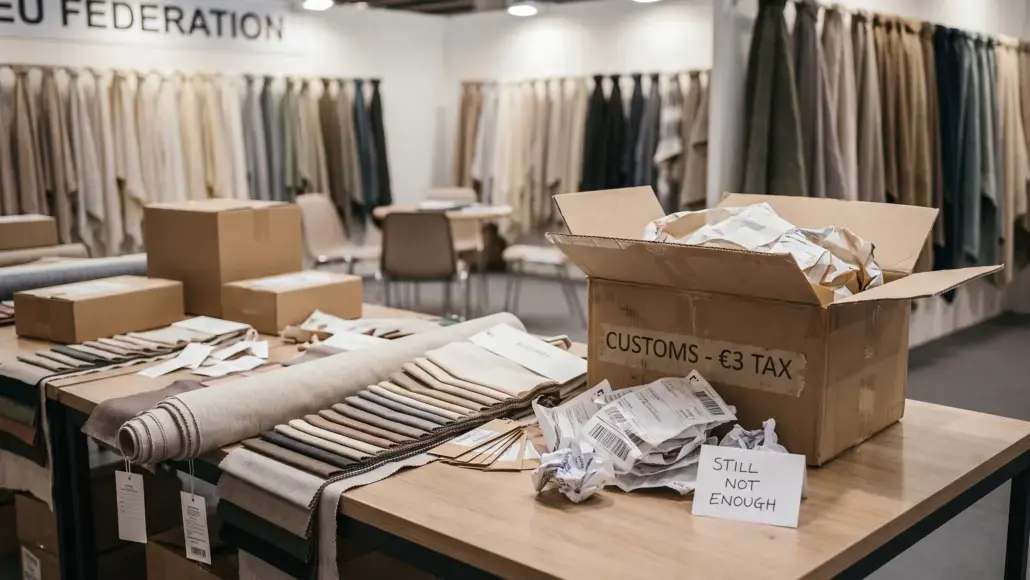
Since July 1, all small parcels entering the European Union have been subject to a €3 tax. While the measure has shown early results, European textile and clothing federations are firm in their assessment — it is not enough. The federations convened for the second time in Villepinte on September 1, 2026, during the Première Vision trade fair to address ongoing concerns around ultra-fast fashion and the EU parcel tax textile framework.
A Notable Drop, But the Fight Is Far From Over
In a video address to industry professionals gathered at the event, France’s Minister Delegate for Industry acknowledged the impact of the small parcel tax — a measure France was the first to champion before it was adopted union-wide. According to French customs data, the number of parcels entering Europe has fallen by nearly 40% since the tax came into force.
Despite welcoming this result, the minister acknowledged that vigilance remains essential and that more needs to be done.
That sentiment was echoed loudly by the federations themselves. Olivier Ducatillion, president of the French Union of Textile Industries, and Pierre-François Le Louet, president of the French Union of Fashion and Clothing Industries, were direct in highlighting a critical flaw in how the small parcel tax is applied. The €3 charge is levied only once per product category within a given parcel — meaning a shipment containing ten identical items is taxed just once.
“For 10 identical items sent in the same parcel, it is applied only once. And €3 for 10 items is not enough,” the two noted.
The Handling Fee Question
The conversation quickly shifted to an upcoming regulatory development — handling fees, due to come into force in the autumn. The funds collected are intended to finance the creation of a European customs administration. Like the existing small parcel tax, this additional €2 charge will also be applied per product category rather than per item, meaning a parcel containing a T-shirt and a pair of jeans will generate two charges.
Mario Jorge Machado, president of Euratex — the European confederation of textile industries — stressed that this approach still does not go far enough given the scale of the challenge. He noted that 90% of EU imports now arrive as small parcels, underlining how dramatically trade flows have shifted.
“If trade has shifted in this way, we must now change how our customs operate and, to do that, they need resources. The handling fees and the amount currently under discussion — around €2 to €4 — will surely not be sufficient to give customs the right tools to carry out proper checks and enforce the regulations,” Machado stated.
In a joint effort, Euratex, the French Union of Textile Industries, and the French Union of Fashion and Clothing Industries are calling for the handling fee to be set at approximately €10 per parcel — a level they consider more reflective of the actual costs generated within the EU by the high volume of small parcels arriving from Asia.
Commission Responds, But Reopening the Amount Unlikely
Valère Moutarlier, Deputy Director General for European Industry and Decarbonisation at the European Commission’s DG GROW, confirmed that the Commission is actively working on implementing handling fees on small parcels. However, when questioned by FashionNetwork.com, he indicated that he did not expect the question of the fee amount or the method of taxation to be revisited.
He pointed to other EU-level efforts underway, including improvements to automated web crawlers that monitor offers from non-compliant operators, as well as enhancements to product testing capacity across member states. He also referenced the forthcoming European Product Act — legislation aimed at regulating product offerings — expected later in 2026.
“We are essentially working to add value to what Member States do individually by pooling resources, consolidating digital solutions and breaking down silos between the various authorities,” Moutarlier explained.
A Level Playing Field, Not Special Treatment
A consistent theme across all participants was clarity of intent. The federations are not seeking exemptions or preferential treatment for the European textile industry. Their goal is straightforward competitive fairness — the same rules for all market operators, regardless of origin.
“Same market, same products: same rules,” as Machado put it succinctly.
To achieve this, the federations are prioritising legal accountability for online platforms through a “deemed importer” model, closing logistical loopholes that could allow platforms to sidestep tougher business-to-consumer rules by routing shipments through European wholesale or transit warehouses. They also advocate for standardising customs data requirements across both business-to-consumer and business-to-business channels.
Additionally, the federations call for easing the regulatory and administrative burden on European manufacturers and distributors who already comply with standards — ensuring compliant businesses are not stifled by bureaucracy while non-compliant imported products continue to enter the single market under weaker scrutiny. Stabilising the current EU parcel tax textile framework while enforcing existing compliance rules rigorously is also high on their agenda.
The European textile industry’s message is clear: the small parcel tax was a step forward, but without stronger handling fees, tighter platform accountability, and improved customs enforcement, ultra-fast fashion will continue to operate on an uneven playing field.

