




























A new report by BCC Research has highlighted a sweeping shift across the global technical textiles sector, with manufacturers increasingly integrating artificial intelligence and machine learning into core production operations. From weaving and knitting to thermoforming, AI in technical textiles is no longer a distant ambition — it is becoming an operational standard driven by labour economics, sustainability mandates, and Industry 4.0 infrastructure investment.
The report provides a qualitative assessment of AI and ML adoption trends, investment activity, emerging technologies, and competitive dynamics across the global technical textiles value chain.
A Structural Shift, Not a Cyclical Trend
BCC Research’s findings make clear that the combined pressure of labour market challenges, ESG compliance requirements, and expanding digital infrastructure is building a structural case for AI adoption across technical textiles — not simply a passing technology wave.
Limited availability and high cost of qualified textile workers are pushing manufacturers towards AI-powered sewing robots and automated production systems. These systems are being adopted to reduce dependence on manual labour, lower training costs, and improve output consistency at scale.
At the same time, end-use industries that have already deployed AI in their own manufacturing are requiring upstream suppliers to follow suit, accelerating adoption across the supply chain. Advances in cloud computing infrastructure and big data analytics are also lowering deployment barriers, while AI-powered supply chain management systems are improving demand projection accuracy and reducing overstocking and stockouts in raw fibre and polymer procurement.
Regional Maturity Across Five Stages
BCC Research classified regional adoption across five distinct maturity stages, offering a clear picture of where different parts of the world currently stand on the AI adoption curve.
North America and Europe are in the integration phase. North American producers are prioritising domestic technology implementation for supply chain resilience, while European manufacturers are deploying AI and ML to meet European Union Green Deal and Circular Economy Action Plan requirements.
Asia-Pacific is at the early adoption stage, with China targeting production efficiency and Japan using AI for property enhancement and catalyst formulation.
South America, including Brazil, and the Middle East, including Türkiye and Saudi Arabia, are at the exploration stage. Africa remains at the awareness stage, with domestic producers beginning to collaborate with foreign technology partners.
Sustainability Regulation as a Compliance-Driven Accelerant
Sustainability regulation is acting as a powerful driver — particularly in Europe — where monitoring of water consumption, energy use, carbon emissions, and textile waste is pushing manufacturers toward AI and ML systems that optimise resource use. This intersection of ESG compliance and smart manufacturing is increasingly central to how technical textiles producers are positioning themselves competitively.
Ekoten achieved an A evaluation from the Carbon Disclosure Project (CDP) Climate Change assessment in 2025, following AI-driven reductions in unnecessary water consumption. Yeşim Group reduced defects by 70 per cent in lycra jersey technical textiles production using optical sensors combined with machine learning algorithms.
Emerging Applications Identified by the Report
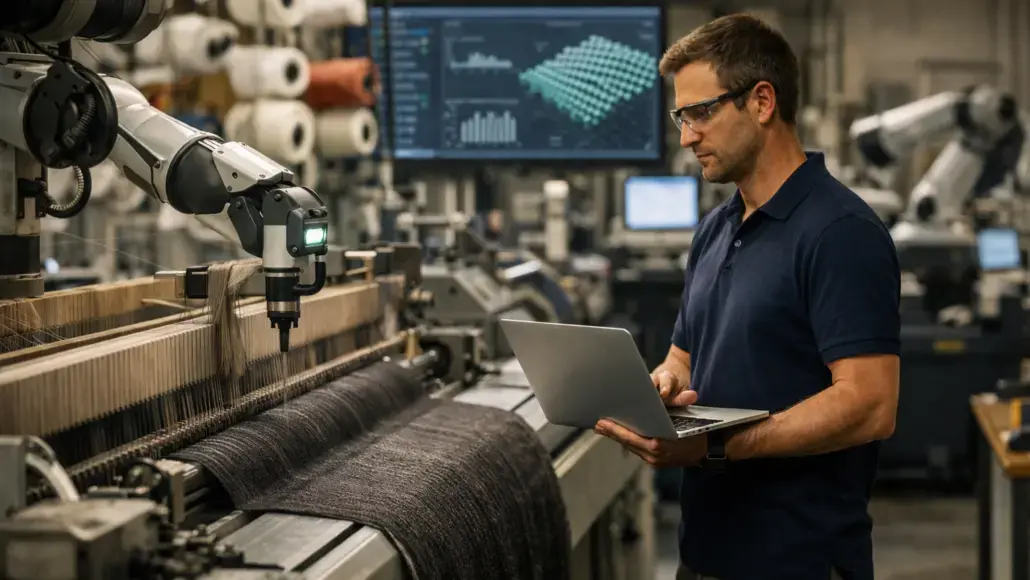
The BCC Research report identified a range of emerging applications currently reshaping how technical textiles are manufactured and managed. These include AI-powered defect detection using optical sensors, AI-powered sewing robots, AI-driven material selection and screening, AI optimisation of the polymerisation process, AI-driven supply chain and logistics intelligence, and AI integration in 3D weaving and advanced textile manufacturing technologies.
AI and ML systems are also demonstrating the ability to predict tensile strength, abrasion resistance, thermal resistance, flame retardancy, and electrical conductivity during the initial production phase — offering manufacturers greater precision and quality control earlier in the production cycle.
Companies Leading AI Adoption in Technical Textiles
BCC Research named several companies advancing AI adoption across the technical textiles value chain, with multiple completing or planning AI system implementations between October 2025 and April 2026. These include Aitu (Zhejiang) Intelligent Sewing Technology Co. Ltd., Yeşim Group, Ekoten, Ahlstrom, Freudenberg Group, RAGHUVIR EXIM LTD., Makalot Industrial Co. Ltd., UNSPUN, DAGA Group, and ZYOD.
UNSPUN’s planned April 2026 implementation of AI-enabled 3D weaving systems has been highlighted as a near-term commercialisation milestone.
Barriers to Adoption Remain in Emerging Markets
While momentum is building, adoption remains uneven — particularly in emerging markets. BCC Research identified shortages of skilled AI professionals, inadequate digital infrastructure, high upfront capital requirements, and dependence on foreign technology vendors as key constraints.
Data quality and privacy concerns, along with unresolved governance and ethical frameworks in some jurisdictions, are adding further complexity for producers attempting to scale AI systems beyond pilot phases.
Positioning and Risk Outlook
For companies already in the integration phase of AI in technical textiles — particularly those demonstrating results in defect reduction, ESG compliance, and supply chain optimisation — BCC Research notes they are best positioned to capture margin expansion and secure preferential supplier status with AI-enabled end-use industries.
Near-term catalysts include anticipated foreign investment into African markets during the forecast period and the commercialisation of AI-enabled 3D weaving systems. Key risks identified include uneven infrastructure readiness, vendor lock-in exposure in emerging markets, and regulatory uncertainty around AI governance.
The report’s overall conclusion is that AI and ML adoption in technical textiles is being shaped by converging forces — and for manufacturers at every stage of the maturity curve, the question is no longer whether to adopt, but how quickly and at what scale.