




























Bangladesh’s government has moved to tighten controls on yarn imports, a policy shift aimed at unlocking approximately $1.5 billion in stalled local textile investments and breathing new life into the country’s struggling domestic spinning sector.
The decision comes in response to persistent complaints from local spinning mill owners, who have long argued that unchecked yarn imports — particularly from India — are undercutting their ability to compete and discouraging fresh capital from flowing into the sector.
Stricter Regulations on Yarn Imports
Under the updated regulatory framework, the government has imposed tougher conditions on yarn import restrictions, making it more difficult for garment manufacturers to bring in yarn from abroad unless specific criteria are met. The move is designed to compel buyers within the readymade garment (RMG) supply chain to source yarn locally, rather than opting for cheaper imported alternatives.
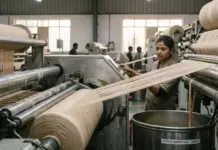
Local spinning mill operators have repeatedly pointed out that despite Bangladesh’s massive garment export industry — one of the largest in the world — a disproportionately large share of the yarn consumed by manufacturers is sourced from outside the country. This dynamic, they argue, leaves domestic producers in a precarious position, unable to scale up or attract long-term investment.
The Bangladesh Textile Mills Association (BTMA) had been at the forefront of lobbying for these changes, maintaining that stronger yarn import restrictions were essential for the survival and growth of the local textile industry.
$1.5 Billion in Local Investment at Stake
One of the central arguments driving this policy shift is the scale of investment that remains locked due to the unfavorable competitive environment. According to information cited in the original report, around $1.5 billion in textile investment in Bangladesh has been held back, with mill owners reluctant to commit capital when imported yarn continues to flood the market at prices that domestic producers struggle to match.
By introducing more rigorous yarn import restrictions, the government is hoping to create the market conditions necessary to make spinning mills Bangladesh-based a more viable and attractive proposition for investors. The policy essentially seeks to tilt the playing field back toward local manufacturers who have faced an uneven battle against lower-cost imports.
The textile investment Bangladesh stakeholders had flagged that without government intervention, many existing spinning operations were also at risk of downsizing or shutting down entirely, which would have broader consequences for employment and industrial capacity.
Impact on the Readymade Garment Sector
The policy has also sparked discussion within the RMG sector, where manufacturers have historically relied on imported yarn — particularly from India — due to price advantages and consistent supply. Some in the garment industry have expressed concern that tighter yarn import restrictions could raise their input costs in the short term, potentially affecting their competitiveness in global export markets.
However, government officials and BTMA representatives have countered that developing a stronger foundation in local yarn production is a necessary investment for the long-term resilience of Bangladesh’s textile and apparel supply chain. They maintain that the RMG sector’s overdependence on imported inputs creates structural vulnerabilities that can be addressed by scaling up spinning mills in Bangladesh.
The local yarn production capacity, if adequately supported through protective measures and investment incentives, could eventually meet a significantly larger share of domestic demand, reducing the sector’s exposure to external supply disruptions and currency pressures.
Government’s Position
The government’s stance reflects a broader industrial policy objective: to move Bangladesh up the textile value chain by strengthening upstream segments like spinning and weaving, rather than remaining concentrated primarily at the garment assembly stage.
Officials have indicated that the yarn import restrictions are not intended to be punitive but are rather a structured mechanism to encourage sourcing from within Bangladesh’s own textile ecosystem. The intent, as presented, is to strike a balance — ensuring that the RMG sector continues to function efficiently while giving domestic spinning mills Bangladesh a fair opportunity to grow and attract the textile investment Bangladesh so urgently needs.
The effectiveness of these measures will depend on how consistently they are enforced and whether complementary steps — such as infrastructure support, utility supply improvements, and access to financing — are also extended to local spinning manufacturers.