

























The European Union’s accelerating shift toward circular fashion is creating fresh pressure — and opportunity — for Pakistan’s textile industry to upgrade its recycling infrastructure, supply-chain traceability, and sustainable production systems, as the country works to protect its competitive position in one of its most critical export markets.
EU Regulatory Framework Reshaping Textile Trade
Under the revised EU Waste Framework Directive, EU member states have 30 months from the directive’s October 2025 entry into force to establish extended producer responsibility (EPR) schemes covering textiles and footwear. Under these schemes, producers placing goods on the EU market will be required to contribute financially to the cost of collecting and managing textile waste.
Textiles are equally a priority under the EU’s Ecodesign for Sustainable Products Regulation. The European Commission has scheduled the adoption of textile-specific ecodesign requirements and Digital Product Passport mandates for the fourth quarter of 2027, adding a further layer of compliance obligations that suppliers to the EU market — including those based in Pakistan — will need to meet.
What This Means for Pakistan’s Textile Exports
The transition carries direct commercial significance for Pakistan. EU–Pakistan goods trade reached €12.2 billion in 2025, with textiles and clothing forming the backbone of Pakistani export revenues. More than 85% of Pakistan’s exports — including textiles and clothing — currently enter the EU duty-free and quota-free under the GSP+ preferential trade arrangement, making the preservation of that access a key economic priority.
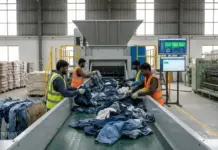
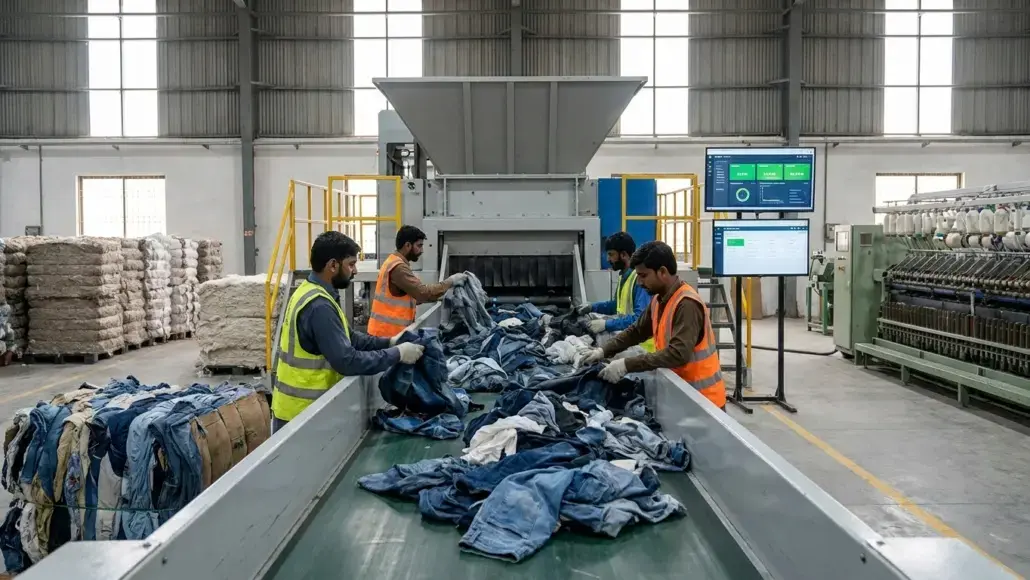
Pakistan does have a foundation to build on. Leading export-oriented manufacturers have already begun investing in digital tracking and sustainability systems. Textile reuse and mechanical recycling activities are already present in the country, with used clothing currently sorted, reused, or refurbished, and lower-grade textile material mechanically recycled into fibre or converted into products such as industrial wiping cloths and cleaning materials.
A senior government official from the Ministry of Commerce told Wealth Pakistan that major exporters had already begun preparing for requirements relating to the Digital Product Passport, supply-chain transparency, and traceability — with large export-oriented manufacturers investing in software, product tracking, and sustainability systems ahead of the mandates becoming enforceable.
The SME Challenge and Investment Needs
The preparedness gap, the official noted, is most pronounced among small and medium-sized enterprises (SMEs), which have comparatively limited financial, technological, and human-resource capacity to manage the transition. Substantial investment will be required across recycling technology, textile-waste collection and sorting, digital traceability, testing, and certification — areas where SMEs face the greatest constraints.
The official added that the next step for Pakistan’s recycling sector is to bring existing activities into a more organised and traceable circular system through better waste segregation, advanced recycling technology, improved documentation, and verification of recycled inputs and outputs.
Higher durability standards, environmental performance requirements, and product quality demands are also expected to increase production costs — costs that manufacturers cannot absorb indefinitely on their own. The official indicated that responsibility for these additional circular-production costs would increasingly need to be shared across the value chain, encompassing manufacturers, international brands, and end consumers.
Broader Compliance Environment
EU circular fashion compliance sits alongside a wider regulatory package. The official pointed to the EU’s REACH chemical requirements and the Better Work Pakistan programme — jointly implemented by the International Labour Organization and the International Finance Corporation — as part of the environmental and social compliance landscape already facing Pakistani exporters.
The Ministry of Commerce is also working with GIZ under the Improvement of Labour, Social and Environmental Standards in Pakistan’s Textile Industry II programme, known as TextILES II. Running through 2026, the programme supports the sector in aligning production practices with the sustainability and circular-economy requirements associated with the EU Green Deal.
Financing and Policy Support Mechanisms
Financing will be particularly critical for SMEs seeking to invest in recycling equipment, waste collection and sorting systems, Digital Product Passport-ready traceability tools, and certification. The official highlighted the Pakistan Green Taxonomy — circulated by the State Bank of Pakistan in December 2025 as a common classification system for green economic activities and investments — as a tool that could help financial institutions and investors channel capital toward environmentally sustainable projects.
An additional support channel is the EU-backed Better Governance and Business Environment initiative. A €20 million grant agreement signed in 2025 includes specific measures to strengthen SME competitiveness, support the green transition of export-oriented firms, and facilitate green investment within Pakistan.
On the institutional side, the Ministry of Commerce has constituted an Advisory Council on Sustainability and Circularity in Textiles and Apparel Sector. A Task Force on Traceability is also active, focused on preparing the sector for evolving international requirements.
Industry Perspective: Uneven Readiness Across the Sector
Sarah Javaid, Trade Economist at the All-Pakistan Textile Mills Association, told Wealth Pakistan that leading exporters supplying European buyers had already begun incorporating sustainable and circular practices into their operations, but that readiness remained uneven across the industry.
Javaid cautioned that recycling processes could raise per-unit production costs in a sector already operating on narrow margins, and that the effect on Pakistan’s overall competitiveness would also depend on the purchasing practices of international brands and whether those brands were prepared to support the additional cost of more sustainable production.
She identified the need for clearer national guidance that translates evolving EU circular fashion rules into practical, actionable requirements for manufacturers. Recycling infrastructure, textile-waste collection and sorting capacity, traceability systems, testing and certification capabilities, technology access, and skills development were identified as the primary investment priorities, requiring coordinated financing and policy support.
The Road Ahead for Pakistan’s Textile Industry
Pakistan’s central challenge is to extend the progress already being made by leading exporters and bring smaller suppliers into the circular transition. As EU circular fashion requirements continue to advance, building stronger recycling capacity, robust traceability frameworks, credible certification systems, and access to affordable finance will be essential for the Pakistan textile industry to convert the regulatory shift into a genuine opportunity for industrial upgrading and long-term competitiveness in the European market.

