


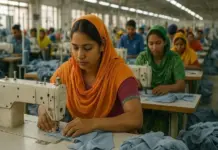




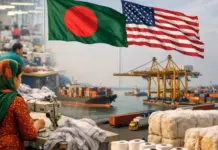





















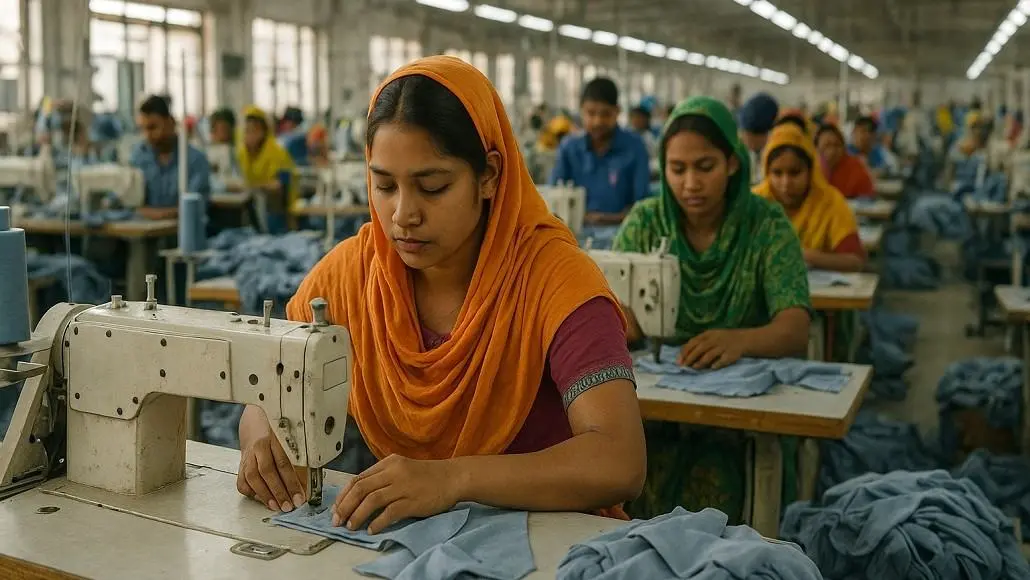
The Bangladesh garment industry, long regarded as a backbone of the country’s economy, is navigating a convergence of structural and operational pressures that global buyers are watching with growing caution. Recent media reports indicate that major international fashion retailers are overhauling their global sourcing networks to spread operational, geopolitical, and energy risks — and some long-time buyers are reportedly shifting work orders away from Bangladesh.
The Bangladesh Garment Manufacturers and Exporters Association (BGMEA) president has acknowledged the shift, noting that buyers are increasingly spreading their sourcing across multiple countries rather than depending on a single supplier nation. For Bangladesh, this is more than a routine adjustment. Once buyers begin factoring country-level risks more heavily into their sourcing decisions, cost competitiveness and product quality alone are no longer enough to hold business.
LDC Graduation Adding Uncertainty to an Already Shifting Landscape
One of the key risk variables buyers are reportedly weighing is Bangladesh’s scheduled graduation from Least Developed Country (LDC) status. Bangladesh remains on course to graduate on November 24, 2026, although the government has sought a three-year deferment and the process remains pending.
The uncertainty carries real weight. LDC trade preferences are central to Bangladesh garment exports’ competitiveness in several major export markets. But graduation does not produce the same outcome across all markets, which means buyers must assess not only the timing of graduation but also the specific tariff treatment that follows in each market where they source from Bangladesh.
The EU Trade Equation
The European Union remains the most critical market in this equation. Bangladesh will retain Everything But Arms (EBA) duty-free preferences for three years after LDC graduation, meaning there is no immediate cliff-edge loss of access. However, that three-year buffer is a window, not a permanent resolution.
Within that same window, competition is intensifying. Vietnam already holds an EU free trade agreement. The EU and India concluded negotiations on their own FTA in January, with most tariffs on Indian textiles and apparel expected to be removed once the agreement takes effect. Bangladesh shipped an estimated €19.41 billion (approximately $21.8 billion) worth of apparel to the EU in 2025, accounting for 21.57 per cent of the bloc’s total apparel import market — a scale that makes the comparison with India and Vietnam impossible to ignore. European buyers are steadily gaining more preferential sourcing options, while Bangladesh’s post-EBA trade position remains unresolved.
Energy Disruptions Compounding the Sourcing Risk Picture
Adding urgency to an already complex picture, a recent gas shortage disrupted industrial production across Bangladesh and affected shipment schedules at a particularly sensitive time. Industry groups reported order cancellations and reductions as factories struggled with interrupted supply. One industry survey reportedly found that 55 per cent of surveyed knitwear factories experienced reduced or cancelled orders during the disruption, 78 per cent faced partial production shutdowns, and 87 per cent encountered shipment delays. Factories also reportedly incurred higher costs from alternative fuel and transportation arrangements.
Supply Recovery and the Durability Question
The situation has since improved considerably. Data from Petrobangla, the state-owned national oil company of Bangladesh, showed gas supply rising to approximately 2,600 million cubic feet per day (mmcfd) in late September, up from around 2,300 mmcfd a month earlier, following a recovery in liquefied natural gas (LNG) supplies. The BGMEA president has also acknowledged that the energy disruption has improved significantly, and reports from industry areas indicate production has been picking up.
Yet even as the immediate energy pressure eases, the more important question is whether this improvement will prove durable. The energy disruption arrived at precisely the wrong moment — when buyers were already reassessing global sourcing strategies. Bangladesh garment exports cannot afford repeated uncertainty over whether factories can reliably maintain production and shipment schedules while competing for orders against Vietnam, India, and other sourcing destinations.
Industry Response and the Case for an EU Free Trade Agreement
The BGMEA chief has reportedly stated that buyers will not necessarily concentrate all sourcing in one country, and that the association is actively working to attract new buyers while encouraging existing ones to increase sourcing from Bangladesh. Notably, he argued that Bangladesh should pursue a Free Trade Agreement with the EU within three to four years, rather than depend on a Generalised Scheme of Preferences Plus (GSP Plus) arrangement.
This position takes on added significance given the current trade environment. With the three-year EBA post-graduation window available, the priority, as industry insiders see it, should be using that time to negotiate a longer-term trade arrangement with the EU — rather than allowing uncertainty over post-EBA access to become yet another factor in buyers’ sourcing calculations.
Industry insiders have also stressed that the government must make the recent improvement in gas and electricity supply last. The two issues — EU trade preferences and energy reliability — are distinct in nature but converge at the same decision point: the buyer choosing where to place the next order.
What Bangladesh’s Competitive Position Now Depends On
Bangladesh garment exports retain considerable strengths — established factories, significant production capacity, and a well-developed buyer base built over decades. But the landscape around it is shifting. India is improving its EU market access through a concluded FTA, Vietnam already holds preferential access, and global sourcing diversification is a stated objective among major retailers. Meanwhile, Bangladesh is still working through its post-LDC trade future while recovering from an energy shock that reinforced buyer concerns about supply reliability.
The central question for the Bangladesh garment industry is no longer simply whether it can attract buyers. It is whether it can offer buyers enough structural certainty — on trade preferences, energy reliability, and production continuity — to choose Bangladesh over an increasingly competitive set of alternatives.

