






























The apparel industry is entering a new phase of automation as humanoid robotics in apparel manufacturing moves from research laboratories to real production environments. Driven by rapid advances in artificial intelligence (AI), computer vision, and robotic dexterity, manufacturers are increasingly exploring humanoid robots to address labour shortages, improve productivity, and strengthen supply chain resilience.
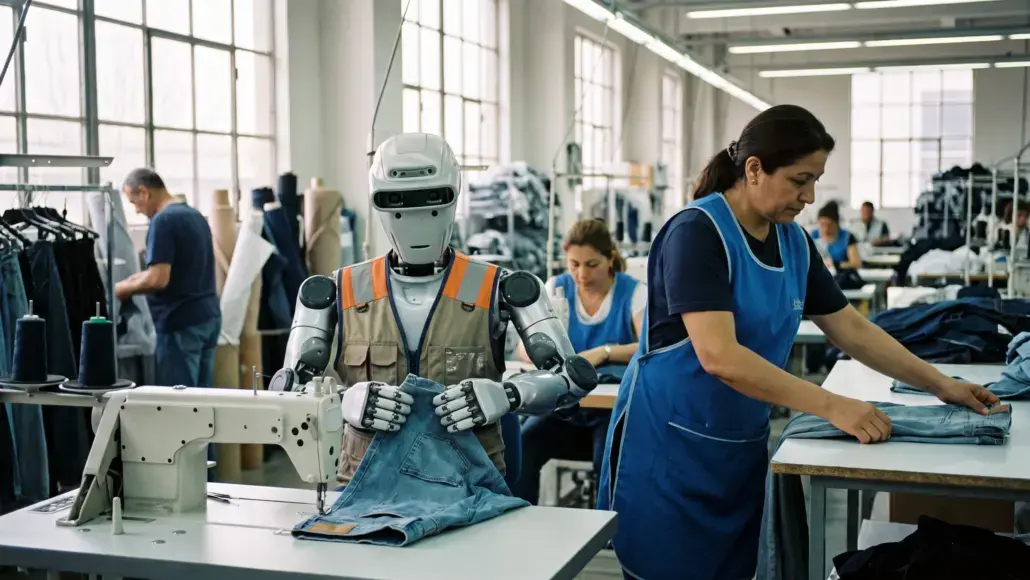
Unlike traditional industrial robots designed for repetitive, fixed tasks, humanoid robots are engineered to operate in workspaces originally built for people. Their human-like structure enables them to perform a wider variety of production activities with minimal changes to existing factory layouts, making them an attractive solution for the labour-intensive apparel sector.
Garment manufacturing has historically remained one of the most difficult industries to automate because fabrics are soft, flexible, and constantly change shape during handling. Activities such as separating fabric layers, aligning garment panels, and feeding materials into sewing machines require a level of precision and adaptability that conventional automation has struggled to achieve.
Recent developments in embodied AI, advanced sensors, and machine learning are helping overcome these challenges. New-generation humanoid robots are now capable of identifying fabrics, grasping delicate materials, positioning textile components, and preparing them for sewing with significantly higher levels of accuracy than earlier robotic systems.
Several technology companies have already begun deploying humanoid robots in industrial environments to perform repetitive and physically demanding tasks. While early applications have focused on logistics and material handling, apparel manufacturing is emerging as one of the next major sectors for commercial deployment.
Industry experts believe humanoid robotics in apparel manufacturing could help address persistent labour shortages while improving production efficiency. Rather than replacing skilled workers immediately, current deployments are largely intended to complement human operators by taking over repetitive processes and allowing employees to focus on quality control, complex sewing operations, and production supervision.
China has become one of the first countries to test humanoid robots directly on garment production lines. In one large-scale initiative, robots are being evaluated for tasks such as separating fabric pieces, laying materials flat, aligning components, and preparing garments for stitching. Developers report high success rates in both fabric handling and sewing quality, highlighting the growing commercial potential of robotic apparel production.
Researchers also point out that the combination of digital twins, AI-driven production planning, and collaborative robotics is making automated garment manufacturing more practical. These technologies enable factories to validate workflows before deployment, reduce commissioning time, improve operational efficiency, and simplify integration with existing sewing equipment.
Despite this progress, experts acknowledge that humanoid robots are unlikely to replace human garment workers entirely in the near future. Complex sewing techniques, creative craftsmanship, fabric inspection, and decision-making tasks continue to require human expertise, while robots are expected to take on repetitive, physically demanding, and standardized operations.
As investment in robotics and AI continues to accelerate, apparel manufacturers are expected to adopt more flexible automation systems capable of improving productivity without requiring major factory redesigns. The evolution of humanoid robotics in apparel manufacturing is therefore likely to reshape production models by combining human skills with intelligent automation, creating more resilient and efficient textile supply chains in the years ahead.

