


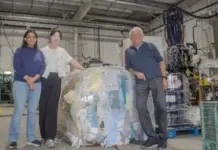



















Goodwill Industries has partnered with Western University and Fanshawe College in Ontario, Canada, to develop innovative solutions that reduce landfill waste by improving textile recycling and enhancing the processing of donated goods through advanced technologies.
The collaborative initiative combines textile recycling with AI to tackle one of the sector’s biggest challenges—finding sustainable uses for donated clothing that cannot be resold or reused. The project focuses on converting unusable textiles into valuable products while also modernizing donation sorting through artificial intelligence.
According to Western University, more than 43 million pounds of donated goods were received across Ontario’s Great Lakes region during the last fiscal year. While many items are resold or repurposed, a significant volume remains unsuitable for reuse, leaving organizations with limited alternatives other than disposal in landfills.
To address this growing issue, Goodwill joined forces with researchers from Western University and Fanshawe College, combining expertise in sustainable materials, recycling technologies, and intelligent automation.
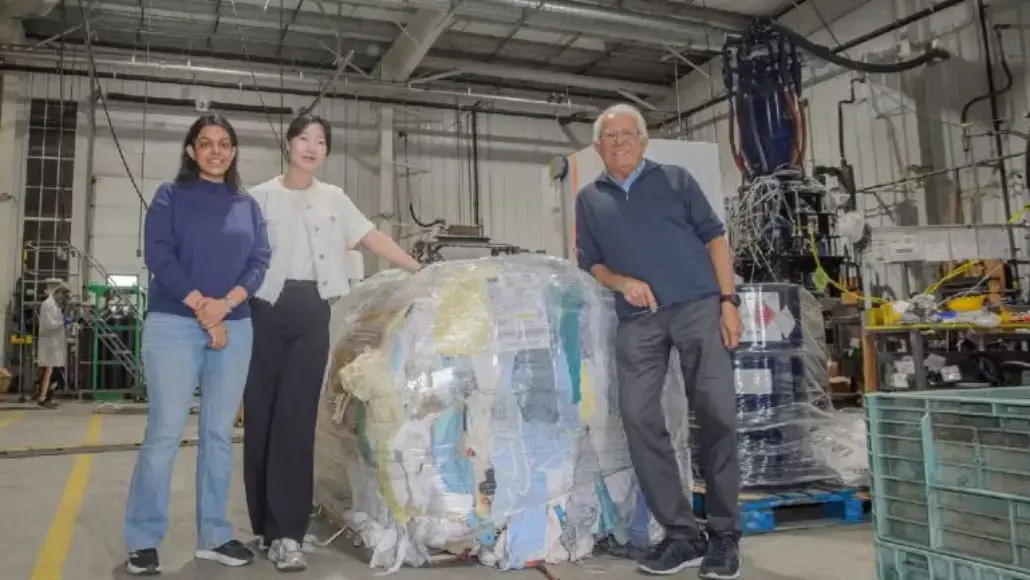
Scientists from Western’s Institute for Chemicals and Fuels from Alternative Resources (ICFAR), working alongside Fanshawe’s Centre for Research and Innovation, are using pyrolysis to transform discarded clothing into biochar. The thermal conversion process breaks down mixed-fibre textiles—including materials containing dyes and chemical additives—into a carbon-rich product suitable for environmental applications.
Biochar is widely recognized for improving soil quality by enhancing nutrient retention, increasing water-holding capacity, and supporting beneficial microbial activity. Preliminary findings suggest that biochar produced from discarded textiles may promote healthier plant growth compared with untreated soil.
Explaining the challenge of textile recycling, Heejin Lee, a postdoctoral research associate at Fanshawe College collaborating with ICFAR, said:
“Textile waste is often difficult to recycle using conventional methods because it’s a mixture of different kinds of fibres with dyes and additives. That means many textiles end up in landfills.”
Researchers are also exploring enzyme-based recycling techniques capable of breaking down natural fibres such as cotton and hemp into sugars that could serve as raw materials for future industrial processes. The team noted that a large proportion of donated textiles across North America still ends up in landfill once resale opportunities have been exhausted.
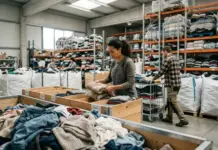
Alongside its textile recycling with AI initiative, Western University is developing an intelligent sorting system designed to improve how donated goods are processed. At present, most items are inspected and sorted manually, making the process both labour-intensive and susceptible to reusable products being discarded.
The AI-powered platform uses smart cameras positioned along a conveyor belt to identify, classify, and monitor donated items in real time. The technology is intended to assist workers by flagging reusable products and reducing the likelihood of valuable materials being mistakenly sent to landfill.
Discussing the system, Professor Min Xia from Western University’s Faculty of Engineering said:
“Cameras will help to identify the items, and if they miss them, the system will give the workers a signal to easily identify them. Then again at the end of the conveyor, there will be another camera to guarantee nothing ends up in the landfill that shouldn’t.”
Since the textile recycling project began more than four years ago, the partnership has successfully diverted approximately 5,000 pounds of clothing waste from landfill. The research team has also applied for federal funding to expand the programme and develop solutions for the remaining volume of unsellable textiles.
The AI-enabled sorting system is expected to become operational within the next year, with researchers continuing to refine both the automation platform and textile recycling technologies to further reduce landfill waste and strengthen circular economy practices.

