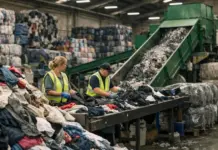











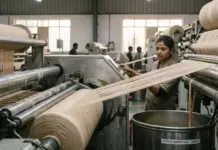










Axens, IFPEN and JEPLAN announced the successful completion of a major industrial test using the Rewind® PET technology to recycle polyester-rich post-consumer textile waste. The semi-industrial unit operated by JEPLAN in Japan, with a capacity of 1,000 tonne/year, processed several tens of tons of sorted and prepared textiles supplied from French public collection streams managed by Nouvelles Fibres Textile and Mapea. The trial produced several tens of tonnes of the polyester base monomer BHET, which will be converted into polyester yarns, fabrics and garments.
Industrial demonstration and process integration
This industrial textile-to-textile recycling test, carried out under representative industrial conditions, is among the first examples at this scale. It demonstrates the potential to integrate polyester recycling into existing industrial sites that produce polyester for textiles, enabling substitution of fossil-based feedstocks with recycled material. The technology has previously been proven and commercialized for PET packaging recycling, including food-contact applications, and is now validated for textile use.
“Science, scale-up engineering and operational expertise come together to demonstrate the performance of the Rewind® PET process developed by IFPEN, JEPLAN, and Axens. Axens and its partners thus demonstrate the robustness, stability and reproducibility of a cutting-edge recycling technology specifically designed to promote the closed loop circularity of textile polyester”, commented Quentin Debuisschert, CEO and Chairman of Axens.
Deployment and market application
Under an exclusive license granted by IFPEN and JEPLAN to Axens, the Rewind® PET technology can be offered worldwide to industrial players seeking to develop regional textile-to-textile loops. The recycled PET monomer produced in these tests is intended for conversion into yarn, fabric and garments, completing a textile-to-textile production loop for sectors including sportswear and outdoor apparel, home furnishings, and certain luxury applications that use polyester in a controlled manner.
“By hosting the Rewind® PET semi-industrial demonstrator at our Kitakyushu Hibikinada Plant, we are demonstrating in practice that this technology can be integrated into a real industrial environment, with its complex constraints and waste streams. This breakthrough opens up new possibilities for the market to develop fibers and fabrics incorporating a very high percentage of recycled material, without compromising on performance or sustainability”, said Masaki Takao, CEO of Jeplan.
Contribution to circularity and recycling pathways
Approximately 60% of global textile production relies on polyester and other synthetic fibres, while genuine textile-to-textile recycling remains limited. This semi-industrial validation provides concrete evidence that polyester recycling at scale can be implemented from post-consumer waste streams, supporting a short-loop approach that can reduce reliance on virgin feedstocks and improve lifecycle outcomes. “With Rewind® PET, IFPEN is realizing more than ten years of research to put chemical recycling at the service of an ambitious circular economy. Our work has enabled the production of a high-purity recycled monomer that can be directly reintroduced into the most demanding applications such as textiles. This is an important step”, added Franck Chevet, President and CEO of Ifpen.