


























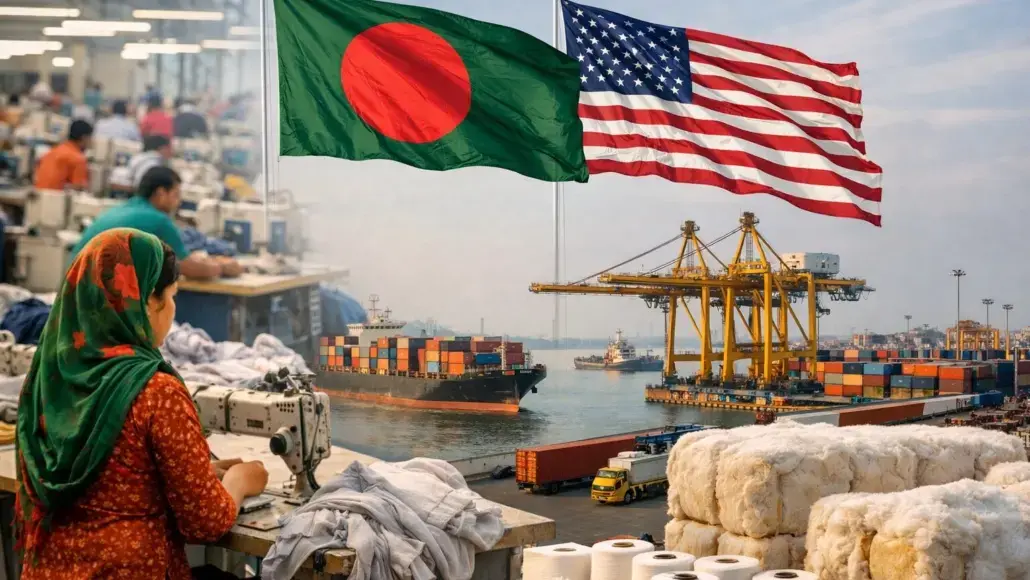
DHAKA — When the US Bangladesh trade agreement on reciprocal trade was signed in February 2026, much of the public debate centred on Bangladesh’s obligations: labour-related commitments, intellectual property provisions, export-control alignment and wider strategic undertakings. Those issues are not trivial. Yet the deal also contains quieter provisions that could prove more influential for Bangladesh’s apparel economy than the headlines suggest particularly if implementation details fall in Bangladesh’s favour.
Bangladesh ships roughly $9–10 billion of garments to the United States each year, serving the world’s largest apparel import market. With its current share estimated at around the high single digits, industry analysts argue there is room for meaningful expansion over the medium term potentially adding several billion dollars in export earnings if access conditions improve and suppliers can move into higher-value categories. The agreement is being read by parts of the industry as a potential route to that outcome.
Three components stand out: a tariff-preference pathway linked to purchases of US cotton and man-made fibres, the prospect of US-backed development finance, and what appears to be deliberate flexibility around how origin requirements may be defined. Together, they could alter Bangladesh’s competitive position at a time when it faces both rising global competition and looming changes in its trade privileges elsewhere.
A tariff mechanism tied to cotton purchases
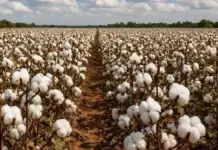
A central provision, contained in Article 5.3, points to a mechanism under which eligible Bangladeshi textile and apparel products could enter the US market at a zero reciprocal tariff rate. The qualifying export volumes would be linked to Bangladesh’s purchases of US-origin cotton and man-made fibres.
Much of the criticism has focused on the immediate commercial friction: US cotton is often more expensive than regional supply and typically involves longer shipping cycles. But supporters of the provision argue the strategic angle is broader. US cotton is widely viewed as higher quality, capable of producing finer yarns and more durable fabrics—characteristics that can support a shift away from low-margin basics toward higher-grade products with better pricing power.
Notably, the most consequential aspect may be what the agreement does not fully define. Key thresholds and implementation rules are described as “to be specified,” leaving significant space for negotiation. Observers suggest Bangladesh’s model could end up differing from more rigid frameworks that enforce strict, factory-level content requirements. Instead, the structure appears to link eligibility to national-level purchases of US fibre, which—if applied as an aggregate system—could be simpler to administer and more commercially workable than traditional approaches.
That distinction matters because Bangladesh’s growth challenge is not only volume; it is value. Access to higher-grade fibre can improve product mix, but only if mills can finance the switch and manage the longer supply cycle.
The real barrier is liquidity, not preference
For many mills, the practical obstacle is working capital. Regional cotton can often arrive within days, allowing short inventory turns and limited exposure to long letters of credit. US cotton, by contrast, can involve months-long lead times and extended financing, tying up bank limits for longer periods. For mid-sized spinners operating with tight liquidity, the financing burden can outweigh any quality advantage.
Even so, the mathematics of tariff relief can be compelling in a low-margin sector. If the US Bangladesh trade agreement ultimately delivers a predictable zero-tariff window at scale, even a modest tariff differential could become a decisive sourcing incentive for US buyers particularly if competitors continue to face standard duties.
A possible opening for US development finance
Another potentially significant element is contained in Article 5.1, which commits the US to work through the Export-Import Bank and the US International Development Finance Corporation (DFC) to consider investment financing for priority sectors in Bangladesh.
The DFC’s financing instruments—long-tenor loans, guarantees, equity participation and political risk insurance—are precisely the tools that have historically been limited in Bangladesh for large-scale projects involving Western capital. Industry voices argue that opening access to these mechanisms could shift what is feasible in energy, logistics and upstream textiles.
In textiles specifically, DFC- or EXIM-supported capital could help expand spinning and yarn capacity suited to processing imported US cotton at scale. One frequently discussed idea is the creation of a central bonded warehouse for US cotton and man-made fibres inside Bangladesh, designed to reduce the working-capital drag associated with long-cycle imports. If funded and structured effectively, such infrastructure could broaden participation beyond the largest groups and make US fibre sourcing commercially viable for a larger share of the spinning base.
Energy is widely seen as the most immediate pressure point. Gas and electricity constraints continue to limit industrial utilisation rates, and any financing that supports reliability upgrades or renewable capacity could quickly feed into manufacturing competitiveness.
A hedge ahead of LDC graduation
The timing is also strategic. Bangladesh is scheduled to graduate from Least Developed Country status in November 2026. While transitional measures preserve certain benefits in Europe for a limited period, the longer-term outlook implies higher tariffs in a market that currently absorbs a large share of Bangladesh’s apparel exports. That makes diversification more urgent.
Against that backdrop, the US agreement can be interpreted as a hedge—an attempt to build a durable access route into another major consumer market before preference erosion elsewhere becomes fully felt. Commitments reported around large purchases and deeper economic alignment form part of the broader trade-off: Bangladesh accepts policy and strategic obligations in exchange for a pathway to improved market access and investment support.
The agreement does not, by itself, guarantee transformation. Execution will depend on the final shape of tariff rules, the practicality of origin requirements, and whether development finance converts into bankable projects. Still, within the constraints of the deal, Bangladesh may have gained three high-value levers: a potential tariff advantage, access to higher-quality industrial inputs, and an entry point into a development finance ecosystem that has long supported competing economies in the region.