






























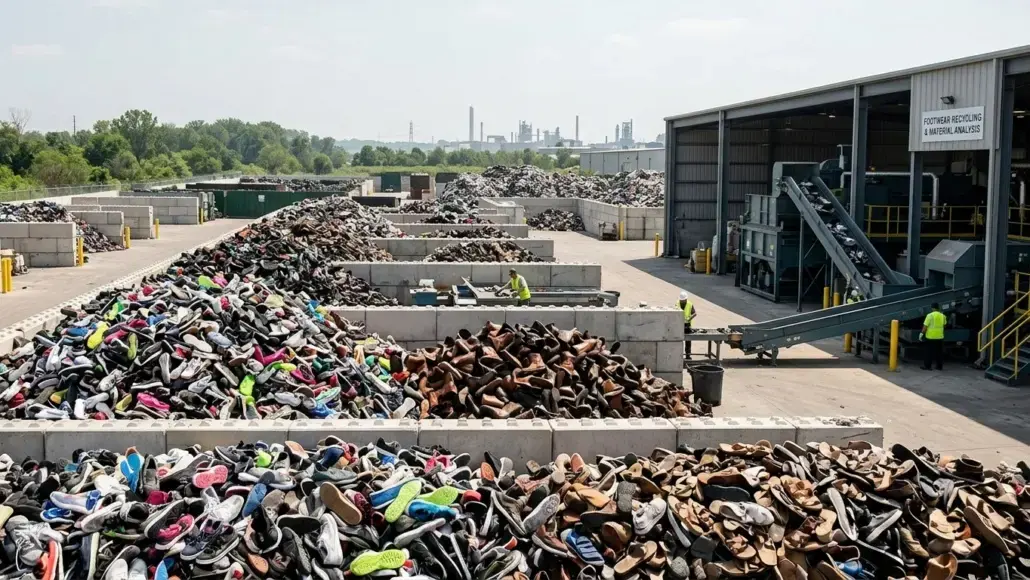
A comprehensive material analysis of 1,200 shoes has identified design complexity as the primary obstacle preventing global footwear recycling rates from exceeding one percent. The study, conducted by Circle Economy and Fashion for Good, highlights that the intricate construction of modern footwear, rather than a lack of technological solutions, is the critical barrier to establishing a viable end-of-life system for shoes.
The Complex Anatomy of Modern Footwear
Unlike apparel, which is often mono-layered and easier to sort for recycling, shoes are engineered as tightly assembled, multi-material objects. Industrial adhesives, designed for durability, make disassembly at scale exceedingly difficult. The analysis of post-consumer footwear revealed that a significant majority, 52 percent, were assembled using permanent adhesives, with only 19 percent relying on stitching. Furthermore, a mere 10.5 percent of the shoes analyzed utilized the same material for both their midsole and outsole, a common characteristic that would simplify material separation. These findings underscore the inherent challenges in breaking down shoes for effective recycling.
Material Identification: A Critical Bottleneck
The process of recycling relies heavily on accurate material identification. However, the complex assembly of footwear presents immediate hurdles. Near-infrared (NIR) scanning, a foundational technology for automated textile sorting, struggles with the prevalence of carbon black pigments commonly used in dark soles. These pigments absorb the infrared spectrum, rendering 97 percent of black soles unidentifiable by NIR scanners. In the analyzed sample, this meant that over a fifth of the sole stream became unclassifiable before any disassembly could occur. Across the entire sample, 37 percent of sole materials and 17 percent of upper materials remained unknown due to identification challenges. While prototypes of advanced sorting technologies, including NIR scanners, X-ray capabilities, and image capture systems, showed promising identification rates of over 60 percent for a substantial portion of materials, the carbon black issue remains a clear technological gap requiring dedicated sensor development.
Understanding Discarded Footwear
Of the 7,200 items initially sorted, 60.2 percent were deemed rewearable, 34.7 percent non-rewearable, and 5.1 percent contaminated. The subsequent in-depth material analysis focused on the 1,200 non-rewearable shoes. Intriguingly, 76 percent of these shoes exhibited visible damage, predominantly aesthetic such as soiling or discoloration, rather than structural. Only 9 percent showed sole detachment or tears. A significant finding was that 24 percent of non-rewearable shoes had no physical damage at all, indicating they were discarded due to systemic issues like market demand for specific archetypes or being single shoes without a pair. This represents a clear failure in the existing system, where functional products are unnecessarily entering the waste stream. Lifestyle shoes, including trainers and slip-ons, constituted the largest category (37.5 percent) within the non-rewearable sample, followed by sandals (25.2 percent) and slippers/slides (14.9 percent). Performance shoes made up 11.2 percent.
The Limitations of Export-Based Solutions
Currently, approximately 90 percent of collected and sorted footwear in Europe is exported to second-hand markets, primarily in Asia and Africa. This export model is driven by the high cost of domestic incineration in Europe, making export the more economically viable, albeit unsustainable, option for lower-grade materials. However, it’s estimated that 5 to 6 percent of footwear arriving in these markets cannot be reabsorbed and ends up being incinerated or disposed of improperly. The report emphasizes that this export system, while offering some degree of informal circularity, is essentially waste management, not true circular recovery, and does not address the fundamental issues of footwear design and end-of-life processing within Europe.
Policy and Design Interventions for Footwear Circularity
The report highlights France as an example of effective policy implementation for footwear circularity, with a mandatory Extended Producer Responsibility (EPR) scheme that finances collection, sorting, and treatment. This has led to 90 percent of collected footwear in France being reused. The upcoming EU Waste Framework Directive, scheduled for April 2028, mandates EPR for footwear across the Union, requiring national producer responsibility organizations to include footwear sorting.
For established footwear brands and retailers, the study points to circular design as the most impactful leverage point. Key interventions include replacing permanent adhesives with reversible bonding or mechanical fasteners, eliminating non-functional decorative elements, avoiding carbon black pigments in soles where alternatives exist, and implementing Digital Product Passports for material traceability. The finding that a quarter of discarded footwear is physically undamaged also supports the development of brand-operated cleaning, repair, and take-back programs.
For recycling innovators and infrastructure operators, the lifestyle and performance shoe stream presents the most viable feedstock for near-term economic success due to consistent rubber and EVA yields. The report underscores the need for off-take commitments from brands to ensure the economic viability of scaling recycling operations. A significant missing link is pre-processing capacity for disassembly, with no industrial-scale footwear disassembly facilities currently operational in Europe, presenting both a constraint and an investment opportunity for the industry. The ongoing analysis of footwear circularity is a crucial step towards addressing these pervasive footwear recycling challenges and fostering a more sustainable model.

