
























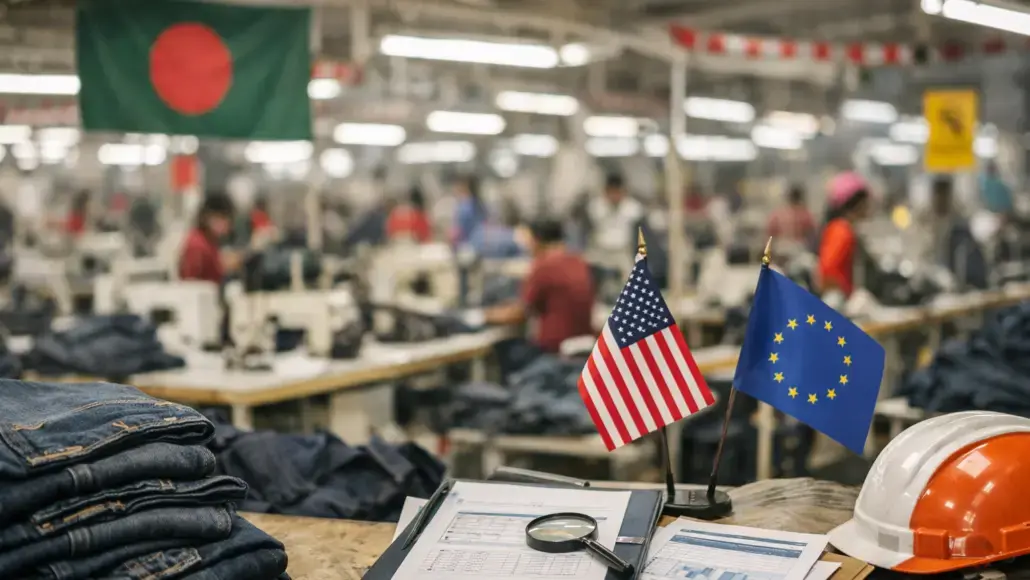
Bangladesh’s apparel industry is entering a more demanding phase of international trade, as labour standards and supply-chain transparency increasingly influence whether garments can reach major Western markets. For exporters targeting the European Union (EU) and United States (US), compliance is moving beyond factory audits and becoming an important element of market access, customs clearance and buyer sourcing decisions.
The shift is particularly significant for Bangladesh because the ready-made garment industry remains central to the country’s export economy. The sector has traditionally benefited from competitive labour costs, a large manufacturing workforce and preferential access to major international markets. However, changing trade rules and stricter buyer requirements are raising the importance of verifiable labour practices and supply-chain traceability.
A recent policy paper, From Compliance to Competitiveness: The Growing Importance of Labour Issues for Bangladeshi Exporters in the European Union and the United States, by economist Selim Raihan, executive director of the South Asian Network on Economic Modeling (Sanem), highlights how labour compliance is becoming increasingly connected to export competitiveness.
EU market shifts compliance towards supply-chain accountability
The European Union remains one of Bangladesh’s most important apparel markets. Bangladesh currently benefits from the EU’s Everything But Arms (EBA) arrangement as a least-developed country, providing duty-free and quota-free access for eligible exports. The European Commission identifies Bangladesh as the largest beneficiary of the EBA scheme, with €19 billion of exports benefiting from the preferences in 2024.
Bangladesh’s scheduled graduation from LDC status makes the future trading environment particularly important. Under the EU’s new GSP framework, countries graduating from LDC status, including Bangladesh, are set to retain EBA preferences for three additional years, at least through the end of 2029, while also having the opportunity to seek GSP+ status.
Alongside tariff considerations, European regulation is putting greater emphasis on the origin and production conditions of goods. The EU Forced Labour Regulation will apply from 14 December 2027 and prohibits products made wholly or partly with forced labour from being placed on, made available on or exported from the EU market. The regulation applies regardless of where products are manufactured.
This means Bangladeshi garment producers will increasingly need to understand labour risks throughout their supply networks rather than limiting compliance checks to their own factories.
US market brings stronger customs scrutiny
The compliance environment in the United States operates differently but creates similar pressure for greater supply-chain visibility.
US law prohibits the importation of goods produced wholly or partly with forced labour. The Uyghur Forced Labor Prevention Act (UFLPA) has added another layer of scrutiny, particularly for products containing inputs connected to China’s Xinjiang region or entities included on the UFLPA Entity List. US Customs and Border Protection (CBP) leads enforcement of the UFLPA and applies a rebuttable presumption to covered goods.
For Bangladeshi apparel manufacturers, the issue is not limited to where the finished garment was sewn. Cotton, yarn, fabric, dyes, trims and other inputs may originate from different countries, creating a need for exporters and their US customers to establish a clear chain of documentation.
CBP can review supply-chain records when examining forced-labour concerns, and importers may need to provide documentation supporting the admissibility of detained shipments.
As a result, Bangladeshi exporters supplying the US market face increasing pressure to demonstrate where materials came from and how they moved through the production chain.
Buyer requirements are becoming part of market access
Government regulations are only one part of the challenge.
Major international fashion brands and retailers increasingly impose their own supplier standards covering forced labour, child labour, workplace safety, freedom of association and broader worker rights. These requirements can influence sourcing decisions even where a shipment satisfies formal customs requirements.
For Bangladeshi manufacturers, this creates a dual compliance environment. A factory must satisfy government regulations governing market access while also meeting individual standards established by international buyers.
The result is a gradual shift from compliance as an annual audit exercise to compliance as an ongoing business function.
Traceability becomes increasingly important
Greater scrutiny in both markets is likely to increase demand for detailed records covering workers, subcontractors, raw-material suppliers and production processes.
This is particularly relevant to the textile industry because a finished garment can involve multiple stages and suppliers. Fibre may be sourced in one country, spun into yarn elsewhere, converted into fabric at another facility and ultimately cut and sewn in Bangladesh.
Without reliable documentation connecting these stages, exporters can find it difficult to demonstrate that their products meet increasingly demanding labour and sourcing requirements.
The US environment makes this challenge particularly visible because CBP’s forced-labour enforcement can require importers to provide detailed supply-chain documentation.
Smaller manufacturers face the biggest adjustment
The cost of adapting to these requirements is unlikely to be distributed evenly across Bangladesh’s apparel sector.
Large exporters generally have greater resources to invest in digital traceability platforms, supplier mapping, compliance teams, worker grievance mechanisms and electronic record-keeping. Smaller factories and subcontractors may still depend heavily on paper-based systems and manual processes.
That difference could influence future sourcing patterns. Buyers seeking reliable documentation may increasingly favour suppliers capable of providing consistent, digitally accessible evidence of compliance.
However, stronger labour-management systems can also become a competitive advantage. Manufacturers that demonstrate reliable workplace standards and transparent supply chains may be better positioned to secure longer-term relationships with demanding international brands.
From regulatory burden to competitive advantage
For Bangladesh, the challenge is therefore broader than simply complying with another set of regulations. The country is entering a period in which labour compliance and apparel competitiveness are becoming increasingly interconnected.
Improved inspection systems, faster mechanisms for resolving labour disputes and stronger support for smaller factories could help the industry adapt. Industry associations could also reduce the compliance burden by developing shared traceability systems, common training programmes and digital tools that allow suppliers to meet multiple buyer requirements more efficiently.
Exporters, meanwhile, will need to move away from preparing documentation only before an audit. Supplier mapping, subcontractor monitoring, worker engagement, grievance procedures and raw-material traceability need to become part of routine production management.
EU and US rules create a common strategic challenge
Although the EU and US use different regulatory mechanisms, their direction of travel is increasingly similar: greater accountability for the conditions under which products are made and stronger expectations around supply-chain transparency.
For the EU, the approaching Forced Labour Regulation adds a formal market-access requirement from December 2027.
For the US, forced-labour enforcement through CBP and the UFLPA places significant emphasis on documentation and the ability of importers to demonstrate the origin and production history of goods.
For Bangladeshi apparel exporters, the message from both markets is becoming clearer: labour standards can no longer be treated as a separate compliance function. They are becoming part of the commercial infrastructure required to remain competitive in global fashion supply chains.
With Bangladesh also preparing for the loss of its LDC status and the associated changes in preferential trade access, strengthening labour governance, traceability and supply-chain transparency could become an important part of protecting its position in the EU and US apparel markets.

