




















Every day, thousands of tonnes of clothing discarded by European consumers make their way across oceans and into the hands of workers in Pakistan — many of them teenagers, many earning below the legal minimum wage, and most too afraid to speak up. At the heart of this trade is Karachi’s Export Processing Zone (KEPZ), an industrial enclave that has quietly become one of the world’s most significant processing hubs for Europe’s fast fashion waste.
As the European Union strengthens its regulations around textile waste while doing little to address the sheer volume of clothing being produced and thrown away, the burden of handling those discarded garments is being steadily transferred to workers and communities far outside the bloc’s borders — and far outside its legal protections.
Inside the Factory: A Teenager’s Day
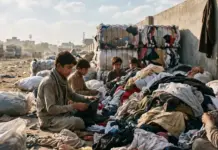
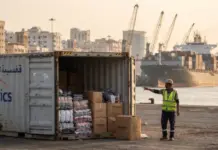
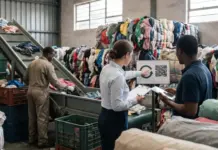
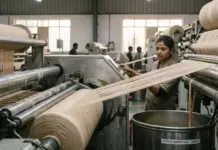
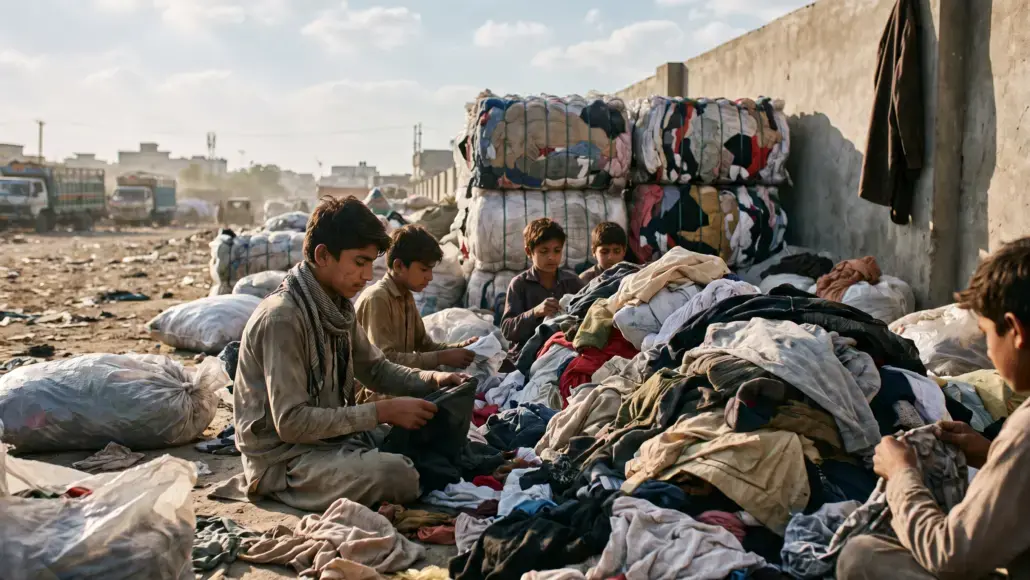
A sixteen-year-old girl — referred to here as Ayesha — spends her working days sorting mountains of discarded clothing inside a factory at the KEPZ. The garments she handles arrive in large bales from the port of Karachi and originate largely from Europe. Her team of thirty workers is expected to process approximately seventeen tonnes of clothing every single day. No one is permitted to leave until that daily quota is met.
Ayesha earns the equivalent of €70 to €75 per month, including overtime pay and attendance bonuses. This figure is roughly 35% below the legal minimum wage applicable in the industrial zone where she works. Payslip documentation confirms these figures.
Her working day runs from 7 am to 7 pm. Any moment spent not actively sorting is met with reprimands from supervisors. On one occasion, when Ayesha attempted to leave the factory in the evening because she was the only woman still inside — a situation that felt unsafe to her — her supervisor responded with a verbal outburst severe enough to reduce her to tears. When she reached the factory gate, the security guard demanded she return her company-issued shoes before leaving. Unwilling to go back inside, she walked home barefoot.
Her mother, also based in Karachi, explained that the family cannot afford for Ayesha to leave. Their household of twelve people depends on Ayesha’s income, alongside her younger brother’s earnings and her mother’s salary.
The Karachi Export Processing Zone: A Hub Built on Tax Breaks
The KEPZ was established in 1982 and was constructed around preferential tax conditions and limited regulatory oversight. It is notoriously difficult for journalists to access. Reporters who gained rare entry to the zone interviewed workers, factory owners, and KEPZ officials, obtained payslips, and documented conditions through on-site photography.
Once clothing arrives from the port, large bales of mixed garments are opened on the factory floor. Trained labourers sort garments by hand into large metal cages categorised by item type — T-shirts, long-sleeve shirts, trousers, jeans, and similar categories.
According to United Nations data, the EU exported 216,649 tonnes of used clothing to Pakistan in 2025 alone, making Pakistan one of the primary recipients of EU second-hand clothing. A tracking exercise, in which twenty-eight SmartTags were placed inside donated garments across seven European cities, confirmed this trade directly: four of the twelve trackers that ultimately left the EU ended up inside the KEPZ.
EU Policy Is Pushing More Clothing Outward
Since 19 July 2026, large companies across the EU have been prohibited from destroying unsold clothing, accessories, and footwear. Medium-sized companies will face the same restrictions from 2030. While the ban on destruction marks a regulatory step forward, it has not been accompanied by any meaningful restrictions on overproduction. This means an increasing volume of surplus clothing may be directed toward export markets.
This stands in tension with the EU Waste Framework Directive, which stipulates that discarded textiles should be processed within the bloc. In practice, however, those garments are flowing outward in growing quantities — and the processing is being carried out by workers like Ayesha in facilities with little to no regulatory accountability.
EU Sorting Sector Under Pressure
Why European Facilities Are Struggling
The infrastructure within the EU for handling donated and discarded clothing is under significant strain. Sorting facilities are receiving ever-larger volumes of predominantly low-quality polyester garments — a direct consequence of the rise of fast fashion — while being paid relatively small amounts per tonne of clothing processed.
Antonio Cannone, head of Cannone srl, a sorting company based in Andria in southern Italy, described the situation plainly: “We can’t handle this amount of clothes. We look for foreign solutions, because we are up against the wall.”
Philippe Doliger, a policy advisor at the think tank Recycling Europe, noted that while sorters in the EU are poorly compensated, their costs have nonetheless risen in recent years due to inflation and energy prices. Some companies have already been pushed into insolvency as a result. Doliger warned that if the sector continues to deteriorate, rebuilding it would take considerable time, and sorting would increasingly shift outside of Europe entirely.
This structural bottleneck is a key driver behind the outsourcing of textile processing to countries such as Pakistan, where labour costs are dramatically lower and regulatory oversight far weaker.
The Return Journey: Some Clothes Come Back
Not all of the clothing sorted in Karachi stays in Asia or Africa. Between 2015 and 2025, second-hand clothing imports from Pakistan to the EU increased by more than 300 per cent, reaching over 2,561 tonnes in 2025.
A factory owner in the KEPZ, who asked not to be named, explained that the highest-quality items are returned to Europe for resale or recycling. “These items are sold mainly to sustainable shops in Italy, where they are recycled, cut, and remade into new garments. This recycling process makes them among the most valuable items we handle,” he said.
Some of these returned garments are processed near Florence, where specialised machinery converts them into fine textiles used by major fashion brands. The Karachi Export Processing Zone therefore sits at both ends of a circular loop that begins and ends in Europe — with Pakistani workers absorbing the labour-intensive middle stage.
A Workforce Shaped by Climate Disaster
Climate Displacement Feeding the Textile Trade
Labour researchers based in Karachi describe it as a city of migrants, with many displaced workers arriving in the textile sector after losing their livelihoods to Pakistan’s devastating floods and droughts. Climate change, to which the EU has historically contributed at a disproportionate scale, is now a significant driver of the workforce processing EU textile exports.
Nineteen-year-old Madiha is one such worker. She and her family relocated to Karachi around four years ago from a village in Sindh after the 2022 floods destroyed their home. She now earns approximately €80 per month sorting clothes in a KEPZ factory — a figure that includes an attendance bonus subject to deduction if she misses more than two working days in a month, for any reason.
“The work is tiring. I am mostly working with my arms and neck in constant pain due to the repeated action required in sorting clothes,” Madiha said. Her income, combined with her father’s earnings as a day labourer, supports a family of seven. “I don’t have an option. I have to earn so my family can survive in this big city.”
Eighteen-year-old Zameer comes from a farming family in Sindh whose agricultural income was wiped out by recurring droughts. He now earns around €100 per month packing sorted clothing into bales for export inside a KEPZ factory, sending half of that home each month. “Life isn’t easy here as it was back in the village, but the money I earn here means survival for my family back home,” he said. He shares a single room with eight other men in the so-called labour colony — a government-designated residential area for factory workers that dates to the 1970s. Walls are thin, lanes are too narrow for two people to walk side by side, and sewage runs openly through the settlement. Frequent electricity and gas cuts mean residents often cannot cool themselves in Karachi’s intense heat or cook a proper meal. Meanwhile, the factories a short distance away are fully powered around the clock, and the roads leading to them are well maintained.
Labour Laws in Name Only
When the KEPZ was first established, it was exempted from all Pakistani labour laws. Those exemptions were partially lifted in 2021, making statutory leave, social security contributions, retirement benefits, and overtime pay legally mandatory within the zone. Yet five years later, many employers continue to operate as though those obligations do not apply.
Workers are reluctant to raise concerns. “If we make the slightest complaint about safety issues or extra hours, companies fire us and replace us with other people in a matter of hours,” Zameer said.
A representative of a national trade union federation, who requested anonymity due to safety concerns, attributed the ongoing non-compliance directly to the absence of effective worker representation. “One of the main reasons factory owners can blatantly defy the law is the absence of a labour union,” he said. Workers are too afraid of losing their income to organise or complain.
The EPR Policy Gap
Since 2025, EU member states have been rolling out Extended Producer Responsibility schemes for textiles, which require clothing brands and retailers to fund the collection, sorting, and recycling of the garments they bring to market. However, this financial obligation applies only within EU borders. Once a bale of clothing is exported, the associated responsibility disappears entirely.
Emily Macintosh, a senior policy officer for textiles at the European Environmental Bureau, identified this as a fundamental gap. “The key thing missing from the EPR schemes is a mechanism to transfer fees,” she said. “How these funds could be transferred to countries receiving large volumes of EU textile exports is not addressed. This transfer would be a way to recognise that these countries are already doing the circularity that we are trying to promote in the EU.”
Progress on EPR implementation has been slow and inconsistent across member states. Industry voices have also cautioned that even full implementation of the EPR is unlikely to eliminate large-scale textile exports to countries like Pakistan, given the persistent lack of sorting capacity within the EU.
Natàlia Yesares, from the Spanish Association of Recovery Entities for Social and Supportive Economy, described the current moment as the most severe crisis the sector has faced: “For years, the networks we belong to have warned about the sector’s lack of circularity, its dependence on exports and the lack of public funding. But the crisis we are experiencing now is more severe than anything we have seen before.”
Invisible in the Supply Chain
Some of the garments sorted by workers in the KEPZ will eventually return to Europe. They may appear on resale platforms, in vintage shops, or within collections marketed as “sustainable fashion.” The labels attached to those garments rarely disclose where the item was sorted or who handled it along the way.
A European consumer purchasing second-hand clothing under the promise of circular fashion has no means of knowing whether that garment passed through a facility where workers earn below Pakistan’s own legal minimum wage and face penalties for missing daily production targets.
For Ayesha, Madiha, and Zameer, few paths forward exist. There is no accessible union, no labour inspector with effective authority to enforce wage law inside the KEPZ, and no binding EU mechanism that reaches into the zone’s supply chains. Pakistan’s labour rights framework may have been updated on paper, but enforcement inside the zone remains largely absent.
“I am trying to find a job outside the zone which would have better conditions and pay, but so far I have had no luck,” Zameer said. “I am stuck with this because I have to send money back home at any cost.”
Fast fashion waste and the EU textile exports driving it continue to grow. So too does the distance between European policy ambitions and the daily reality faced by workers like Ayesha in the Karachi Export Processing Zone — where second-hand clothing arrives in abundance and Pakistan labour rights remain, for most, out of reach.