






























Despite mounting tariff pressure on offshore production markets, onshoring in the American fashion industry has not emerged as the sweeping trend many anticipated. A panel of industry experts at the Fashion Tech Show, hosted by PI Apparel in Los Angeles, made clear that while the political and economic environment may be pushing brands to reconsider where they produce, the structural realities of U.S. apparel manufacturing are far more complicated than a simple geographic redirect.
Scalability challenges, labor costs, and a deeply fragmented domestic supply chain remain the defining obstacles. Yet the conversation also revealed a growing consensus: technology — from AI-driven design tools to advanced factory automation — may be the only realistic lever capable of making fashion onshoring work at any meaningful scale.
The Real Cost of Long Lead Times and Offshore Dependency
Ashley Stickler, Vice President of Marketing and Partnerships at CreateMe Technologies, Inc., framed the issue in terms of the fundamental economics of the current production model. With lead times stretching to 19 months and forecasting locked in well in advance, the pipeline brands rely on is slow, cumbersome, and deeply tied to inputs from overseas markets that take considerable time to produce and ship.
According to Stickler, the economic value of a garment produced offshore is already diminished by the time it arrives on U.S. soil, simply because of how much the market has shifted during that long journey from concept to shelf. “Trends have shifted. We’ve moved on,” she noted.
CreateMe Technologies directly addresses part of this problem. The company automates the manufacturing process for apparel and similar products, replacing traditional thread-based construction with digital adhesives to enable faster, more localized, on-demand production — a model better suited to the speed requirements of today’s fashion market.
Stickler was direct about why simply transplanting the Asian manufacturing model into the United States is not a viable solution. The labor cost structure that underpins large-scale garment production in countries like China simply does not translate to a market like California. In her words, the math only works if the entire system is redesigned from the ground up — a shift she sees factory automation making possible by removing labor as the primary cost variable.
AI’s Role in Smarter Production Decisions
Keith Hoover, President of Black Swan Textiles, a digital product development consultancy specializing in textiles, echoed the concern about the fashion industry’s traditional production calendar. The standard practice of forecasting consumer demand 18 months ahead consistently results in either overproduction leading to liquidation, or underproduction leading to lost revenue — both costly outcomes that have long plagued the industry.
Hoover sees artificial intelligence as integral to improving how brands decide what to make in the first place. By using AI agents to analyze readily available data, brands could identify near-term consumer demand more accurately, produce in smaller initial lots, and then scale up or pivot based on actual sales performance. This data-driven approach to production planning could reduce the chronic misalignment between what gets made and what consumers actually want — a core problem that the existing forecasting model has failed to solve.
On the design side, Hoover highlighted how tools like 3D design software are already helping creative teams work faster. Generative AI has added another layer of acceleration, allowing designers to move quickly from a preliminary sketch or even a verbal description to fully visualized concepts ready for merchant review. Hoover was careful to frame this not as AI supplanting the designer’s role but as a powerful tool in the designer’s hands — one that dramatically speeds up iteration and improves the likelihood that a concept will make it into a final line.
The Raw Materials Problem: A Gap Technology Cannot Close Alone
Where the conversation shifted was on the subject of raw materials — and here, the limitations of technology became clear. Hoover laid out the upstream supply chain reality plainly. While the United States is the third largest cotton producer globally, approximately 75 to 80 percent of that cotton is exported offshore. Polyester, the single most widely used fiber in apparel, is manufactured predominantly in Asia. Domestic knitting capacity is limited, woven mill infrastructure is sparse, and dye houses are similarly scarce.
The upstream components of a functional, end-to-end apparel supply chain are, in large part, absent from the U.S. domestic market. This is not a gap that AI or automation can fill on its own — it reflects decades of industrial offshoring that left the domestic manufacturing ecosystem incomplete.
Alexander Zar, CEO of Lalaland Production and Design — Downtown Los Angeles’s largest leather goods producer — reinforced this point from a manufacturer’s perspective. The limited availability of raw materials domestically is both a constraint on capacity and a significant cost burden for any producer serious about scaling within the United States. Lalaland manufactures luxury footwear and handbags for some of the world’s most recognized labels, operating in a segment where premium pricing can absorb the higher cost of U.S. labor and quality materials.
Luxury vs. Mass Market: A Fundamental Divide in the Onshoring Debate
Zar drew a sharp distinction between what fashion onshoring can realistically deliver for the luxury segment versus the mass market. For luxury brands, domestic production is achievable and even commercially viable. The premium price point accommodates the higher cost structure. However, any attempt to pursue domestic production at mass-market scale — particularly in categories like footwear — runs into a wall.
Many have already tried and failed by attempting to replicate the labor-intensive factory model common in Asia, hoping to approach similar margins or price points. Zar was unambiguous: that approach has not worked and will not work, primarily because labor costs in cities like Los Angeles make it economically unviable to compete on price with offshore producers.
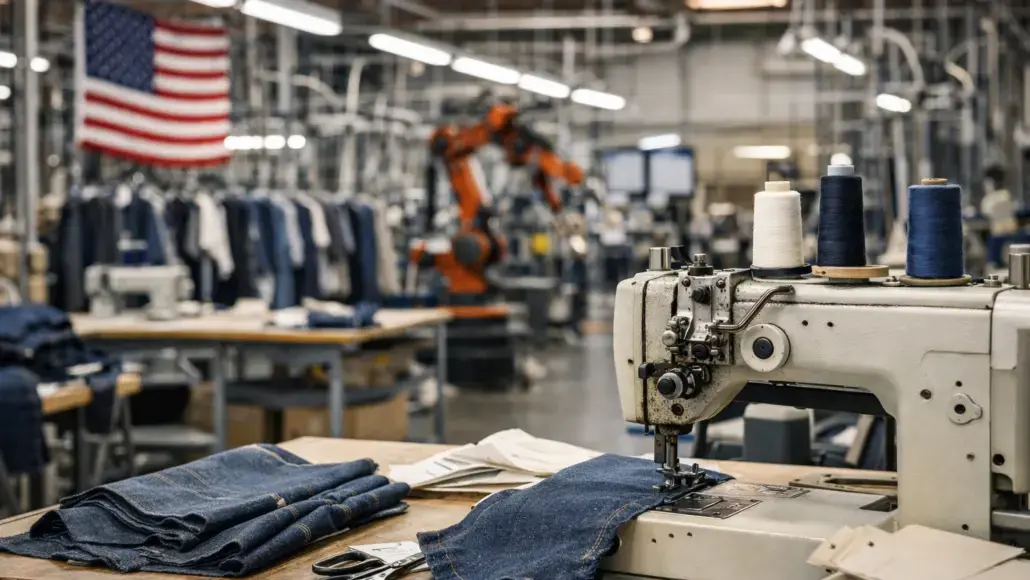
His conclusion was that the industry must look beyond existing models. Rather than trying to adapt a system designed for low-cost, high-labor environments, U.S. manufacturers need to leapfrog to a fundamentally different production paradigm — one built around automation technologies like 3D knitting, 3D bonding, and 3D printing.
Rethinking Production Architecture for Domestic Scale
Zar offered a concrete illustration of how this rethinking might apply in practice. In footwear manufacturing, the upper is typically the most time-consuming component to produce. By incorporating automated solutions — such as a 3D knitted, technical-knit full-sock upper — manufacturers can eliminate what is often the biggest bottleneck in the production process, reducing both time and labor requirements.
The scale of the challenge, however, is not lost on him. The United States imports approximately 2.3 billion pairs of shoes annually. Building a domestic infrastructure capable of replacing that volume entirely is, by Zar’s own assessment, not realistic. But capturing even 10 to 20 percent of that market through domestic production could be achievable — provided manufacturers are willing to accept the capital-intensive nature of the investment, or embrace new technologies that remove the high-touch, labor-heavy aspects of production.
The goal Lalaland and others are working toward is a fully automated, continuously operating production environment — what Zar describes as a “dark factory” capable of running 24 hours a day without the dependency on large human labor pools. In his view, this is the only model through which scalable, domestically produced fashion becomes commercially possible.
The broader takeaway from the panel is that fashion onshoring, while not a near-term mass-market reality, is not an impossibility — provided the industry accepts that it cannot simply reproduce offshore systems on American soil. The path forward, if there is one, runs through a wholesale reimagining of how garments are designed, planned, and manufactured, with AI in fashion and advanced factory automation serving as the foundational building blocks of whatever comes next.