




















For years, apparel retailers have focused their attention on shipping costs, tariff fluctuations, and factory reliability. Today, a less visible but equally critical vulnerability is rising on the industry agenda: the availability of water. The global fashion sector generates an estimated 80 to 150 billion clothing items annually. According to an EU textile study, a single cotton T-shirt requires approximately 2,700 litres of water. Overall, British charity Oxfam calculates that the broader industry consumes a minimum of 93 billion cubic metres of water each year.
Ollie Carpenter, analytics lead at climate risk intelligence firm Risilience, notes that this resource can no longer be viewed exclusively as an environmental issue; it is a profound financial risk. According to Carpenter, water stress is increasingly challenging the structural viability of the global fashion supply chain.
Understanding Water Stress in Textile Manufacturing
In the apparel sector, water stress is defined as the lack of adequate water—of the necessary quality, in the correct location, and at the required time—to cultivate raw materials and operate facilities. Agricultural processes like cotton farming rely on either “green water” from rainfall or “blue water” sourced from groundwater and surface irrigation.
Once these raw materials enter the industrial phases of the fashion supply chain, requirements shift. Operations such as washing, dyeing, and wet processing demand high-quality water, typically sourced from municipal systems or private wells. Because these resources are highly location-specific and non-fungible, factories situated in regions facing severe water stress face elevated operational risks.
The complexity is compounded by the fragmented nature of textile manufacturing. A retailer may maintain direct relationships with garment factories but lack visibility into the upstream farms that produce the initial cotton.
Financial Risks and Supply Chain Disruptions
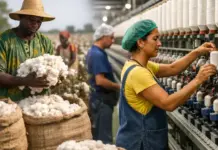
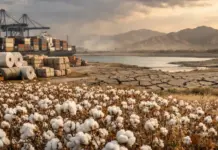
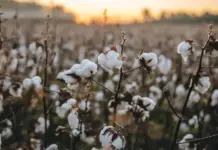
Cotton is particularly vulnerable to climate variables. Cultivated heavily in the US, China, and India, its subsequent processing into garments is primarily concentrated in South Asia. Recent research indicates a rising probability of combined heat and drought events in global cotton-growing regions, which directly correlates with yield failures.
For instance, the US Department of Agriculture projected that cotton planting in 2025 would drop to its lowest point since 2015, following three consecutive years of drought in the Southwest. Conversely, recent flooding in Pakistan highlighted another climatic extreme, with Reuters reporting in September 2025 that crop damage threatened the nation’s textile manufacturing output due to impending cotton shortages.
When shortages constrain the availability of raw materials, water stress rapidly evolves into a commercial dilemma. It disrupts essential wet-processing stages, forces textile producers to compete for limited resources, and drives up costs. These delays translate into supply volatility, higher price premiums, missed delivery windows, and ultimately, lost sales on the shop floor.
Strategic Sourcing and Adaptation
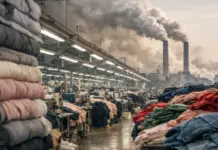
The vulnerabilities extend beyond agriculture into industrial dyeing and spinning, which are universally water-intensive operations. A localized drought can disrupt the crop, the mill, and the factory simultaneously.
This reality forces brands to reevaluate their sourcing strategies and raw materials. Regenerative cotton, for example, frequently demonstrates greater resilience to water stress compared to conventional cotton. While transitioning to alternative fibers requires millions of pounds in corporate testing and investment, it is increasingly viewed as a pathway to stability.
Although some companies may consider shifting production away from South Asian hubs like India and Bangladesh to nearshore locations such as Turkey, analysts warn against viewing any single region as a simple solution to water risk. Instead, companies must thoroughly map their exposure by identifying factory locations within vulnerable basins and calculating the precise financial revenue at risk if those facilities halt operations.
The Future of Sustainable Apparel
Adaptation strategies now include investing in water-efficient production methods, modifying agricultural practices, and diversifying supplier networks. In northern India, circularity initiatives are already emerging, enabling water to be recycled directly through textile-processing facilities.
These resource limitations could eventually pressure the economics of ultra-fast fashion, a model reliant on moving goods through the fashion supply chain at high speeds. During periods of ecological volatility, this model faces substantial friction from the rising cost of secure raw materials.
Simultaneously, consumer demand for sustainable apparel continues to expand. Risilience modeling suggests that sustainable apparel could eventually capture between 13% and 40% of the market share. Retailers are consequently caught in a balancing act between consumer demands for eco-friendly products and persistent price sensitivity. Overcoming these hurdles requires looking past immediate financial quarters to make multi-year investments that ensure the long-term endurance of the fashion supply chain.