
































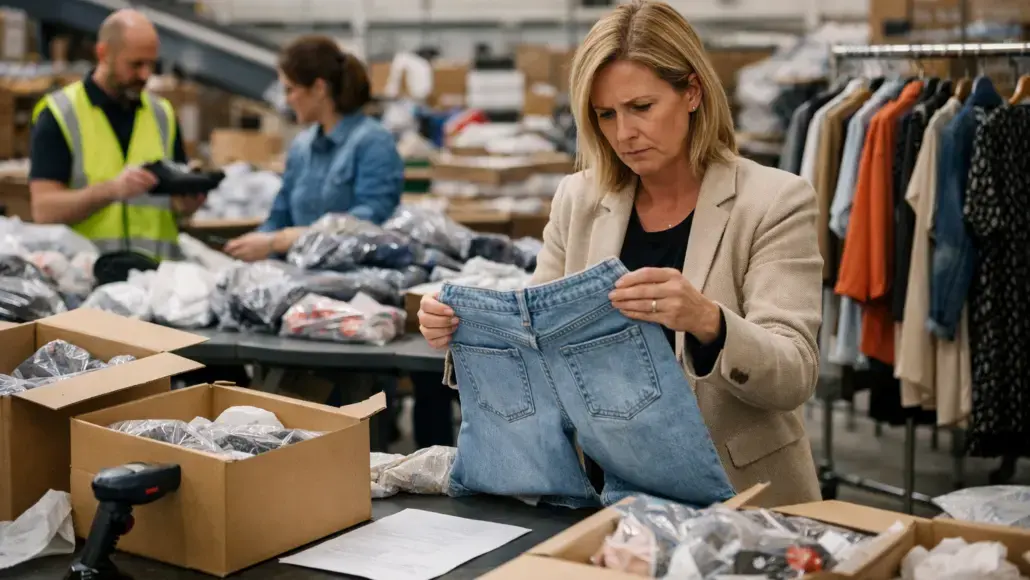
A new study surveying 150 senior retail leaders across the UK and Europe has found that while the majority of retailers demonstrate a strong commitment to circularity in principle, the actual execution — particularly when it comes to returns value recovery — continues to fall well short of expectations. The research, commissioned by ReBound Returns and Advanced Supply Chain and conducted by Opinium in July 2026, benchmarked retailers across four key themes: strategy, operations, value recovery, and sustainability.
Circularity Scores Tell a Mixed Story
Overall, 53% of retailers received an “advanced” score on circularity, while 28% were classified as “leading” and 19% as “emerging.” Retailers performed most strongly in strategy and sustainability, with 49% achieving “leading” status in both categories. However, the picture changes considerably when it comes to returns value recovery. Only 25% of those surveyed achieved “leading” status in this area, and the data reveals that retailers are reselling returned items at under 30% of their original full price — a stark indicator of how much commercial and environmental potential is currently being lost in the returns process.
The Gap Between Ambition and Action
Despite widespread intent to improve, the translation of that ambition into operational outcomes remains a significant challenge. Nearly nine in ten retailers surveyed are already measuring their environmental impact, and most acknowledge that there is untapped value sitting within their returned stock. Yet converting that awareness into tangible results has proven difficult.
Inge Bujakiewicz-Baars, Head of Sustainability at ReBound Returns, addressed this directly: “The most striking thing about these findings is that the will to improve circularity is already there. Where it becomes tricky is turning that ambition into action.”
She further noted the growing regulatory context shaping how retailers must now approach their returns processes: “This matters more than ever with regulation like ESPR giving retailers no choice but to think more carefully about what happens to returned items. Value recovery is now about compliance as much as cost-saving. Fortunately, the best environmental and commercial outcomes are the same; retailers don’t have to choose between benefitting the planet or the business anymore. The leading brands in our circularity benchmark have proved that closing the loop works.”
ESPR Regulation Raises the Stakes for Retail Circularity
The EU’s Ecodesign for Sustainable Products Regulation (ESPR) is a central factor redefining how retailers must manage returned and unsold goods. The regulation explicitly bans the destruction of unsold consumer goods — including apparel, footwear, and textiles — in EU markets. This makes retail circularity not only an environmental objective but a legal compliance requirement.
Beyond the destruction ban, the ESPR also requires businesses to disclose data on discarded unsold consumer products. These disclosure obligations apply to large companies immediately and will extend to medium-sized companies from 2030. As ESPR regulation tightens its grip on the industry, the pressure to build robust, transparent, and commercially viable returns systems is only set to intensify.
Logistics at the Heart of the Challenge
Stuart Greenfield, UK and European Sales Director at Advanced Supply Chain, highlighted the operational urgency that underpins effective returns value recovery: “These findings reflect what we see every day: retailers are not short of ambition, but they are lacking in speed. A returned item only holds its value for a short time, so every extra mile, touchpoint, or hour it sits unprocessed lowers the chance of any value being recovered.”
Greenfield also pointed to reverse logistics as a critical differentiator in whether retailers can successfully close the loop: “Logistics is a key differentiator, because products need to move through the right route and warehouses quickly for circularity to be effective. Otherwise, writing off stock becomes the default, which is wasted potential both for value recovery and sustainability.”
The findings reinforce a broader industry reality — that sustainable returns management cannot be treated as a back-office concern. When returned goods sit unprocessed or travel unnecessary distances through a supply chain, the window for recovering any meaningful value narrows rapidly. Effective reverse logistics is therefore inseparable from both financial performance and environmental responsibility.
What the Benchmark Reveals About the Road Ahead
The research makes clear that while retail circularity strategy and sustainability frameworks are increasingly in place, the operational infrastructure needed to support genuine returns value recovery continues to lag. For retailers operating within or trading into EU markets, ESPR regulation creates a non-negotiable imperative to accelerate progress in this space. The benchmark also signals that the brands already achieving “leading” status in circularity are demonstrating that the commercial and environmental goals are not in conflict — they are, in fact, mutually reinforcing.
For the wider retail sector, the message from this research is straightforward: the intent is there, but speed, logistics efficiency, and operational discipline around sustainable returns will ultimately determine which retailers succeed in closing the loop — and which continue to write off value they can no longer afford to lose.

