



























This week’s roundup brings together some of the most noteworthy developments across the materials sector — from recycled yarn engineering and wetland-based insulation to sugarcane-derived spandex and in-house label manufacturing.
Toray Advances Recycled Content in Polyester-Nylon Yarn
Toray Industries is preparing to launch a polyester-nylon yarn composed of at least 93 percent recycled material by weight, with fabrics incorporating this yarn slated for Fall/Winter 2027 collections. Both polymer components in the blend incorporate recycled raw materials, and the company credits its polymer-design and composite-spinning technologies for enabling it to increase recycled content without compromising consistent yarn quality — a technical challenge inherent to combining different polymer types.
The 93 percent recycled content figure applies to the raw yarn itself. The proportion of recycled content in the finished fabric or garment will depend on the other materials used alongside it. Toray is integrating this fiber into Artirosa CX, a textile range developed for outerwear, urban outdoor clothing, and premium casualwear. The fabrics feature a dense, finely textured surface with a crisp hand feel, and are available with construction and finishing options that can deliver waterproofing, water repellency, and wind resistance. The company has stated that the water-repellent agents used do not intentionally contain PFAS, though it notes that performance will vary with the material, fabric design, and processing.
Toray will assess the technology’s readiness for mass production while continuing development aimed at pushing recycled yarn content further. For its first year, the company is targeting Artirosa CX sales of 200,000 meters.
Ponda Brings Wetland Insulation to Corporate Clothing
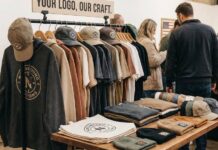
Bristol-based biomaterials company Ponda is extending the reach of its bulrush-based plant-based insulation into the corporate clothing market with a collection called Wear the Wetland. The range consists of three customizable vest styles — the Otter, Heron, and Mallard — available for organizations to commission directly, with delivery scheduled for fall 2027.
Each garment uses BioPuff, an insulation material derived from the fluffy seedhead fibers of bulrushes grown on restored British and European wetlands. Also commonly known as cattails or typha, these plants can be cultivated through paludiculture — the farming of wetland crops on rewetted land. Ponda’s broader commercial strategy is built around creating consistent demand for those crops, directing branded orders to companies, universities, and other organizations.
Building Farmer Income Through Orders
Julian Ellis-Brown, Ponda’s co-founder and CEO, explained that every order placed generates demand for bulrushes grown on rewetted land, helping farmers establish a reliable income through paludiculture. Organizations are asked to reserve their allocation ahead of production, with all garments produced in a single batch coordinated with the bulrush harvest. Ponda notes that committed reservations allow it to plan production more efficiently and limit speculative inventory.
The company has previously collaborated with Berghaus, Stella McCartney, Ahluwalia, and Sheep Inc. Its ongoing collaboration with Imperial College London includes a Mallard vest and Fern cap as part of the university’s branded clothing range.
Hyosung Connects Sugarcane Feedstock to Biobased Spandex
Hyosung TNC is developing its biobased materials business through an integrated Vietnamese production network that links sugarcane-derived chemical inputs directly to finished spandex. In an update shared on October 19, the company outlined the production pathway from bio-based 1,4-butanediol (bio-BDO) to PTMG, an intermediate used to manufacture its Regen Bio biobased spandex.
The bio-BDO plant carries an initial annual capacity of 50,000 metric tons and was already operating commercially prior to the October announcement. Hyosung plans to scale annual capacity in stages from 50,000 to 200,000 metric tons as demand develops, with total planned investment across the project reaching one billion dollars. The facility produces bio-BDO by fermenting sugarcane-derived sugars. Chemically identical to conventional BDO, it replaces fossil-based feedstock at that stage of the production process before being supplied to Hyosung’s Dong Nai operations for conversion into PTMG and spandex.
Performance, Certification, and Broader Applications
Hyosung Chairman Cho Hyun-Joon stated that the company has established an integrated production system connecting bio-based raw materials with finished spandex fiber. According to Hyosung, the resulting biobased spandex offers stretch and recovery equivalent to conventional versions, with intended applications spanning sportswear, intimates, swimwear, and denim.
Sugarcane sourcing and traceability are verified through the VIVE Sustainable Program, while SGS certifies bio-based content under its Environmentally Evaluated Product Scheme. Beyond textiles, Hyosung also plans to supply bio-based intermediates for thermoplastic polyurethane and PBAT, a resin used in biodegradable plastics.
Weavabel Brings Care-Label Production In-House
Trims and packaging supplier Weavabel reports that its care-label business is now growing faster than any other department, prompting the company to expand its team and begin producing labels directly in Portugal. In the second quarter of this year, Weavabel produced 3.6 million care labels — four times the approximately 900,000 it produced during the same period the previous year.
The department now employs eight people, double the four working in the unit earlier in 2025. Recent additions include Leyla Liu as variable data account manager in China, and João Melo and Jorge Miguel, who manage production in Portugal. The Portuguese operation marks Weavabel’s first foray into in-house label manufacturing.
Centralizing Label Control for Brands
Weavabel attributes its growth to a broader trend of brands seeking greater control over label artwork, translations, and ordering across their supplier networks. Rather than allowing individual factories to source care labels independently, more brands are channeling orders through a single central provider.
Travis Stutterheim, variable data manager at Weavabel, noted that the biggest misconception about care labels is that they are simple, pointing out that behind every label lies a process involving artwork, translations, approval, and production that must be correct from the start.
The company has introduced an online artwork and ordering portal, increased European production capacity by 50 percent, and broadened its production-partner network across Bangladesh, Vietnam, and Turkey. It has also integrated with digital product passport providers Bombiix and Osapiens. These investments come as brands prepare for EU textile requirements under the Ecodesign for Sustainable Products Regulation. The European Commission currently plans to adopt the textile-specific delegated act in late 2027, a date separate from the compliance deadline. Weavabel aims to double the number of brands using its care-label services over the next two years.
Karl Mayer Previews New Knitting Machinery in China
Karl Mayer will demonstrate new textile innovation machinery for apparel, footwear, and technical textiles at its Changzhou, China, facility during ITMA Asia 2026. The product show is scheduled to run November 19 to 21 and November 23, running alongside the company’s exhibition in Shanghai.
Among the footwear developments on display will be the RDJ 7/3 double-raschel machine, which features three jacquard bars that allow manufacturers to create larger openings, differentiated functional zones, and multicolor designs. The company will also show an RDJ 6/2 model in a finer E 32 gauge, designed for producing spacer fabrics with finer structures and smoother surfaces.
For the apparel segment, Karl Mayer will present warp-knitting equipment suited to lingerie, sportswear, and athleisure, as well as an updated TM WEFT machine featuring a finer gauge, electronic pattern drive, and revised yarn-tension controls. Visitors will also be able to view textile developments at the site’s approximately 480-square-meter Textile Innovation Center, including woven-like knits, shoe uppers, and fabrics produced with natural fibers.
Eastman Naia Highlights Commercial Applications at Textile Exchange
Eastman Naia used its presence at the Textile Exchange Conference in Vancouver to showcase garments made with its cellulose acetate fibers and to highlight its fifth consecutive Dark Green Shirt designation in Canopy’s Hot Button Progress Report. The display covered applications across eveningwear, casualwear, athleisure, and denim.
Eastman also drew attention to Naia Renew, which carries 40 percent GRS-certified recycled content through a mass-balance process using the company’s molecular recycling technology. In this process, recycled and virgin feedstocks are mixed during production, with the 40 percent figure calculated through mass-balance accounting. Individual garments may therefore contain varying amounts of recycled material.
Jason Keller, sustainability leader for Eastman’s fibers business, noted that five consecutive years of Dark Green Shirt recognition reflect the company’s commitment to responsible sourcing and forest conservation. Eastman also indicated that its work includes exploring textile-waste-based pulp for future Naia Renew ES developments.
Södra Establishes U.S. Commercial Office
Swedish forest-owner association Södra is opening a commercial office near Boston to support U.S. sales of pulp and sawn timber. The expansion also involves a logistics partnership aimed at improving market access and customer service in the region. Martin Chovan, sales director at Södra Cell, will oversee the new office.
Chovan said that by increasing local presence, the company can collaborate more closely with customers, gain deeper insight into their needs, and develop its offering in ways that create value across both its pulp and sawn timber businesses. Henrik Wettergren, VP of Södra International, described the expansion as a proactive commercial investment in a market where the company’s products, quality, and sustainability profile are well aligned with customer expectations. Wettergren added that Södra already has a strong foundation in North America, and that this investment creates better opportunities to grow alongside both existing and new customers.