


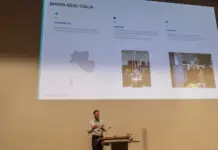






















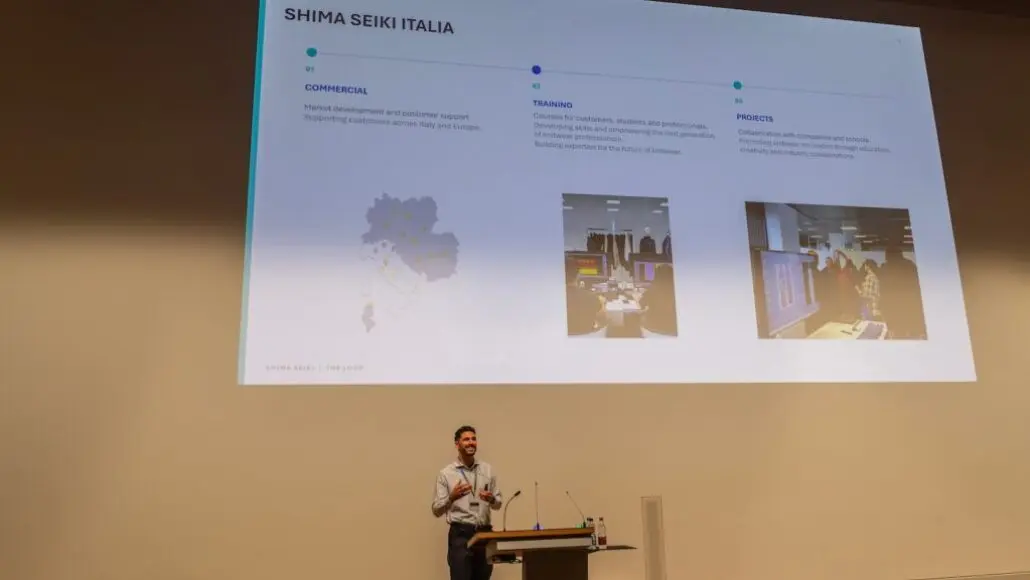
Japanese flat knitting technology specialist Shima Seiki has presented its integrated approach to knitted goods production at The Loop – Chapter One: Medical Textiles, an open machine demonstration event hosted at Groz-Beckert’s global headquarters in Albstadt, Germany. The presentation covered the company’s computerised flat knitting machines, three-dimensional shaping capabilities, WHOLEGARMENT production technology and digital design solutions, with a specific emphasis on medical and technical textile applications.
Shima Seiki Italia’s Giulio Codato delivered the presentation, which traced the company’s development from its early machinery innovations through to its current portfolio of flat knitting systems and digital workflows. The session demonstrated how Shima Seiki’s technologies can support manufacturers across the entire production process — from initial design and virtual sampling through to finished knitted products.
Four machines were displayed at the event: the SES-R, N.SVR123SP, SWG091N2 and SWG-XR144, each representing different approaches to shaped knitting, complex fabric structures and seamless production.
SES-R: Expanding the Boundaries of Flat Knitting Technology
Among the machines exhibited, the SES-R stood out as the latest evolution of Shima Seiki’s long-established SES series of computerised flat knitting machines. The new model introduces several technological advancements designed to expand knitting possibilities, particularly in the area of complex three-dimensional structures and technical applications.
A redesigned movable sinker system significantly increases the machine’s three-dimensional shaping capabilities, enabling greater freedom in the development of engineered knitted structures. This is complemented by motorised Auto Yarn Carriers, which are capable of moving independently of the knitting carriage, alongside individually controlled loop pressers.
Together, these features provide enhanced flexibility in yarn handling, stitch formation and fabric construction — extending the possibilities for producing complex knitted structures well beyond conventional knitwear. Such capabilities are especially relevant to technical textile applications where precise shaping, structural complexity and the integration of varied functional characteristics are key considerations.
Inlay Knitting with the N.SVR123SP
The N.SVR123SP was also on display at the event. Incorporating inlay knitting capabilities, this machine enables additional yarns to be introduced into knitted structures, widening the scope for functional fabrics and engineered textile products.
In medical and orthopaedic textiles, inlay techniques carry particular relevance where elastic or reinforcement yarns are needed to influence fabric properties, support or dimensional stability. Potential applications highlighted include knitted orthopaedic supports, compression panels and other shaped technical products.
WHOLEGARMENT Production: Seamless Knitting from Machine to Finished Product
Shima Seiki also gave prominence to its WHOLEGARMENT technology — first introduced in 1995 — which enables complete knitted garments and products to be produced directly on the machine, eliminating the need for conventional linking and sewing operations. The technology presents opportunities to reduce production steps, minimise material waste and create three-dimensional knitted products with greater design freedom and comfort.
SWG091N2: Compact WHOLEGARMENT Machine for Medical Applications
The compact SWG091N2 WHOLEGARMENT machine illustrates the potential of seamless knitting for smaller, closely fitting products. Shima Seiki has previously demonstrated compression socks and medical knee braces produced on this machine, underlining the relevance of seamless knitted structures in healthcare and orthopaedic applications.
SWG-XR144: Extending WHOLEGARMENT Possibilities
The SWG-XR144, also displayed in Albstadt, represents a further development in the company’s WHOLEGARMENT machinery portfolio, extending the range of three-dimensional seamless knitted products that manufacturers can produce.
The medical textiles sector presents opportunities for both conventional shaped flat knitting and WHOLEGARMENT technologies, depending on the functional and structural requirements of the finished product. Applications such as orthopaedic supports, compression garments and anatomically shaped textiles require careful attention to fabric construction, elasticity, fit and repeatability.
Conventional graduated medical compression stockings are generally produced on specialised circular knitting machines, while flat knitting technology is particularly suited to shaped compression garments, orthopaedic supports and more complex medical textile structures. For medical compression applications, achieving a defined pressure profile requires precise control of yarn selection, elastic yarn tension, stitch construction and garment dimensions, along with appropriate testing and validation procedures.
Digitalisation: APEXFiz and Integrated Design Workflows
Alongside its knitting machinery, Shima Seiki placed considerable emphasis on digitalisation and integrated workflows as a growing priority in modern textile manufacturing. Central to this approach is APEXFiz, the company’s software-based digital textile design solution. Unlike the dedicated SDS-ONE APEX system, APEXFiz can be installed on users’ own computer hardware, making it a more accessible option for a broader range of manufacturers.
APEXFiz incorporates a wide range of software tools addressing different creative and product development needs — from original design and colour variations to realistic digital product imagery suitable for e-commerce. The platform also supports virtual sampling, allowing designers and manufacturers to visualise knitted products and evaluate design variations before physical production begins. This can reduce the number of physical samples required and shorten overall product development cycles.
Critically, APEXFiz moves beyond digital visualisation alone. Design data generated within the system can be carried forward and converted into knitting machine data by a qualified knit technician, creating a more continuous link between the creative and production stages. This integration can improve communication between designers, brands and manufacturing partners, while supporting more efficient development of complex knitted products — a significant advantage in both medical textiles and technical textiles development.
Shima Online and the Broader Digital Ecosystem
Shima Seiki also introduced its wider digital ecosystem during the event, including Shima Seiki Online Services (Shima Online), yarnbank and ShimaNavi — platforms intended to support material selection, product development and manufacturing operations.
The presentation reinforced Shima Seiki’s overarching strategy of combining advanced flat knitting machinery with digital design tools and connected manufacturing solutions to address the evolving demands of the global knitting industry. For medical and technical textiles in particular, the combination of sophisticated shaping technologies, functional knitting capabilities and integrated digital workflows offers opportunities to develop increasingly complex products while improving production flexibility and overall efficiency.

