










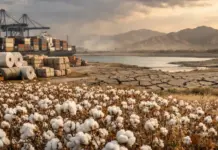





















Azerbaijan is preparing to introduce new insurance tools for cotton producers as it looks to shield growers from volatility in global commodity prices, senior presidential administration official Zeynal Naghdaliyev said during a regional consultation on cotton-growing held in Sabirabad. The proposed insurance mechanisms are intended to reduce the financial shocks that international price swings can create for Azerbaijan cotton farming, a sector the government continues to treat as a strategic rural employer and export earner.
Naghdaliyev told participants that the cotton industry is currently served by 15 specialised companies. He said these firms operate independently, deciding cultivation areas, signing contracts directly with farmers and managing production without outside interference.
Alongside risk-management measures, officials at the meeting emphasised productivity upgrades, particularly in the Shirvan-Salyan economic region, one of the country’s main cotton belts. Deputy agriculture minister Seymur Safarli said the ministry is planning more efficient irrigation practices and broader deployment of laser land-levelling technology interventions aimed at raising yields and, ultimately, improving farm incomes.
“Proper leveling ensures equal water distribution, reduces losses, supports uniform plant growth and allows for more efficient mechanized harvesting,” he was quoted as saying by a regional media outlet.
Safarli pointed to Bilasuvar, Neftchala and Salyan as districts with deep experience in cotton, available labour and established irrigation and processing capacity. He argued that the policy priority should not be to simply expand the number of hectares planted, but to increase output per hectare and strengthen earnings for growers an approach designed to make Azerbaijan cotton farming more resilient and economically attractive over time.
Minister of Agriculture Majnun Mammadov said the sector remains a significant source of employment, with almost 50,000 permanent and seasonal workers engaged in cotton cultivation and processing last year.
Trade figures underscore cotton’s importance to the country’s external earnings. In the first quarter of this year, Azerbaijan exported 47,700 tonnes of cotton valued at $70 million. That represented an increase of $22.7 million in export value about 1.5 times higher than a year earlier and a 56.8% rise in volume, or 17,300 tonnes, year on year.
At the same time, the country imported cotton worth $2.7 million in the quarter, up 24.1% year on year, suggesting that domestic supply and industrial demand dynamics remain in flux even as exports grow.
Officials did not provide a timeline for the proposed insurance rollout, but the discussion in Sabirabad signals a two-track strategy: reduce exposure to global price risk through new financial instruments, while improving on-farm efficiency through water management and field-levelling technologies that can lift yields and support mechanised harvesting.

