



























Barmag has completed practical-scale trials aimed at proving whether end-of-life carpets can be turned back into carpet yarn, a step that could push the sector closer to a true closed loop. Working with Object Carpet GmbH (Denkendorf), the Institute for Textile Technology (ITA) in Augsburg, and Austria-based Next Generation Recyclingmaschinen GmbH (NGR), the company assessed whether 100% recycled polyester from used carpet material can be processed into recycled polyester BCF yarn without blending in virgin polymer.
The project targeted a longstanding limitation in the market. While recycled PET (rPET) has been used commercially in bulked continuous filament (BCF) yarn, the feedstock has typically come from bottle pellets rather than textile waste. The partners set out to test whether mono-material carpets could serve as a viable alternative input supporting a carpet-to-carpet recycling loop rather than relying on packaging waste streams.
Trials run on Neumag BCF line in Neumünster
The test work was carried out on a Neumag BCF line at Barmag’s R&D centre in Neumünster. Barmag said the line’s adjustable process control and parameter flexibility make it suitable for handling difficult polymer streams, enabling development runs that would be hard to perform on less adaptable equipment.
For the trials, the team used recycled PET sourced from Object Carpet’s 100% polyester NEOO carpet material. Importantly, the polymer was processed without adding virgin PET an approach intended to demonstrate whether a genuine closed-loop pathway is technically achievable.
The results indicated that the recycled polymer could be reintroduced into spinning, producing BCF yarn at a scale closer to real manufacturing conditions than lab-only experiments. Dr. Kirsten Prehn, responsible for Neumag BCF processes, said the trials reinforced how sensitive spinning performance can be to the quality of recycled inputs. “During the trials, we observed that, as expected, material quality particularly viscosity and purity significantly influences process stability and yarn quality. Using the Neumag BCF system, we were able to adapt the process control specifically and flexibly to the particular requirements of the recycled polymer and thus produce BCF yarn.”
From yarn to carpet sample
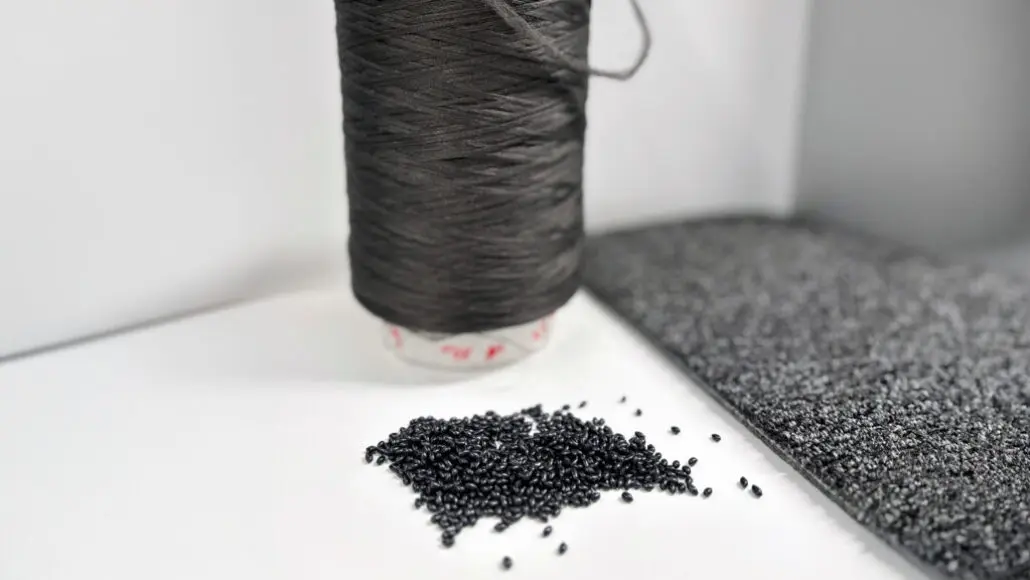
To validate performance beyond yarn formation, part of the recycled output was converted into a carpet sample. The partners said the result demonstrates that a closed-loop model for the BCF segment can move from concept to application: a mono-material carpet can be recycled back into recycled polyester BCF yarn and then used again in carpet production without introducing virgin polymer.
The work also highlighted what still needs to improve before industrialisation. While the trials showed feasibility, they also identified opportunities to further optimise material design and process settings to improve stability, repeatability and product consistency at full-scale production.
Barmag said the ability to fine-tune process control on Neumag BCF systems is central to making such recycling routes workable, particularly as recycled polymers vary more in viscosity and purity than conventional virgin feedstocks. The company added that the latest results position its BCF lines as a useful platform for evaluating carpet-to-carpet recycling and for developing the process refinements needed to scale the concept reliably.

