




























In the global textile industry, waste generation and microplastic pollution remain urgent environmental concerns. Despite sustained efforts in textile recycling, less than 12% of fiber materials are currently recovered, sending substantial volumes to landfills and incineration. Synthetic fabrics exacerbate microplastic pollution during laundering, releasing microscopic fibers that often pass through wastewater treatment and enter aquatic ecosystems and the food chain.
A biology-driven route to sustainable performance
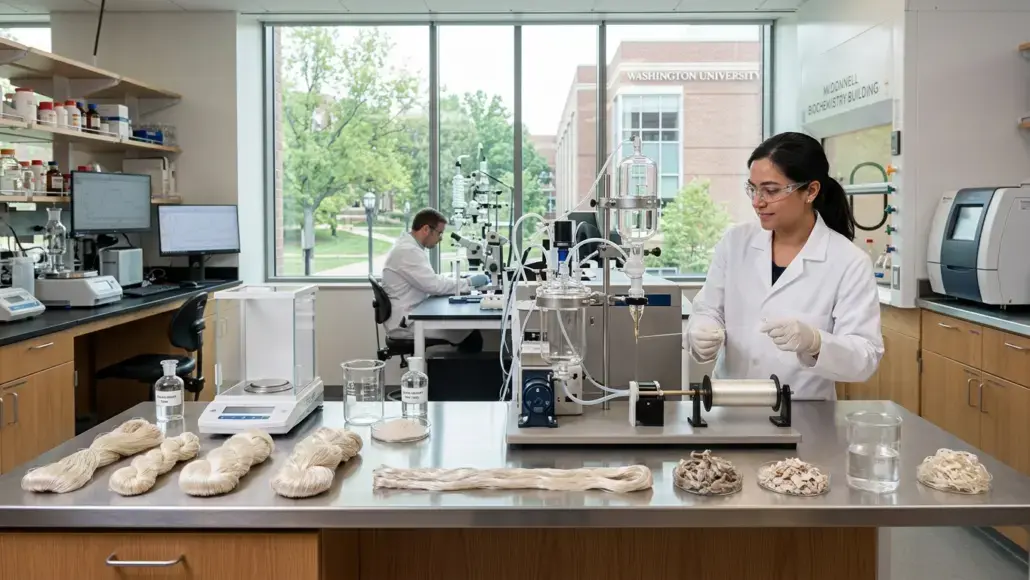
Researchers at Washington University in St. Louis, led by Fuzhong Zhang, the Francis F. Ahmann Professor in the Department of Energy, Environmental & Chemical Engineering and co-director of the Synthetic Biology Manufacturing of Advanced Materials Research Center (SMARC), report a new class of protein-based textile fibers engineered through synthetic biology. Detailed in the journal Advanced Materials, the work presents a protein hybrid material produced efficiently in bioreactors using genetically modified microbes. The resulting fibers are biodegradable fibers and introduce a rapid, reproducible recycling mechanism that preserves physical properties across multiple cycles.
How rapid dissolution and regeneration work
Unlike many petrochemical-based fibers that lose integrity during textile recycling, these protein-based textile fibers dissolve completely in a benign formic acid solution within seconds and can be reformed into the same durable materials. This closed-loop recycling approach is designed to reduce reliance on virgin petrochemical fibers and curb the release of persistent microplastics.
The underlying chemistry relies on formic acid’s effectiveness as a solvent that disrupts protein–protein interactions without altering the protein chains themselves. After dissolution, the solvent evaporates quickly, leaving a purified protein matrix ready for fiber regeneration. This process avoids energy-intensive steps common in polymer recovery that break and reform chemical bonds a major source of cost and emissions in conventional recycling.
Nature-inspired design: the SAM hybrid
The research addresses a central trade-off in materials science: mechanical strength versus recyclability. Drawing on natural proteins, the team integrated sequences from mussel foot proteins (known for adhesion), spider silk (recognized for tensile strength), and amyloids (noted for structural stability). The resulting silk-amyloid-mussel hybrid, or SAM, enables independent tuning of strength and dissolvability.
In SAM, mussel-derived segments govern dissolution behavior in formic acid, enabling rapid breakdown without compromising stability in water. Spider silk and amyloid motifs form crosslinks and interactions that reconnect polymer chains during regeneration, helping the fibers retain their original performance after closed-loop recycling. The material resists shrinking in water and maintains strength through repeated wash-and-reuse cycles key attributes for apparel and functional materials made with biodegradable fibers.
Performance across cycles and added versatility
The team demonstrated that multiple rounds of dissolution and re-spinning preserve high tensile strength and uniformity. Beyond fibers, the purified proteins can be repurposed into adhesive hydrogels with applications across biomedicine and industry; these hydrogels can be recycled back into high-strength fibers or reconfigured as hydrogels, underscoring the circularity of the platform.
Scaling benefits through circular manufacturing
Biological production has often faced cost barriers at scale, but a durable recycling loop can reduce fresh feedstock demand over time. By recapturing and reusing advanced biomaterials, this approach supports accessible, sustainable products that align with circular manufacturing goals. The strategy complements synthetic biology-driven material design and strengthens pathways for practical textile recycling using biodegradable fibers.
Environmental context and potential impact
Widespread adoption of this platform could reduce persistent fibers entering waterways and help address microplastic pollution. It also highlights how intelligently designed biological materials can maximize recyclability without sacrificing function—an approach consistent with industry efforts to advance closed-loop recycling and cut material-related emissions with the aid of synthetic biology.
Publication and support
The study appears in Advanced Materials as “Biosynthesized Silk-Amyloid-Mussel Proteins as Dissolution Recyclable Materials With Tunable Supercontraction” (2026): e73200, authored by Li J, Jeon J, Lee KZ, and Zhang F. The work was supported by grants from the United States Department of Agriculture and the National Science Foundation and leveraged mass spectrometry facilities at Washington University in St. Louis.
Outlook within the article’s findings
The results show how materials designed with nature’s molecular toolkit can pair high performance with circular recyclability. As textile waste and microplastic pollution continue to rise globally, advances like SAM emphasize pathways to reduce environmental burden through effective textile recycling. In this framework, protein-based textile fibers present a route where fashion and function can progress alongside environmental stewardship shaped by synthetic biology and biodegradable fibers.